
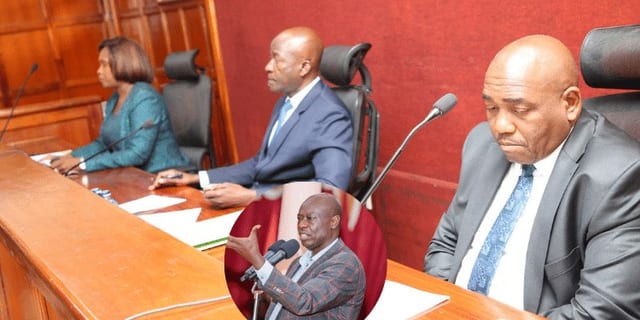
The most important lesson from the Gachagua impeachment judgment is that the Senate cannot hide behind the Judiciary after mismanaging a constitutional process that was already prescribed in the 2010 Constitution.
The Judiciary cannot be blamed for the mistakes of other arms of government, especially when the Senate was the institution that created the fatal fair hearing problem and then expected the courts to look away in the name of political convenience.
This case is unique and peculiar because it is the first real moment the 2010 Constitution has been stretched, tested and strained on the impeachment of a Deputy President, the legal effect of that impeachment, and the consequences that follow after another Deputy President has already been sworn into office.
For the first time, Kenya came dangerously close to the absurd constitutional risk of having two Deputy Presidents claiming legitimacy, one arguing that his removal violated fair trial rights and another already occupying the office under Article 149.
That alone should remind the political class that constitutional gaps are not academic jokes, because they can easily become national crises when reckless politicians weaponize them without thinking through the consequences.
The impeachment of a President or Deputy President is not a creature of an ordinary Act of Parliament, because it is directly prescribed by the Constitution under Articles 145 and 150, which means the absence of a special Act of Parliament cannot automatically make the process dead on arrival.
That is why the court was very clear that Parliament should urgently enact a dedicated statutory framework for the removal of a Deputy President, but the absence of that framework did not vitiate the impeachment that had already taken place.
In simple language, the court did not say Parliament had no power to impeach Gachagua, neither did it say the National Assembly acted outside the Constitution by processing the motion and escalating the matter to the Senate.
In fact, the court found that the National Assembly’s public participation met the constitutional threshold, the Standing Orders were not unconstitutional, IEBC was not required in the replacement process, and Kindiki’s nomination and appointment were valid.
The real problem, and this is where the Senate completely dropped the ball, was the refusal to adjourn when Gachagua was reported ill during the proceedings.
This is where the Senate’s own arrogance became its biggest enemy, because even the Speaker’s communication showed that the Senate still had room to adjourn the matter to Saturday and conclude within the constitutional window.
Instead of exercising discretion carefully, reasonably and with the seriousness demanded by a process removing a Deputy President, the Senate chose political speed over constitutional fairness.
That is why the court found that Gachagua’s rights under Articles 47 and 50 were infringed when the Senate declined to allow the adjournment.
This was not the Judiciary inventing sympathy for Gachagua, and it was not the Judiciary frustrating the impeachment process, because the court simply examined the record and found that Senate had an option to slow down without breaking the Constitution.
The irony is that the same political actors now attacking the Judiciary are the same people who created the problem by refusing to do the obvious thing, which was to adjourn briefly and deny Gachagua the argument that he was condemned unheard.
The Senate wanted to appear ruthless, efficient and politically decisive, but in doing so, it handed Gachagua the cleanest constitutional argument in the entire case.
Even then, the court did not reverse the impeachment because it found that Article 145 creates finality once the Senate resolves to impeach and the vacancy is subsequently filled.
That part is very important because it means the court recognized the violation of rights but refused to create a bigger constitutional absurdity where the country would have two Deputy Presidents or a destabilized executive office.
So the honest reading of this judgment is not that Gachagua won everything or that the State lost everything, but that Senate messed up a process that the Constitution had already given Parliament power to conduct.
The National Assembly followed enough of the law to make the impeachment survive, but the Senate handled the fair hearing question so badly that the court had no choice but to call out the violation.
This is why the current attempt to blame the Judiciary is dishonest, because judges did not hospitalize Gachagua, judges did not refuse the adjournment, and judges did not force Senate to proceed when it still had time left.
The Judiciary only read the Constitution, read the Senate record, and told the country that political convenience cannot be treated as a substitute for fair hearing.
The lesson for future impeachments is simple enough for even the most excited politician to understand.
If Senate wants to remove a President, Deputy President, Governor or any other public officer, it must treat impeachment as a constitutional trial and not as a political rally with Standing Orders.
It is now time to amend the Constitution and enact a clear supporting law giving direct, unambiguous and complete guidance on how a Deputy President can be removed from office, how the hearing should be conducted, when courts can intervene, and whether replacement should wait until constitutional challenges are resolved.
As things stand, the same confusion can return in 2029 or in any other political cycle, because the country now knows that a Deputy President can be impeached, replaced, and still successfully prove that his rights were violated during the process.
That is not a small legal inconvenience.
That is a constitutional time bomb.
Senate had the power, Senate had the numbers, Senate had the constitutional window, but Senate still chose unnecessary recklessness at the exact point where discipline was required.
That is not the Judiciary’s failure.
That is Senate being given a loaded constitutional weapon and still managing to shoot itself in the foot.