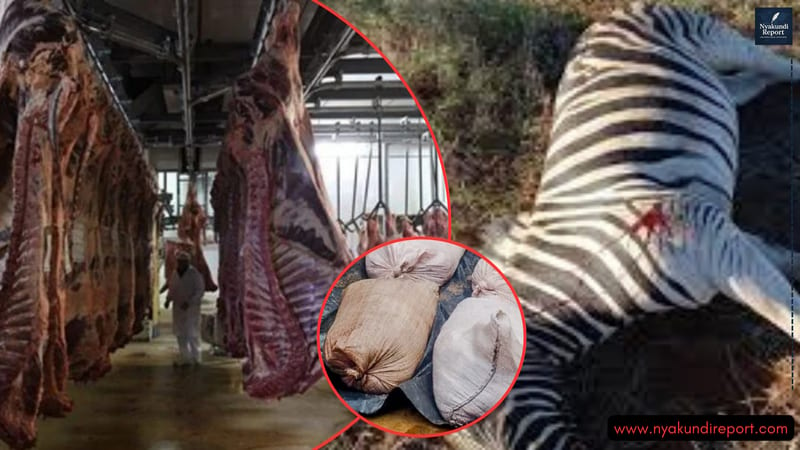
Police and wildlife officers uncovered a disturbing illegal zebra meat operation hidden inside a residential apartment in Gikambura, Kikuyu Sub-County, after acting on targeted intelligence about suspicious meat distribution in the area. During the coordinated raid, officers recovered more than one tonne of suspected zebra meat, including a freshly skinned carcass and processed portions that investigators believe were ready for circulation in local markets. Authorities arrested three suspects at the scene and seized equipment and a vehicle linked to the trade, exposing a bold wildlife crime network operating within Kiambu County. Illegal zebra meat is a calculated crime against Kenya’s wildlife, public health, and legal order. Authorities must sustain pressure, secure convictions, and dismantle every network profiting from protected species. Illegal Zebra Meat Discovered in Gikambura Apartment Raises Serious Legal and Public Health Concerns The operation brought together officers from the National Police Service and the Kenya Wildlife Service , who conducted the raid at a residential premise in the Gikambura area of Kiambu County. Investigators entered what appeared to be an ordinary apartment and discovered sacks filled with suspected zebra meat stored inside the house under conditions that immediately raised both conservation and health concerns.
Authorities confirmed that the recovered meat weighed more than one tonne, a quantity that clearly pointed to a commercial enterprise rather than isolated poaching for personal consumption. Officers also seized tools and equipment believed to have been used to slaughter, skin, and process the animal, alongside a vehicle suspected to have transported the meat across different locations.
The scale and organization of the operation suggest that the suspects had established a distribution chain designed to move illegal zebra meat discreetly through local supply routes. Investigators now believe the apartment functioned as a processing and storage hub, where meat was prepared before being dispatched to buyers who may not have known its true origin. Kenya Banned Game Meat Trade and Imposed Tough Penalties Under Wildlife Law Kenya banned the sale of game meat in 2001, restricting legal trade to specific approved species such as crocodile and ostrich under tightly regulated systems. Zebra meat does not fall within the permitted categories, making its possession, processing, or sale a direct violation of the law.
Under the Wildlife Conservation and Management Act (2013), hunting, killing, dealing in, transporting, or possessing wildlife without a permit constitutes a serious criminal offence. Section 98 of the Act imposes a minimum three-year prison sentence without the option of a fine for anyone convicted of dealing in wildlife meat or carcasses.
General purchasing of such meat attracts penalties of up to KSh 1 million in fines or up to 12 months in prison, or both. Individuals found holding wildlife trophies without proper permits face even harsher consequences, including fines of at least KSh 1 million or a minimum five-year jail term. Under the Wildlife Conservation and Management Act (2013), hunting, killing, dealing in, transporting, or possessing wildlife without a valid permit constitutes a criminal offence punishable by strict penalties. Section 98 of the Act imposes a mandatory minimum three-year prison sentence without the option of a fine for anyone convicted of dealing in wildlife meat or carcasses. How Illegal Zebra Meat Bypassed Inspection Systems and Entered Urban Circulation Investigators suspect that the suspects relied on the anonymity of a residential neighborhood to conceal their activities and avoid scrutiny from enforcement agencies. By operating from an apartment rather than a commercial slaughterhouse or butchery, they likely reduced the chances of routine inspections or complaints that often accompany suspicious business premises.
The discovery has intensified concerns about public health, especially because illegal zebra meat completely bypasses Kenya’s strict meat inspection framework. The government last year ordered the nationwide closure of businesses selling uninspected meat as part of heightened surveillance during the festive season, reinforcing requirements that every animal intended for slaughter undergo ante-mortem inspection by a certified veterinary or public health officer.
After slaughter, carcasses must pass a post-mortem inspection and receive an official stamp confirming that the meat is fit for human consumption. Meat processed in a hidden apartment does not undergo any of these procedures, which means consumers face unknown health risks if the product reaches the market disguised as legitimate livestock meat.
Authorities are now tracing possible distribution routes to determine whether any of the seized meat had already entered circulation before the raid. Previous Illegal Meat Cases Show Courts Are Willing to Impose Harsh Penalties Although cases involving possession of game meat remain relatively rare, Kenyan courts have consistently issued stiff penalties to deter wildlife crime. In 2021, three men received 10-year prison sentences and fines of KSh 2.2 million each after authorities found them in possession of 595 kilograms of bushmeat, including dik-diks and gerenuks. In a separate 2019 case in Nyahururu, a 23-year-old man was sentenced to 11 years in prison or ordered to pay a KSh 2.2 million fine after officers arrested him with 200 kilograms of zebra meat.
These rulings demonstrate that the judiciary treats wildlife offences as serious crimes that undermine conservation efforts and threaten national heritage. The law defines meat broadly to include the flesh, fat, or blood of any game animal, closing loopholes that traffickers might attempt to exploit.
The Kiambu apartment raid now stands as one of the most significant recent seizures involving illegal zebra meat, both because of the volume recovered and the urban setting in which the operation functioned. Authorities have confirmed that investigations continue as officers pursue additional suspects and attempt to dismantle any broader network connected to the trade.