The Strait of Hormuz is one of the world’s most dangerous pressure poin ts. A narrow waterway off Iran’s coast through which about 20 percent of global oil and liquefied natural gas exports must pass. Whenever regional tensions spike, this chokepoint becomes a direct transmission belt between war risk in the Gulf and prices, inflation, and investor behavior across the global economy. Why the Strait of Hormuz matters Geographically, the Strait of Hormuz is only about 21 nautical miles wide at its narrowest. Sitting between Iran to the north and Oman and the UAE to the south, linking the Persian Gulf to the Arabian Sea. Yet through this narrow channel flows roughly a fifth of the world’s oil supply, over 20 million barrels per day of crude, condensate, and refined products. As well as almost all of Qatar’s liquefied natural gas exports, most of which go to Asian buyers. The Strait of Hormuz remains a critical global chokepoint, where geopolitical tensions can trigger oil price spikes, disrupt supply chains, and impact economies worldwide, including Kenya. Gulf producers such as Saudi Arabia, Iraq, Kuwait, the UAE, and Qatar rely heavily on the Strait of Hormuz to ship energy to global markets, especially in Asia and Europe. Because so much oil and gas is funneled through such a tight corridor, any sign of conflict, threats to “set ablaze” ships, drone or missile attacks, mines. Or even insurance warnings immediately show up in world prices and freight costs. In effect, Hormuz is not just a local sea lane; it is a global financial risk indicator. Geopolitical risk: Iran, war, and navies Iran sits astride the northern shore of the strait and has, for decades, signaled that it can disrupt or close Hormuz if pushed too hard by the United States, Israel, or Gulf rivals. In the current Iran war, senior Revolutionary Guard advisers have publicly threatened to attack ships trying to transit, and Iranian officials have blamed US-Israeli strikes for the rising risk to shipping. In response, the US and its allies have deployed naval assets and called on energy‑importing nations to help secure the sea lane. While warning they may strike Iranian infrastructure if chokepoint pressure continues. Even without a formal blockade, these signals matter. Analysts note that “even the threat of closing the Strait creates new disruptions in regional security and the global economy” by increasing perceived risk. Therefore, deterring insurers and prompting shipping companies to reroute or delay cargoes. That dynamic has been visible since February 28, when the US-Israeli strikes on Iran began. Brent crude has climbed above 100 dollars per barrel, more than 40 percent higher than pre‑war levels, and gas prices at the pump have risen sharply in the US and other importers. How Hormuz risk hits global markets The most immediate channel is energy prices. When markets fear disruption at Hormuz, oil and gas benchmarks jump: one recent episode saw crude prices surge nearly 10 percent in a day and European stock indices fall by about 2 percent on the news of a possible closure. LNG markets are especially vulnerable because Qatari exports crucial for Europe and Asia, depend almost entirely on safe passage through the strait. Higher oil and gas prices quickly translate into more expensive fuel, power, and transport worldwide, pushing up inflation and squeezing household budgets. Financial markets react too. Investors typically rush into so‑called safe‑haven assets like gold, the Japanese yen, and the Swiss franc when oil shocks are tied to war risk, while riskier assets like equities in energy‑importing economies come under pressure. A sustained Hormuz shock raises freight and insurance costs for all goods moving through the region, not just energy, which can worsen current‑account deficits and increase currency pressure in import‑dependent emerging markets in Asia and Africa. Central banks in those economies then have less room to cut rates or support growth because they must respond to higher inflation and external financing risks. Who is most exposed? The burden of Hormuz risk is not evenly shared. Analysts point out that Asian states are disproportionately exposed because they import large volumes of Gulf oil and gas and have fewer alternative supply routes. Countries such as Japan, South Korea, India, and China rely heavily on tankers that must pass through the strait. Therefore, any prolonged disruption would force them to compete for alternative cargoes, driving prices even higher. In Europe, the impact is felt through both direct LNG imports from Qatar and the broader effect on global benchmark prices that shape what European buyers pay. For lower‑income, import‑dependent economies, especially in parts of Africa and South Asia, higher energy and shipping costs show up as more expensive food, fuel, and fertilizer, feeding inflation and social unrest. What begins as a chokepoint problem in the Gulf can therefore become a growth and stability problem thousands of kilometres away. Opinion: Hormuz as a built‑in risk premium Strategists now warn that as long as the Iran war and broader US–Iran tensions remain unresolved, a Hormuz risk premium will be baked into energy and shipping markets. Naval patrols and ad hoc convoys can reduce the immediate danger and calm prices if they clearly restore confidence that ships can pass safely. But if threats, harassment, and sporadic attacks persist, markets will behave as if the world’s most important oil chokepoint is perennially at risk. Also, keeping oil, LNG, and freight costs higher than they would otherwise be. For policymakers and investors, the lesson is blunt: the Strait of Hormuz is not a distant headline; it is a live variable in inflation, interest‑rate decisions and growth forecasts. Diversifying supply routes, improving energy efficiency, and accelerating the shift to renewables can reduce vulnerability over time, but for now Hormuz remains a single, narrow chokepoint that links local conflict to global prices. Until the underlying geopolitical conflict is de‑escalated, global markets will have to live with the fact that a few nautical miles off Iran’s coast can move everything from oil futures to food prices in Nairobi. ALSO READ: Michael B. Jordan Wins First Oscar for His Dual Role in Sinners
How Hormuz Tensions Push Up Oil Prices and Rattle the World Economy
N
Newsroom Updated 5 min read
Primary source nyakundireportblog
Story · How Hormuz Tensions Push Up Oil Prices and Rattle the World Economy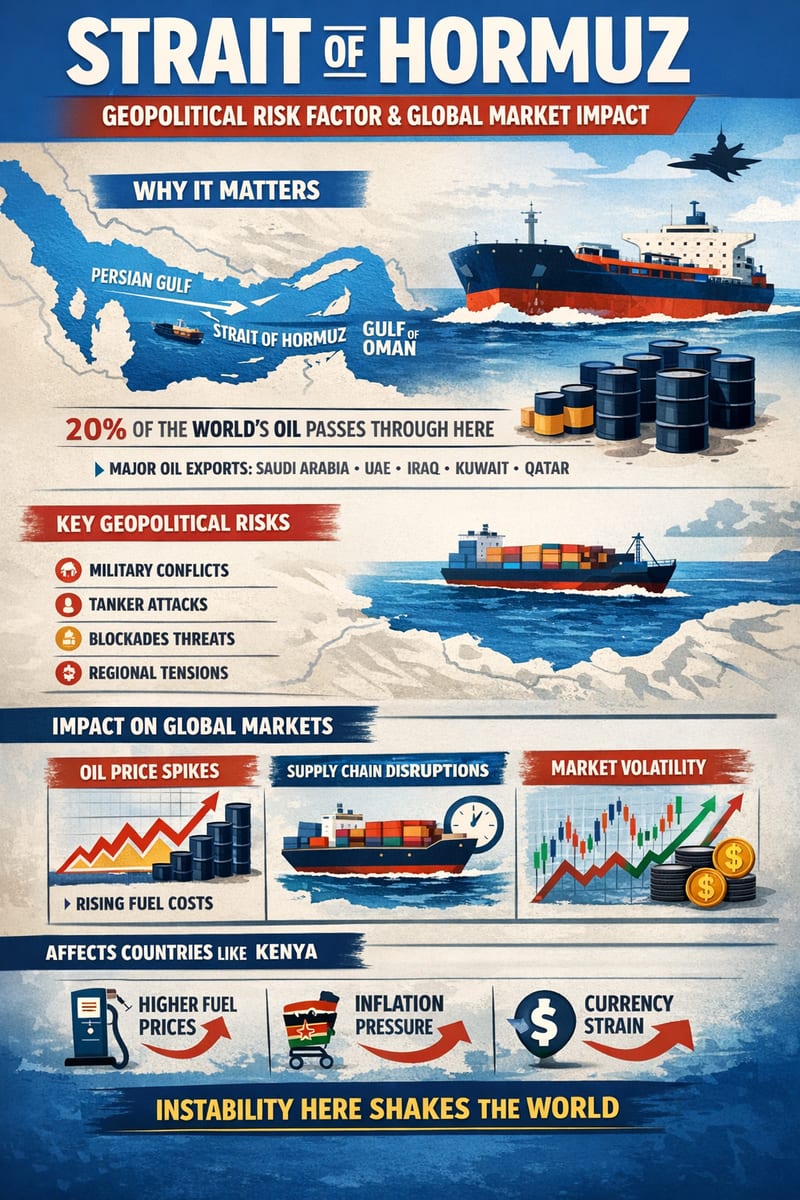
Next read
Elburgon Land Wars — How Armed Goons Are Driving Legal Landowners From Their Homes While Local Leaders Watch
25 April 2026 · 5 min read