


























The “Niko Kadi” movement is a youth‑led voter registration wave turning a casual street phrase into one of the most politically charged statements in Kenya today.
What is the Niko Kadi movement?
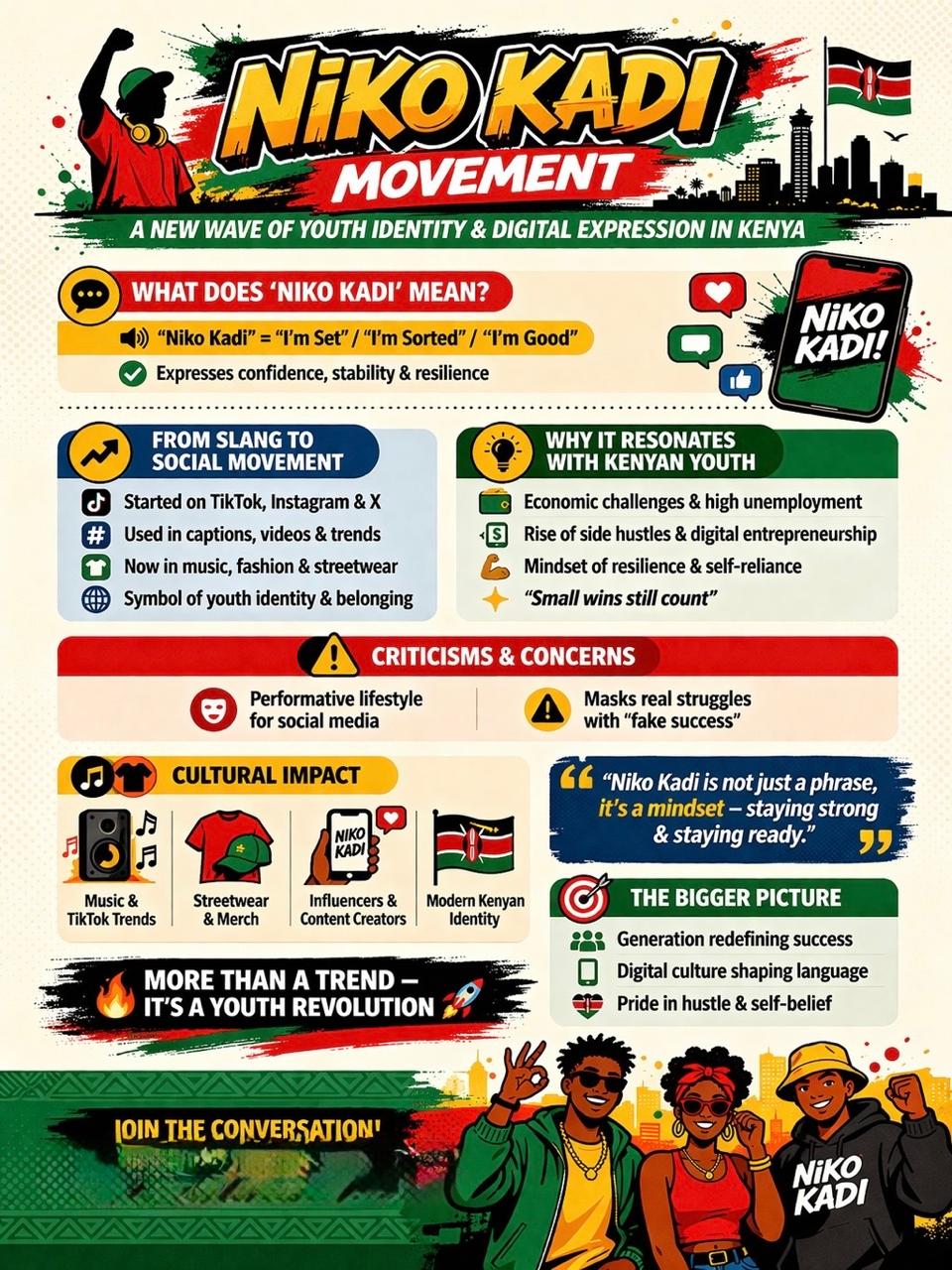
“Niko kadi” started as a playful slang phrase borrowed from card games, meaning “I’m holding a card,” before Gen Z re‑engineered it into a civic badge: “I have my voter’s card, I’m ready.”
The movement is a loose, decentralized campaign by young Kenyans to push their peers to register as voters ahead of the 2027 General Election.
Thus, shifting energy from street protests and online rants to the ballot.
From Kasarani to campuses in Chuka and beyond, organizers have staged pop-up drives and campus walks.
Also, estate activations where registering as a voter is presented as cool, social, and almost a rite of passage.
How it grew into a national youth wave
The spark, according to early organizers, came after the 2024 Finance Bill protests, when many young people felt that street power and online virality were not enough without voter cards.
Youth organizers such as Ademba Allans and others set an ambitious goal: to mobilize up to 15 million young voters by 2027 by making “Niko Kadi” a social identity, not just a slogan.
Media features have shown hundreds of youths queueing at IEBC centers in places like Kasarani, with NTV and other outlets documenting how the campaign is countering the old narrative that youth only rant online but never show up in formal civic processes.
Civil society actors and some politicians, including businesswoman Agnes Kagure, have publicly praised the creativity and self‑organisation behind the movement.
Additionally, seeing it as a rare moment when youth‑driven culture and voter education are pulling in the same direction.
For many young people, “Niko Kadi” is less about endorsing any candidate and more about refusing to be spectators in a system that has long treated them as props or statistics.
Clash with the political establishment
As the slogan went viral, it inevitably attracted the attention of the political class, and that is where the tension began.
During a rally in Kisumu, President William Ruto shouted, “Tuko Kadi! Tuko tayari!” from the podium.
Additionally, echoing the youth movement’s language, which many organizers saw as an attempted hijacking.
The Office of the Government Spokesperson later tweeted, “Mayouth je, mko kadi?” prompting a fierce backlash from young Kenyans who insisted the slogan belongs to them, not to State House or government communicators.
Youth leaders behind Niko Kadi accused the presidency and government allies of “political theft” and “appropriation.”
In addition to arguing that the movement was born out of anger at the very leadership now trying to ride on its popularity.
Commentators have framed the fight as a deeper struggle over narrative control: whether youth‑driven civic mobilization can remain independent, or whether it will be swallowed into the same partisan machinery that has historically sidelined young voters once elections are over.
Why Niko Kadi matters for 2027 and beyond
Beyond the noise, the Niko Kadi movement is important for at least two reasons.
First, it directly targets youth apathy by turning voter registration into a social flex, something you show off in selfies, captions, and group challenges rather than an obligation your parents nag you about.
If that energy holds, even a modest increase in youth registration and turnout could be decisive in a close 2027 race, given estimates that nearly 14 million eligible young Kenyans are unregistered or newly eligible.
Second, it represents a generational shift in strategy: the same demographic that powered the 2024 protests is now testing whether “ballot power” can achieve what “street power” could not.
Whether Niko Kadi remains a bottom‑up civic wave or gets diluted by partisan co‑option will shape not just one election cycle.
But how a whole generation of Kenyans understands the link between their online voice, their street presence, and their voter’s card.
ALSO READ: Nairobi Dam Water Levels Rise: Areas at Risk of Flooding