

















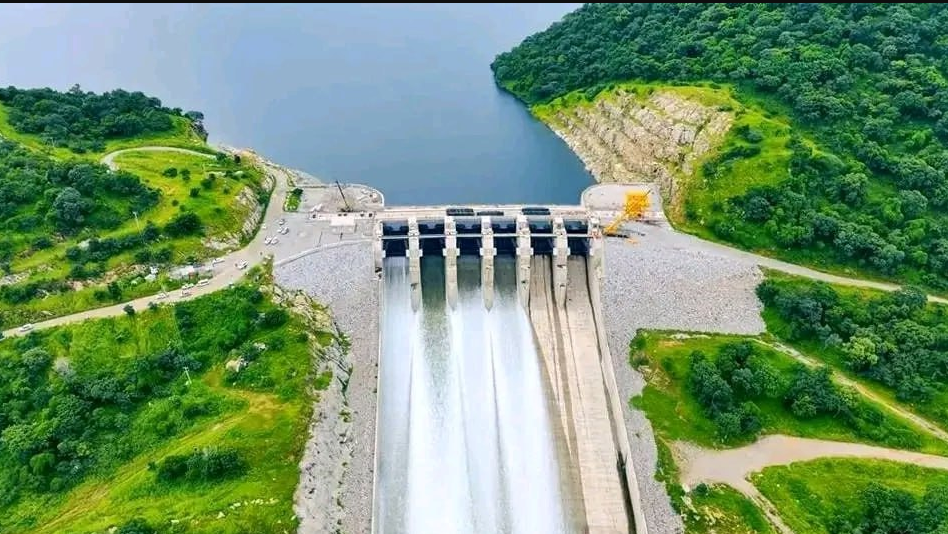


The Grand Ethiopian Renaissance Dam (GERD) is a massive hydroelectric project on the Blue Nile in Ethiopia.
Designed to be Africa’s largest power plant and a strategic pillar of Ethiopia’s development.
The GERD is built on the Blue Nile River in northwestern Ethiopia, about 15–30 kilometers from the Sudanese border.
It is a concrete gravity dam with a main wall roughly 1,780 meters long and about 145–170 meters high, depending on the specific engineering reference.
A separate rock‑fill saddle dam helps contain the reservoir on the side where the valley is lower.
The crest sits at around 655 metres above sea level, with the reservoir stretching back into the Ethiopian highlands.
Size, reservoir and power capacity
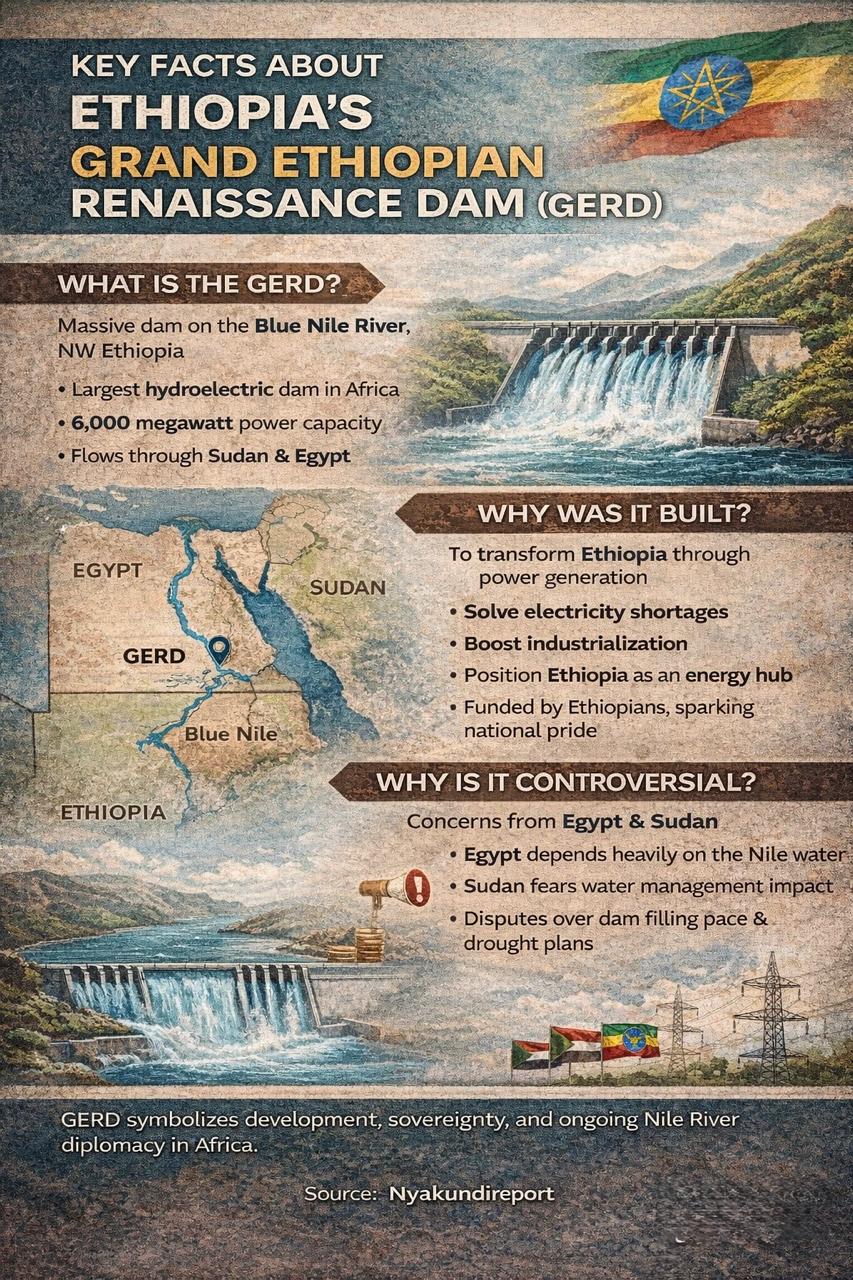
When full, the GERD reservoir can hold about 74 cubic kilometers of water, with roughly 59 cubic kilometers in active storage for power generation.
The flooded area at full supply level is about 1,874 square kilometers, making it one of Africa’s largest artificial lakes.
The dam is designed for an installed capacity of 5,150–6,450 megawatts.
With annual electricity generation expected at roughly 15–16 terawatt‑hours, it places it among the largest hydropower plants in the world and the biggest in Africa.
Construction costs are estimated at around 5 billion US dollars, financed mainly through Ethiopian government bonds and domestic contributions.
Timeline and construction progress
Construction of GERD began in April 2011, shortly after the project was announced by Ethiopia.
Over the following decade, work progressed on the main dam, saddle dam, spillways, and powerhouses, with Ethiopia starting initial reservoir filling before a comprehensive agreement with downstream neighbours was in place.
By 2024, multiple turbine units had begun producing electricity, and by mid‑2025, construction was reported to be over 98 percent complete.
In September 2025, Prime Minister Abiy Ahmed formally inaugurated the dam, marking the start of full operation even as diplomatic disputes continued with Egypt and Sudan.
Why GERD matters to Ethiopia
For Ethiopia, GERD is central to plans to expand access to electricity and drive industrial growth.
The project is expected to more than double the country’s power generation capacity and create surplus electricity for export to neighbors such as Sudan, Djibouti, Kenya, and potentially beyond.
Supporters in Ethiopia also see the dam as a symbol of national pride and financial self‑reliance, because it was largely funded domestically rather than through foreign loans.
In policy terms, GERD is meant to reduce reliance on rain‑fed agriculture by underpinning a more diversified, power‑driven economy.
Disputes with Egypt and Sudan
Egypt and Sudan, which lie downstream on the Nile, have raised strong concerns about how GERD will be filled and operated.
Egypt views large, rapid filling as a potential threat to its water security, since the country depends on the Nile for more than 90 percent of its freshwater.
Sudan’s concerns focus on dam safety, flood management, and how GERD operations will interact with its own dams, such as Roseires, which sit close to the Ethiopian border.
Negotiations among Ethiopia, Egypt, and Sudan have been running since 2011, with several African Union and US‑brokered rounds.
But efforts to reach a binding agreement on filling and operation have repeatedly stalled.
Key risks and opportunities
Experts highlight that, if managed cooperatively, GERD could bring benefits to all three countries by smoothing river flows.
Therefore, reducing floods and cutting evaporation losses compared with downstream reservoirs.
However, they also warn that unilateral decisions on filling and operating the dam, without transparent data sharing and agreed rules, raise the risk of diplomatic crises and could affect agriculture, power generation, and livelihoods downstream, especially during droughts.
The GERD story is therefore about more than engineering: it is a test case for transboundary water governance on one of the world’s most politically sensitive rivers.