



















Withdrawing the United States from international organizations and conventions.
In addition to treaties framed as “contrary to the interests of the United States,” it is now a formal pillar of President Donald Trump’s second‑term “America First” foreign policy.
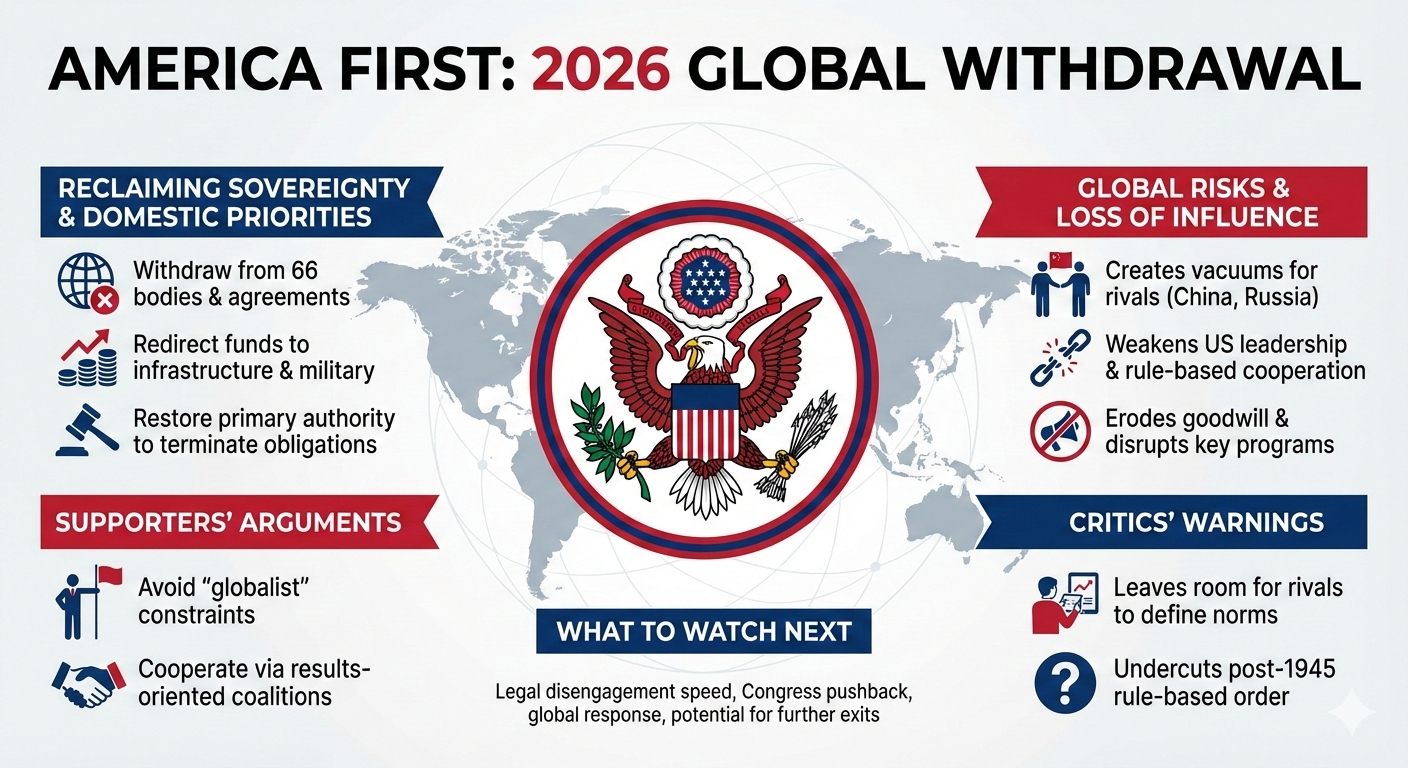
Also, backed by a sweeping 2026 memorandum covering 66 bodies and agreements.
Supporters cast this strategy as reclaiming sovereignty and cutting waste.
While critics warn it weakens US leadership, undermines rule‑based cooperation, and creates vacuums that rivals like China and Russia can fill.
What the New Policy Actually Does
Trump signed a presidential memorandum ordering executive agencies to withdraw from dozens of international organizations identified in an earlier review as mismanaged, redundant, politically hostile to US positions, or harmful to US sovereignty and prosperity.
The State Department’s review flowed from a 2025 executive order that required scrutiny of all intergovernmental bodies and treaties to flag those deemed “contrary to the interests of the United States”; the 2026 directive now instructs departments to stop participation and, where law allows, to cut funding “as soon as possible.”
The list spans 35 non‑UN bodies and 31 UN‑linked entities, heavily concentrated in climate, environmental, development, and governance fields.
Named organizations include the International Renewable Energy Agency, the International Union for Conservation of Nature, and the Intergovernmental Panel on Climate Change.
And several education and democracy initiatives, alongside UN climate and population instruments such as the UN Framework Convention on Climate Change and UNFPA.
Building on a Pattern of Withdrawals
These moves extend a pattern that began in Trump’s first term, when he pulled the US out of the Paris climate agreement, the World Health Organization, the UN Human Rights Council, and UNESCO—decisions reversed by President Joe Biden but now reinstated and deepened.
A White House fact sheet describes the targeted institutions as “wasteful, ineffective, or harmful.”
Also, arguing they are captured by interests opposed to US values and misused to pressure Washington on issues like climate, migration, and human rights.
The administration’s line is that resources freed from multilateral budgets will be redirected to domestic priorities.
Including infrastructure, military readiness, and border security, and to more “results‑oriented” coalitions where the US sets clearer terms.
Officials also insist that, as a permanent UN Security Council member with veto power, Washington can still defend its core interests in New York even while stepping back from specialized UN agencies or related treaties.
The Sovereignty Argument
Ideologically, the withdrawal drive is grounded in a nationalist reading of sovereignty that distrusts supranational rules and global bureaucracies.
Proponents argue that many multilateral regimes, especially in areas like climate or trade, allow unelected international bodies to shape domestic policy.
Therefore, eroding Congress’s authority and constraining the US government beyond what the Constitution contemplates.
In that view, treaties should generally be non‑self‑executing at home, and the president must have primary authority to terminate obligations that no longer serve national interests.
The 2026 memorandum explicitly uses this language, stating that continued membership or funding is “contrary to the interests of the United States” where organizations are seen as redundant, mismanaged, or aligned with adversarial blocs.
America‑First advocates say stepping away from such bodies is a rational way to avoid “globalist” constraints while still cooperating selectively through narrower coalitions built around shared interests.
Power, Influence, and Vacuums
Foreign‑policy experts and many US allies counter that, in practice, mass withdrawal weakens US influence over global rules without meaningfully restoring sovereignty.
Analyses of US multilateral engagement argue for remaining “inside the tent” at the UN.
And treaty‑based forums usually let Washington shape agendas, veto hostile moves, and defend its firm’s advantages it forfeits by exiting.
When the US walks away from bodies like the Human Rights Council, climate regimes, or UNESCO, it leaves more room for rivals to define norms on technology, environment, and human rights in ways that may be less favorable to American interests.
Critics also stress the practical costs: cutting funding to agencies that handle refugees, food aid, health, and climate data can disrupt programs US diplomats and military planners rely on.
While eroding goodwill in regions where Washington competes for influence.
Commentators warn that this retreat from cooperative solutions on global problems—from pandemics to warming seas—undercuts the rule‑based order the US helped build after 1945.
What to Watch Next
Going forward, key questions include how quickly agencies can legally disengage, whether Congress will push back on specific withdrawals, and how other powers respond either by stepping into leadership gaps or by building alternative forums that exclude Washington.
The administration has left the door open to further exits as the State Department’s review continues, suggesting that the list of organizations and treaties deemed “contrary to US interests” could grow.
The balance between sovereignty and sustained global influence will remain at the center of the debate over America’s place in the world.
ALSO READ: COTU Officials Unanimously Endorse Francis Atwoli for a 6th Term