
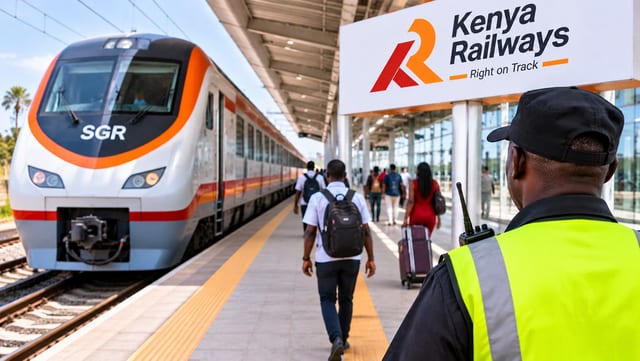
Kenya Railways Corporation (KR) is facing fresh questions over the conduct of security personnel stationed at its Standard Gauge Railway (SGR) passenger terminals following an encounter shared by a photographer and content creator identified on X as Top Shutter (@KagoAvin).
The passenger recounted how what should have been a routine security screening turned into an uncomfortable confrontation involving four to five security guards demanding documentation for a drone he was carrying.
Despite having previously travelled through the facility with his drone and expressing willingness to produce the required documents, the passenger found himself overwhelmed by the manner in which the guards handled the situation, particularly because his train was about to depart. Rather than risk missing his journey or prolonging the confrontation, he contacted someone who had accompanied him and requested that they take the drone back and arrange for its delivery the following day.
What makes the encounter particularly disturbing is the conduct of some security personnel towards their own colleague, who had been assisting the passenger with his suitcase from the moment he arrived. According to the passenger, other guards instructed their colleague to stop helping him, telling him, “Wachana na yeye, usimsaidie.”
It is difficult to understand how a disagreement over drone documentation should extend to denying a passenger ordinary assistance with his luggage. The passenger eventually asked the helpful guard to return to his duties to avoid getting into trouble with his colleagues. The incident raises questions about professionalism, workplace culture and whether some security personnel understand the distinction between enforcing security regulations and unnecessarily antagonising passengers.
The passenger was careful not to make direct accusations about the intentions of the guards, acknowledging that he might have misunderstood aspects of the encounter. He also admitted that he was running late and recognised the importance of complying with security procedures, while praising other guards and police officers within the facility for their professionalism and willingness to assist.
However, he questioned why Kenya Railways cannot establish a clearer and more predictable process for passengers travelling with drones and other specialised equipment, citing Jambojet as an example of how clearer documentation and check-in procedures could help prevent unnecessary confrontations. He also clarified that another bag contained a gimbal whose appearance had prompted questions from security personnel.
Kenya Railways must address the institutional weaknesses exposed by this complaint instead of allowing security procedures to become a source of frustration and intimidation for passengers. There is absolutely nothing wrong with security officers requesting permits, inspecting luggage or enforcing regulations governing the transportation of drones, but such responsibilities must be exercised professionally, consistently and respectfully.
Why should four or five guards simultaneously question a single passenger over documentation when one properly trained officer could coordinate the verification process?
Why should a security officer be discouraged from assisting a passenger simply because his colleagues have had a disagreement with that individual?
Such conduct, if established, points to serious deficiencies in supervision, customer service and professional discipline. Kenya Railways must publish clear guidelines on restricted equipment, required documentation and screening procedures so that passengers know exactly what is expected of them before arriving at its terminals.
The management of Kenya Railways must also establish effective mechanisms for passengers to report harassment, intimidation, misconduct and suspected abuse of authority by security personnel without fearing victimisation or missing their journeys. The circumstances described by this passenger do not establish that the guards intended to unlawfully acquire his drone or solicit anything from him.
Still, they demonstrate why opaque procedures and unnecessarily confrontational interactions can create suspicion and undermine public confidence. Kenya Railways operates a public transport service, and passengers who pay for their journeys deserve dignity, professionalism and consistent treatment. Management should investigate this particular encounter, review the conduct of the officers involved and address any shortcomings identified. Security screening should protect passengers, not become another ordeal they must endure before boarding a train.
Below Is the Passenger's Original Account as Shared on X 
First of all, Kenya Railways, I had a rather interesting experience with some of your guards hapo kwa first check-in ya scanners.I was running late, with only 11 minutes before departure. I had my cameras kwa bag, and the guards didn’t seem to notice I had a drone until I voluntarily mentioned it.The moment I mentioned the drone, I noticed what looked like a sudden change in interest. The guy’s face seemed to light up like Jack Sparrow spotting treasure. 😂 Maybe I misread his reaction, but that’s how it appeared to me. Wanaanza mambo ya drone permit. For context, sijawahi itishwa drone licence in the last 3 years of travelling with one through the SGR. I’m not suggesting permits aren’t required, just explaining why the situation caught me off guard. Nawaambia si the first time napita hapo na drone, and I was willing to show my documents. However, with the train about to leave, I was concerned about the time.At some point, I had about 4–5 guards simultaneously asking about the permit. I felt overwhelmed, and the interaction was beginning to feel like harassment from my perspective. Nikamwambia mmoja aniwache kidogo juu sasa ilikuwa imekuwa too much, but the response was, “No, lazima uandikishe.”Now, having lived in Kenya long enough, I know how easily certain situations can become complicated. Rather than argue or risk missing my train, I called someone I’d arrived with and asked them to take the drone back and send it to me the following day.Now, here’s the part I genuinely didn’t understand.One of the guards had been helping me with my suitcase right from the moment I arrived. Very friendly guy, actually.But as I was heading back, I heard some of the other guards telling him, “Wachana na yeye, usimsaidie.”Hapo sasa ndio nilichanganyikiwa. 😂Why would my interaction over a drone permit suddenly have anything to do with another guard helping me carry my suitcase?Nikamshow, “Wewe rudi, usichome kazi.”I can’t speak to anyone’s intentions, and perhaps there was something I misunderstood, but the whole exchange felt unnecessarily personal.Maybe, just maybe, they expected a different reaction from me. Maybe they thought I’d leave the drone behind. Or maybe I completely misinterpreted the situation. I genuinely don’t know, and I wouldn’t want to make accusations without evidence.That said, the experience left me questioning how such situations are handled, especially when passengers are running out of time.To be fair, most of the other guards I encountered huko ndani, including the police officers, have been extremely helpful. I also acknowledge that I was late and that security procedures must be followed.But Kenya Railways, perhaps some clarity on drone documentation and the check-in process like Jambojet do, it would help passengers avoid such experiences.Has anyone else travelling on the SGR ever experienced something similar?I’m genuinely curious to hear other people’s experiences.Kuchelewa hufanyika, lakini pia Mungu si Mungai. 😂Tamaa ilimuua fisi, ama namna gani?They asked what was in the bag. It had a gimbal and looks like a weapon.— Top Shutter (KagoAvin)