
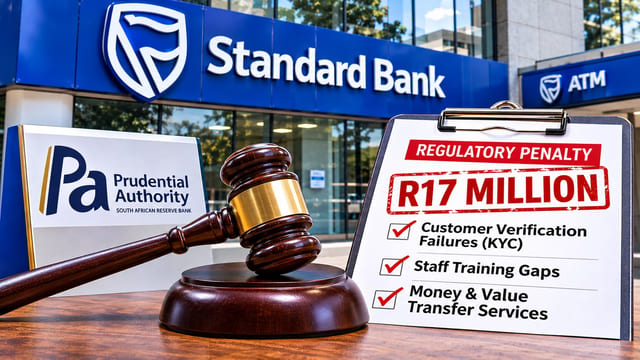
Standard Bank has been slapped with a R17 million penalty, equivalent to approximately KSh130 million, after regulators uncovered serious weaknesses in customer verification, record-keeping and employee training within its money transfer operations. The findings have raised concerns about how financial institutions manage anti-money laundering obligations, particularly when banking services are extended through retail outlets and third-party agents rather than conventional bank branches.
The penalty was imposed by South Africa's Prudential Authority following an inspection conducted in 2023, which established that the bank had failed to comply fully with certain customer due diligence and staff training requirements. Of the total R17 million penalty, R12 million is payable, while R5 million has been conditionally suspended for 36 months. The suspended portion remains subject to the conditions imposed by the regulator.
The inspection revealed that 34 percent of the customer files examined did not contain adequate customer due diligence information. In a separate finding, 52 percent of sampled files were missing proof of address, work permits or both. These documents are important in establishing customers' identities, understanding their circumstances and determining whether transactions present potential financial crime risks.
The shortcomings extended beyond customer records to the employees responsible for implementing compliance procedures. Among staff recruited in 2021, 52 percent of those sampled had not received the required refresher training during 2022 and 2023. Another 37 percent of employees recruited in 2023 had not completed mandatory induction training, exposing weaknesses in how the institution prepared employees to identify suspicious transactions and comply with anti-money laundering requirements.
These findings point to failures in the implementation of compliance controls rather than merely isolated paperwork errors. Financial institutions are expected to maintain accurate customer records, conduct appropriate checks and ensure employees understand the procedures used to prevent money laundering, terrorist financing and other financial crimes. Where such responsibilities are neglected, weaknesses can develop across the transaction process, even where no actual criminal activity has been established.
Standard Bank has acknowledged the regulatory penalty but maintained that the inspection did not identify any actual cases of money laundering, terrorist financing or proliferation financing. The bank also emphasised that the regulator did not find that it had facilitated any of these activities. This distinction is important because the sanctions relate to failures in complying with preventive regulatory requirements, not a finding that the bank participated in financial crime.
However, outsourcing the customer-facing transaction does not transfer the bank's regulatory obligations to the retail partner. The institution remains responsible for ensuring that customers are properly identified, supporting documents are collected where required, transaction records are maintained and employees handling the services receive appropriate training.
The case also carries important lessons for Kenya, where banks, mobile money providers and other financial institutions increasingly depend on agents and digital platforms to serve customers. Institutions such as Equity Bank, KCB, Co-operative Bank and NCBA operate in a market where customers can access financial services through banking agents, mobile applications and other channels without visiting a branch. These arrangements have expanded access to banking, particularly in areas where conventional banking infrastructure is limited, but they also require effective supervision of customer verification and transaction monitoring.
In Kenya, the Central Bank of Kenya regulates banks under a framework that includes the Proceeds of Crime and Anti-Money Laundering Act (POCAMLA) and related regulations. Its customer due diligence guidance requires financial institutions to identify and verify customers, assess their risks, maintain appropriate records and monitor transactions. The guidance also places responsibility on boards and senior management to ensure that compliance systems are properly implemented and employees receive appropriate training.
This means Kenyan banks cannot assume that compliance obligations have been satisfied simply because a customer has presented a national identity card, registered a mobile banking account or completed a transaction through an authorised agent. Financial institutions must ensure that the required checks are appropriate to the customer's risk profile and that records can be retrieved when regulators or investigators need them.
The Central Bank's agent banking guidelines also require institutions to establish systems for monitoring agents, conduct due diligence on those agents and maintain appropriate operational controls. These requirements are particularly relevant in Kenya, where agency banking has become an important channel for deposits, withdrawals, payments and other financial services.
The South African findings raise a practical question for Kenyan financial institutions: how consistently are customer verification requirements being enforced across the expanding networks of banking agents and other third-party service providers? A bank may have detailed compliance manuals at its headquarters, but those policies offer limited protection if the employees and agents processing transactions do not understand or consistently follow them.
The staff training failures identified at Standard Bank are especially significant because employees are often the first line of defence against suspicious financial activity. A worker who has not received appropriate training may fail to recognise unusual transaction patterns, identify inconsistencies in customer information or escalate transactions requiring further scrutiny. Such failures can weaken a financial institution's ability to detect potential financial crime even when its formal compliance policies appear adequate.
The penalty also comes against the background of earlier regulatory action involving Standard Bank. South Africa's Prudential Authority imposed a separate R13 million penalty on the institution in January 2025 for shortcomings involving ongoing customer due diligence, record-keeping and transaction reporting. The latest R17 million sanction therefore adds to an existing record of regulatory findings concerning the bank's compliance controls, although the two enforcement actions relate to separately identified deficiencies.
For Kenya, the relevance extends beyond Standard Bank itself. Financial institutions operating across borders must comply with different national regulatory requirements while maintaining consistent internal standards. Failures identified in one market do not automatically establish similar problems in another, but they demonstrate why regulators must examine how compliance procedures operate in practice rather than relying exclusively on written policies and assurances from management.
The South African regulator divided the latest financial penalty into three components: R7 million for inadequate customer due diligence, R5 million for missing customer documentation and R5 million for employee training failures. Of these amounts, R2 million, R1 million and R2 million respectively were conditionally suspended. The sanctions also included three formal cautions and three reprimands, with the suspension period running from May 19, 2026.
The Prudential Authority confirmed that Standard Bank cooperated in addressing the identified weaknesses. The bank has also stated that it has strengthened oversight and introduced corrective measures within the affected retail partner operations. Nevertheless, the regulatory action demonstrates that cooperation after an inspection does not eliminate accountability for earlier compliance failures.
The wider concern for the banking sector is whether institutions are investing sufficiently in the people responsible for implementing compliance requirements. Expanding branchless banking, increasing transaction volumes and introducing new financial products can generate additional revenue, but these developments must be accompanied by adequate staff training, regular internal audits and effective supervision of external partners.
For Kenyan regulators, the case reinforces the importance of examining not only whether banks have anti-money laundering policies, but also whether employees have completed the necessary training, customer records are properly maintained and deficiencies identified during internal reviews are corrected promptly.
Standard Bank's R17 million penalty ultimately illustrates the financial and regulatory consequences of failing to implement basic compliance requirements. Although the South African inspection did not establish that the bank facilitated money laundering or terrorist financing, the weaknesses were sufficiently serious to warrant substantial sanctions.
As banking institutions across Africa continue expanding their digital and agency networks, the case demonstrates that financial inclusion and regulatory compliance must advance together. Banks remain responsible for the integrity of their services, regardless of whether transactions take place inside a banking hall, through a retail partner or on a digital platform.