
Current
Law Catches Up With ‘Sharp Boy’ Francis Kamau Who Locked Himself in a Metal Cage and Threatened a Magistrate
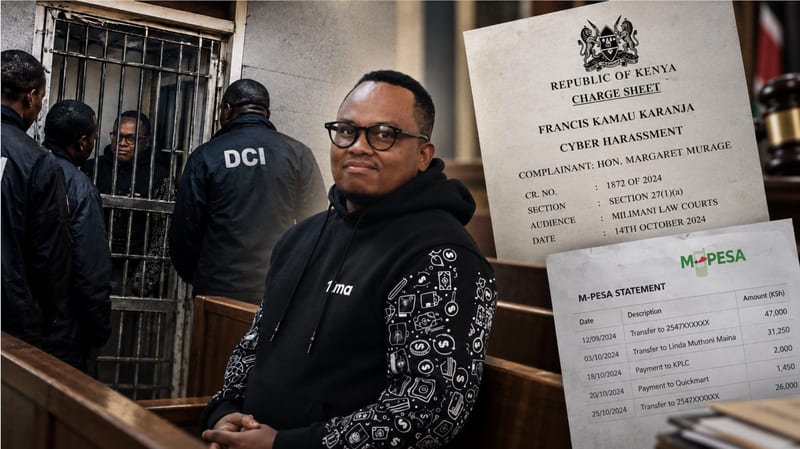
Francis Kamau Karanja’s story has begun to look like one of those Nairobi crime dramas that starts with a small amount of money, gathers police officers, lawyers, court orders and angry messages along the way, then suddenly becomes much bigger than anyone expected.
For months, Francis had fought investigators over a disputed KSh 78,250 payment tied to a technology job, and at one point he even secured High Court protection restraining specified officers from arresting, tracking, or raiding him while his petition remained pending.
That victory could easily have looked like Francis had beaten the system, pushed detectives back, and bought himself enough breathing room to keep fighting, but October brought a completely different problem that put him back in the criminal justice system.
He is now facing a fresh cyber harassment charge over a message sent to Magistrate Margaret Murage, who is named as the complainant, and he is expected to be remanded before appearing at Milimani Court as the new case begins.
The allegation has given Francis’s story a new edge, because the man who had previously gone to court seeking protection from police interference is now returning to court as an accused person facing a separate complaint involving a judicial officer.
The route that brought him here is exactly what makes his story fit into Kenya’s growing conversation about the so-called “Sharp Boys.”
The trouble started after Anthony Karanja reported at Dandora Police Station that he had paid Francis KSh 78,250 for technology services that were never delivered, prompting investigators to begin examining what had happened after the payment was made.
Police later obtained court authority to access the M-Pesa account linked to Francis, and the resulting statement showed the KSh 78,250 entering the account through a Standard Chartered Bank business payment shortly after 2am on March 1, 2026.
From there, the money began moving through a series of transactions involving household expenses, electricity, supermarkets, the Nairobi Expressway, food, entertainment and transfers to different women, creating the kind of financial trail that can later become extremely uncomfortable when investigators start reading it backwards.
Among the names appearing repeatedly in the records was Linda Muthoni Maina, including one transfer of KSh 47,000; the lady is said to be one of his many girlfriends.
That detail still feeds the popular Nairobi joke about the Sharp Boy who receives money today and begins spending it around women tomorrow.
Police later told the High Court that Francis reported the payment as suspicious only after the money had already been used, an allegation he disputes, but one investigators relied upon when explaining why they believed the matter required further criminal investigation.
What might have remained a small argument between two men over a technology job had now become a police file supported by M Pesa records, statements, court applications and allegations that Francis had received money without delivering the agreed service.
Then detectives came to his door 
Police say detectives travelled to Francis’s residence in June using an official DCI vehicle, first reporting to Highridge Police Post before proceeding to the apartment together with uniformed officers who had been requested to assist them.
According to the investigating officer’s affidavit, Francis allegedly locked himself inside a metal caged verandah, refused to open after officers identified themselves, and insisted that the people outside were connected to interests he believed were behind his problems.
The officers say they eventually decided against forcing entry and instead gave Francis an opportunity to present himself at Dandora Police Station, but by then the case had already become a confrontation between one man and the investigators pursuing him.
Francis responded by moving to the High Court, where he secured temporary protection restraining specified officers from raiding his home, arresting him, tracking him, or otherwise interfering with his liberty pending determination of his application.
For anybody watching from outside, that was the sort of move that strengthens the Sharp Boy legend, because police had come knocking, Francis resisted, lawyers entered the matter, and the High Court temporarily restricted what the officers could do next.
The danger with winning one battle is that confidence can quickly become something else, and the Francis story became even more dramatic after prosecutors later accused him of sending a message to a magistrate that crossed into criminal territory.
The case involving Magistrate Margaret Murage 
A charge sheet dated October 6 accuses Francis of cyber harassment over a communication allegedly sent on September 28 to Magistrate Margaret Murage, with prosecutors claiming that the wording accused her of bias and caused apprehension or fear.
The text read
“Greetings Hon: I have noted the great bias in the case of Gabriel Saka. It seems you have taken sides and we will not allow it. I will not stop at anything to ensure justice is done, be warned. Chunga kazi yako. Na ujichunge sana. Tunajua kwako.”
The magistrate is listed as the complainant, meaning Francis had moved from fighting a private complainant and detectives into a completely different case where the alleged recipient of the disputed communication was an officer of the Judiciary.
That development gives the story its strongest twist, because there is a significant difference between arguing with police officers over an investigation and becoming accused of sending language that prosecutors say amounted to harassment of a magistrate.
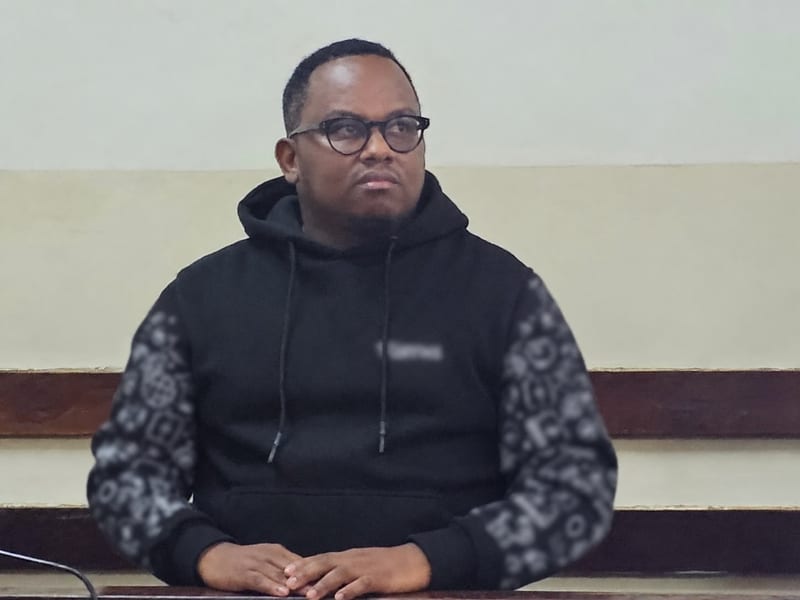
The Kenyan “Sharp Boy” has become a familiar character 
Francis’s case is much smaller than the major cybercrime and wash-wash cases Kenya has seen, but his story sits comfortably inside a culture Nairobi residents now recognise almost immediately when the signs begin appearing.
The Sharp Boy is usually confident, understands technology, talks about business constantly, dislikes the idea of ordinary employment and seems determined to reach the expensive car, apartment, nightlife and social status long before the slow route can realistically provide them.
Sometimes the money is completely legitimate, because Kenya has produced plenty of young entrepreneurs who built technology businesses, trading companies and digital ventures that genuinely made them wealthy much earlier than previous generations would have considered normal.
The suspicion begins when the lifestyle becomes much larger than the visible business, and the explanation for the money keeps changing between forex trading, consulting, crypto, gold, tenders, international deals, technology contracts, and investments nobody can clearly identify.
Around Nairobi, the expensive car can become part of the business card, because somebody claiming to control millions looks considerably more convincing arriving in a Range Rover than arriving in an old Toyota with cracked seats.
The apartment can serve the same purpose, since an address in Kilimani, Kileleshwa, Lavington or Westlands can help create the appearance that whatever mysterious business the person claims to run must be doing extremely well.
Women, restaurants, designer clothes, bottles and frequent travel then complete the picture, creating an expensive public image that tells friends, victims and social media followers that the man has already escaped the ordinary life everyone else is still struggling through.
When the FBI becomes part of the story 
Kenya has already watched several cybercrime suspects discover that an operation carried out from Nairobi can eventually attract investigators from the United States, especially when money, American institutions or victims are involved.
Kenyan suspects have faced extradition proceedings over allegations involving business email compromise, computer intrusions, wire fraud and identity theft, with American investigators sometimes building cases for years before the accused even realise how much information has been collected.
That reality destroys one of the biggest Sharp Boy fantasies, because distance does not necessarily protect somebody whose money moves internationally, and a laptop in Nairobi can create a criminal file sitting inside an American federal office.
The person may change phones, move houses, replace cars and disappear from social media, yet financial records, email accounts, devices, immigration movements and former associates can remain available to investigators long after the lifestyle has changed.
INTERPOL notices and extradition proceedings are rarely part of the Instagram fantasy when the money first arrives, but they become very real when somebody discovers that a foreign investigation never actually disappeared.
Ramon Abbas, better known as Hushpuppi, remains the international example that should have frightened every aspiring Sharp Boy, because his social media pages displayed exactly the life so many young men dream about achieving instantly.
His photographs showed luxury hotels, private jets, designer clothes, expensive watches, and high-end cars, creating the image of a man who had somehow found the shortcut to wealth that millions of ordinary workers spend decades chasing.
Then American investigators produced a completely different account involving money laundering and proceeds from online fraud, before Hushpuppi eventually pleaded guilty and received a federal prison sentence of more than eleven years.
His story became famous because the contrast was almost ridiculous, with millions of followers still able to scroll through photographs of luxury vehicles and designer outfits after the man who posted them had already exchanged Dubai comfort for American federal custody.
Kenya has seen an ending worse than prison 
Samuel Mugoh Muvota offered Kenya a darker example after police linked him to an alleged network involving ATM fraud, SIM swapping and women accused of drugging victims before money was taken from their accounts.
Police accounts released after his death painted the picture of a man surrounded by money, expensive vehicles, women and repeated allegations of fraud, creating another version of the Sharp Boy life that appeared untouchable for years.
Then in May 2022, a gunman approached his vehicle on Mirema Drive and shot him repeatedly in broad daylight, turning the same kind of expensive car that usually represents success into the place where the story ended.
Francis and the problem with believing you are always smarter 
What makes Francis story remarkable is how that amount allegedly opened one door after another, producing a police complaint, M Pesa investigation, attempted arrest, High Court case, temporary protection and eventually a completely separate criminal matter involving a magistrate.
That progression captures the weakness behind the Sharp Boy mentality, where surviving one problem can create the belief that intelligence will always produce another escape, even when the number of institutions, witnesses and records around the person keeps growing.
The modern Sharp Boy may believe technology protects him because money moves instantly and messages can be deleted, yet the same technology creates detailed records showing transfers, dates, accounts, communications and movements that can later be placed before a court.
For Kenya’s Sharp Boys watching from expensive apartments and powerful cars, Francis Kamau’s story carries a simple warning that should be easier to understand than any police affidavit or court ruling.
Fast money can make somebody look clever for a very long time, but once the receipts, investigators and court files begin piling up, cleverness suddenly becomes a much more expensive lifestyle to maintain.
Last updated 14h