
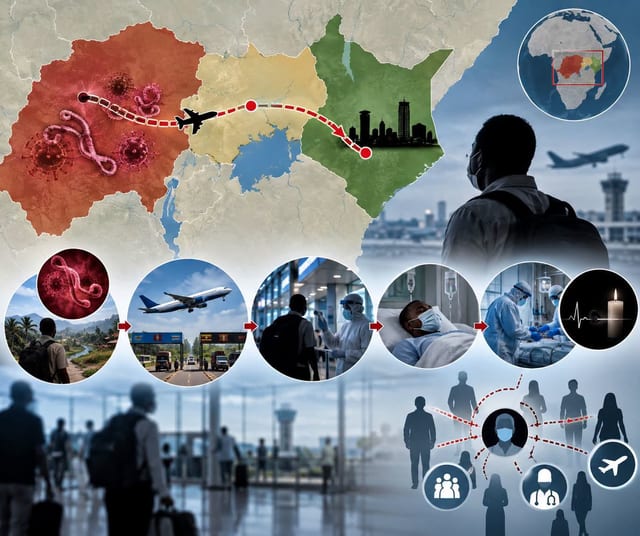
Kenyan health authorities are reconstructing the final movements of the patient at the centre of the country’s first confirmed Ebola case, with attention now turning to everyone who may have encountered the patient between leaving the Democratic Republic of Congo and admission to hospital in Nairobi.
Before October 3: The patient, a Kenyan citizen, had been living in the Democratic Republic of Congo, which is currently battling a major Ebola outbreak that has recorded thousands of infections and deaths.
Journey to Kenya: The patient left the Democratic Republic of Congo and travelled through Uganda before continuing to Kenya, creating a cross-border travel trail that health authorities are now examining as part of contact tracing.
October 3: The patient arrived in Nairobi and underwent routine public health screening upon arrival, before proceeding into the city.
October 3 to October 5: After arriving in Kenya, the patient developed symptoms consistent with haemorrhagic fever and was eventually admitted to Nairobi Hospital, where medical personnel suspected Ebola and samples were collected for laboratory testing.
The tests subsequently returned positive for Ebola, confirming what would become Kenya’s first recorded case of the disease.
October 5: The patient died while undergoing treatment in Nairobi, only two days after arriving in the country from the Democratic Republic of Congo through Uganda.
October 6: Health Cabinet Secretary Aden Duale publicly confirmed that the patient had tested positive for Ebola and announced that authorities had started tracing people who may have been exposed during the patient’s journey and subsequent stay in Nairobi.
At least 28 contacts, including relatives and healthcare workers, had already been identified, while another 23 passengers who travelled on the same flight as the patient were being traced by health authorities.
The contacts will be monitored for 21 days, with authorities watching for symptoms and conducting further testing where necessary as they establish whether the imported infection resulted in transmission within Kenya.
The biggest unanswered part of the chronology remains what happened between the patient’s arrival in Nairobi on October 3 and admission to hospital, including where the patient stayed, the places visited, when symptoms first appeared and how many people had direct contact before isolation.