
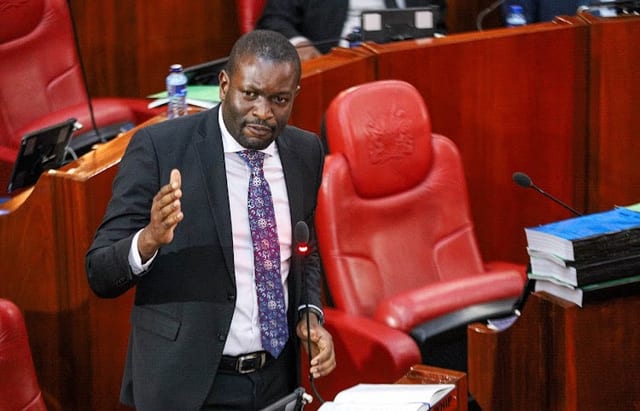
Nairobi Senator Edwin Sifuna has responded to President William Ruto after the President challenged him to use parliamentary procedures if he wants to access the agreement between the Kenyan government and Nigerian businessman Aliko Dangote over the proposed Lamu refinery.
Sifuna's response came on Friday, October 2, a day after Ruto told him that Parliament already has a procedure for obtaining government agreements. The President was reacting to Sifuna's demand that lawmakers be given access to the deal and details of the commitments Kenya has made to facilitate the Sh2.2 trillion project.
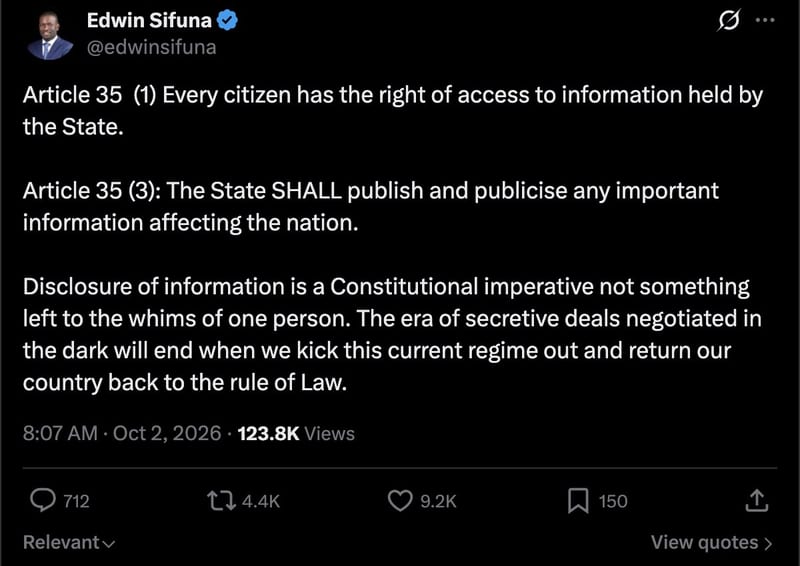
Instead of focusing on the parliamentary procedure suggested by Ruto, Sifuna turned to Article 35 of the Constitution, arguing that access to government information is a constitutional right.
Article 35 (1): Every citizen has the right of access to information held by the State. Article 35 (3): The State SHALL publish and publicise any important information affecting the nation.
Sifuna added that disclosure of government information should not depend on the personal decision of an individual. He said the Constitution places an obligation on the State to make important information available to citizens.
Disclosure of information is a Constitutional imperative not something left to the whims of one person.
Ruto had told Sifuna to use Parliament 
The exchange follows a public disagreement that began in the Senate after Sifuna questioned why lawmakers had not seen the agreement governing the refinery.
On Thursday, Ruto responded during his tour of the Coast, telling Sifuna that if he wanted the document, he should follow the established parliamentary process through which government agreements can be requested and tabled before lawmakers.
Ruto also accused some of those demanding access to the agreement of seeking to frustrate or pressure Dangote. He referred to previous difficulties the businessman encountered when he sought to establish a cement manufacturing operation in Kenya and said his administration would not allow similar treatment of the investor.
The President maintained that people with genuine disputes involving Dangote should use the courts, while lawmakers seeking government documents should use Parliament's established mechanisms.
Sifuna says the issue is bigger than one agreement 
Sifuna has framed the matter as one of public disclosure and constitutional oversight, rather than simply a dispute between himself and the President.
Before Ruto's response, the senator told the Senate that lawmakers had not been shown the refinery agreement and did not know what commitments the Kenyan government had made to facilitate the investment.
None of us has seen the agreement on that refinery. None of us knows the commitments that this country has given in order for that refinery to be built,” Sifuna said.
He has also argued that major investments should be explained to the public, particularly where government commitments and communities affected by the project are involved.
Sifuna has previously raised concerns about residents in Lamu who have taken aspects of the project to court. He said development should not mean ignoring constitutional requirements or the concerns of people directly affected by major projects.
The refinery is a massive undertaking 
The proposed Dangote East Africa Petroleum Refinery is expected to cost about KSh2 trillion to KSh2.2 trillion and have the capacity to process approximately 700,000 barrels of crude oil per day. The project is expected to serve Kenya and other markets in East Africa, with construction projected to take about 40 months.
The Kenyan government has also indicated that it could take a stake in the refinery. Public reports have put Kenya's potential allocation at 10 per cent, while regional governments could collectively take up to 30 per cent. Treasury has said Kenya could increase its stake depending on how other investors take up their allocations.
President Ruto has also encouraged Kenyans to consider buying shares in the project through the Nairobi Securities Exchange if the proposed public offering proceeds.
Because of the scale of the investment and the potential government participation, the agreement has attracted questions about ownership, public commitments, financing, land, energy arrangements and the obligations that could eventually fall on the State.
The debate is now about transparency and procedure 
The latest exchange between Ruto and Sifuna has placed two issues at the centre of the refinery debate.
Ruto's position is that Parliament has procedures for obtaining and examining government agreements, and that those who have legal disputes with Dangote should use the courts. Sifuna, meanwhile, is emphasising Article 35 and the constitutional requirement for public access to important state information.
The two positions concern different parts of the same question. Parliamentary procedure provides a mechanism for lawmakers to request government documents, while Article 35 establishes a broader constitutional right to access information held by the State.
Sifuna has now made it clear that he intends to continue pressing the disclosure issue, arguing that Kenyans should be able to understand the commitments their government is making around a project of such a large financial and national significance.
For now, the actual terms of the government-Dangote agreement remain at the centre of the dispute, with Sifuna demanding greater disclosure and Ruto directing lawmakers to use the established parliamentary process to obtain the document