
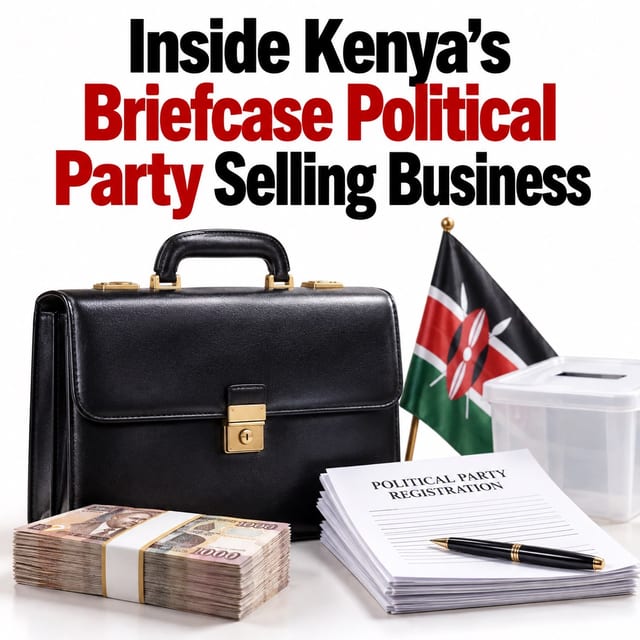
For more than three decades, a quiet cottage industry has operated in the margins of Kenya's multiparty democracy, one that has nothing to do with ideology, manifestos or grassroots organising, and everything to do with timing a name correctly and finding the right buyer.
Lawyer and commentator Donald B. Kipkorir laid out the pattern bluntly this week: since Kenya returned to multiparty politics in 1992, political entrepreneurs have made a habit of registering parties bearing catchy, trending phrases or the developing name of a political movement, only to sell the outfit later, at a price, to whoever actually ends up needing it.
Once the sale is done, Kipkorir noted, the original registrants tend to vanish entirely. "It is like they disappear to the night," he wrote.
It turns out this isn't hyperbole. It's a documented trend with a name, "briefcase parties," and Kenya's political registry shows the scale of it plainly.
Nation reporting has tracked 30 new political outfits granted provisional registration in the run-up to 2027, with names ranging from the Forum for Economic Development Agenda to the United Super Alliance Party to the Freedom and Opportunity Party, entities that surface, secure paperwork, and then wait.
As of the most recent count from the Office of the Registrar of Political Parties (ORPP), Kenya has roughly 92 to 99 fully registered parties, accounts vary slightly depending on the exact reporting date, plus dozens more sitting in provisional status, a number that keeps climbing each election cycle in a way that has little to do with genuine ideological diversity and a great deal to do with the resale value of a well-timed name.
Since Kenya became multiparty in 1992, political fraudsters have developed cottage industry of registering political parties that reflect the trending catchy phrases or developing name of a movement. Then for a price, sell the Parties to the real owners. Then we don’t hear of these political traders again. It is like they disappear to the night! Registrar of Political Parties has enabled & grown this whoring by letting unknown charlatans register parties. Shouldn’t there be a minimum requirements for one to register a party? Shouldn’t the Registrar notify the public & invite objections to an intended registration? And as the Registrar lives in Kenya, shouldn’t she be conscientious & inform those publicly associated with the intended name?
The mechanics of the trade are almost mundane once you see them laid out. A party name gets registered early, often before a political movement or catchphrase has fully crystallised into something with real public momentum.
The registrants sit on it. Once a politician or coalition later decides they need exactly that name, or a coalition vehicle shaped exactly like it, negotiations begin, and money changes hands.
Mainstream media in Kenya have both previously described this as a booming business, and a 2026 Nation feature bluntly titled it the trade of "running a political party" as "a lucrative venture."
Provisionally registered parties are legally required to recruit at least 1,000 members across a minimum of 24 counties and establish physical offices in those counties within 180 days to achieve full registration, requirements that, on paper, are supposed to filter out exactly this kind of shell operation. In practice, enforcement has been loose enough that the requirement has done little to stop the trade.
Kipkorir's core complaint is that the ORPP itself has enabled the practice by failing to apply meaningful gatekeeping at the point of registration.
His questions cut straight at the regulatory gap: shouldn't there be minimum requirements before someone is allowed to register a party at all?
Shouldn't the Registrar be required to publicly notify the intended registration and invite objections before it goes through, the same way land transactions or trademark applications typically require a public notice period?
And given that the current Registrar, John Cox Lorionokou, lives and works in Kenya, shouldn't basic diligence require notifying individuals or movements already publicly associated with a name before a stranger is allowed to register it out from under them?
Those questions are landing at a genuinely consequential moment. The ORPP has now signalled the most serious crackdown attempt in recent memory.
In a letter dated September 14, 2026, addressed to the secretaries-general of all fully registered parties, Lorionokou announced a week-long inspection exercise, running from October 5 to October 9, 2026, to physically verify that head offices and branch offices actually exist as required by the Political Parties Act, complete with checks on lease agreements, accessibility to the public, and named individuals in charge at each location.
The implication is significant, any fully registered party unable to demonstrate a genuine physical presence in at least 24 counties risks being locked out of the 2027 General Election entirely.
Predictably, the announcement has triggered pushback. Several party officials have petitioned the Political Parties Liaison Committee (PPLC) for a crisis meeting, alleging the timing amounts to a plot to disqualify smaller or newer outfits just as the 2027 field takes shape.
PPLC chairperson Evans Misati has said the ORPP is within its rights to conduct the exercise, but warned pointedly that its outcome must not be used to lock any party out of the coming election, vowing that affected parties "will fight viciously" if that happens.
Notably, Kenya's largest and most established parties, Wiper, ODM and UDA among them, appear to be structurally safe from the exercise given their established physical infrastructure, meaning the inspection is likely to bite hardest precisely among the smaller, newer, and more opportunistically registered outfits Kipkorir is describing.
Beneath the bureaucratic language of "compliance inspections" sits the real political stakes, control of a party name, brand, or ready-made electoral vehicle is a genuine commodity in Kenyan politics, valuable enough that people register outfits purely speculatively, betting that a coalition, a movement, or a breakaway faction will eventually need exactly that shell and be willing to pay for it.
Whether the ORPP's October inspection exercise meaningfully disrupts that trade, or simply becomes another round in the cycle of registration, dispute, and negotiation that has defined Kenyan party politics since 1992, will become clear only once the results of the inspection, and any resulting deregistrations, are made public.