
X has filed a High Court claim in England against Vivek Kumar Sen and Zamyang Sherpa, stating that the two men operated a network of accounts that artificially generated engagement and caused X to make more than £207,000 in payments under its Creator Revenue Sharing Programme.
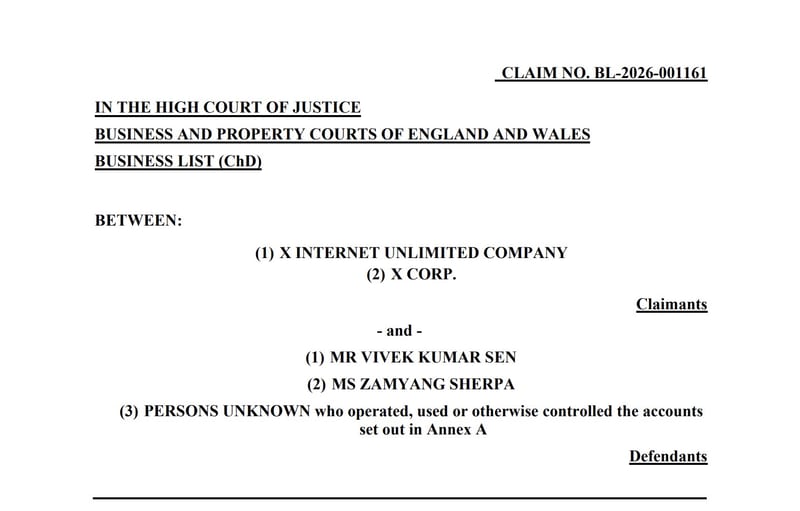
The case, filed on 17 September 2026 in the High Court of Justice, Business and Property Courts of England and Wales, names X Internet Unlimited Company and X Corp. as the claimants. The defendants are Vivek Kumar Sen, Zamyang Sherpa, and persons unknown who operated, used or controlled additional X accounts identified in an annex to the claim.
According to X's claim, the defendants operated several X accounts as a coordinated network rather than as genuinely independent users.
The company says that the accounts were used to repeatedly like, repost and otherwise engage with one another's content. X says this created the appearance of genuine human interaction and artificially increased the engagement figures used to calculate Creator Revenue Sharing payments.
The claim states that the accounts also published substantially similar or identical material, sometimes within seconds or minutes of one another.
X gives several examples in the court papers.
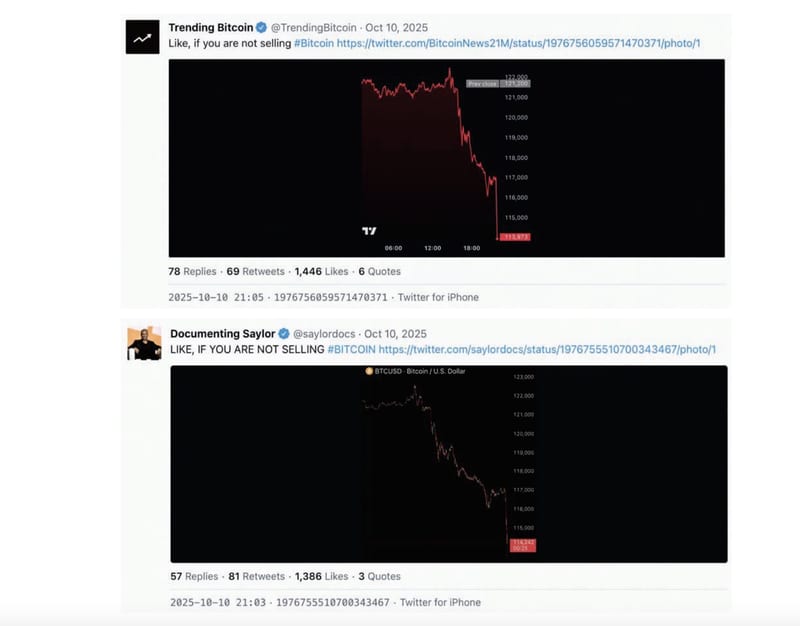
On 10 October 2025, two accounts, @TrendingBitcoin and @saylordocs, published identical posts within two minutes of each other, using the same phrase and image.
On 3 November 2025, X says four accounts, @TrendingBitcoin, @Kalshibacktest, @Bitcoin_Teddy and @saylordocs, again published identical content within minutes of each other. The complaint includes screenshots of the posts as evidence relied upon by X.
The claim also points to activity in 2026. X says that on 13 August 2026, three accounts, @Vivek4real_, @saylordocs and @Bitcoin_Teddy, replied to the same post from another account within 31 seconds.
On 20 April 2026, two accounts published identical content within minutes of each other. X further identifies instances on 23 July, 26 July and 3 August 2026, as well as 5 August 2026, where accounts allegedly posted identical or substantially similar material within minutes or even seconds of one another.
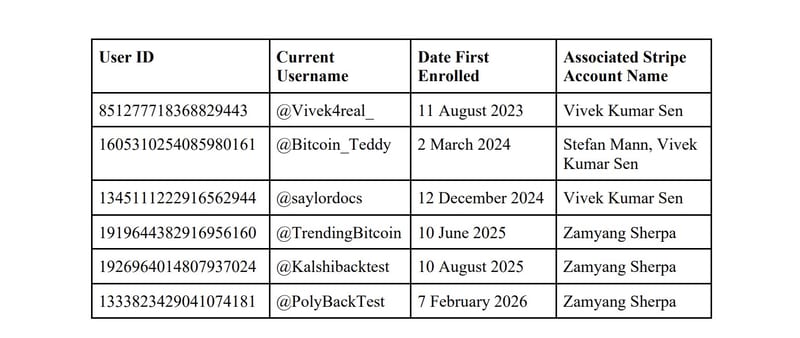
The complaint identifies six principal accounts connected to the two named defendants.
They include:
- @Vivek4real_
- @Bitcoin_Teddy
- @saylordocs
- @TrendingBitcoin
- @Kalshibacktest
- @PolyBackTest
X says Sen was associated with some of the financial accounts linked to @Vivek4real_, @Bitcoin_Teddy and @saylordocs, while Sherpa was associated with financial accounts connected to @TrendingBitcoin, @Kalshibacktest and @PolyBackTest.
The company also alleges that additional accounts were used as part of the scheme, naming handles including @BTC_Vibes, @MrSuperBitcoin and @Laserlump. According to the claim, these accounts repeatedly liked, replied to and reposted material from the defendants' accounts.
One of the more significant parts of the complaint concerns the connections between the accounts.
X claims that the accounts were linked not only through their activity on the platform but also through financial information and technical identifiers.
The company alleges that some of the Stripe payment accounts were registered using names different from the people it says actually controlled the corresponding X accounts.
For example, X says that the Stripe account associated with @Bitcoin_Teddy was registered in the name Stefan Mann, while the bank account connected to it was allegedly held in the name of Vivek Kumar Sen. The complaint also alleges that the email associated with that Stripe account was linked to Sen.
In another example, X says the Stripe and bank accounts associated with @PolyBackTest were registered in Zamyang Sherpa's name, while the email supplied was allegedly linked to Sen.
X further says that the accounts shared technical identifiers, including the same devices, software clients, universally unique identifiers, device tokens and cookies.
According to the company, these connections helped establish that the accounts were not being operated independently as represented.
The complaint sets out specific payments that X says were made to accounts connected to the defendants.
On page 20 of the claim, X lists payments associated with seven account and payment combinations.
The largest individual payment listed is £74,332.44 associated with @Vivek4real_ and paid to Vivek Kumar Sen.
The claim also lists €58,257.48, which X says was equivalent to approximately £50,065, paid to Sen in connection with @Bitcoin_Teddy.
Another payment connected to @Bitcoin_Teddy was listed as 3,916,908 PYG, equivalent at the relevant time to approximately £411.28, paid to Stefan Mann.
Other payments listed include:
- £49,441.91 to Vivek Kumar Sen through @saylordocs
- £22,938.35 to Zamyang Sherpa through @TrendingBitcoin
- £3,490.71 to Sherpa through @Kalshibacktest
- £6,705.25 to Sherpa through @PolyBackTest
Taken together, these are among the transactions X relies on in its claim concerning the manipulation of the Creator Revenue Sharing Programme.
The company's pleaded loss, however, is stated as not less than £207,384 in payments made under the programme.
According to X, the purpose of maintaining several accounts was partly to make the activity more difficult for the platform to stop.
The company says that if one account was suspended or restricted, other accounts in the network could continue generating engagement and payments.
X also says that one of the defendants attempted to expand the operation beyond their own accounts.
The complaint says that through @Vivek4real_, the first defendant sought to provide paid engagement manipulation services to third parties and attempted to acquire additional high follower accounts.
The case is built heavily around X's own platform and monetisation rules. The complaint says X's policies prohibited users from operating multiple accounts to artificially inflate engagement, coordinating likes and reposts, manipulating trending topics, buying or selling accounts and using other methods designed to make an account or its content appear more popular than it genuinely was.
The company's Platform Manipulation and Spam Policy similarly prohibits coordinated activity involving multiple accounts, fake accounts, automation or scripting designed to artificially influence conversations.
It also prohibits purchasing or selling followers and engagements, exchanging engagement and using third party services to inflate account metrics.
The Creator Revenue Sharing terms contained another important provision.
X says creators could lose money and be removed from the programme if the company found that views or engagement had been artificially inflated. The terms also allowed X to suspend payments, adjust future payments, remove users from the programme or recover revenue where it believed a creator had breached the applicable rules.
The Creator Revenue Sharing Programme began around 28 July 2023 and was replaced by X's Original Content Rewards Programme around 7 September 2026, according to the claim. The programme was designed to allow eligible users to earn money from content based on engagement generated by their posts.
Here is the full case