

A young Interior Design student from Thika Business Institute is among students whose path to graduation has been thrown into uncertainty after an attachment at an Affordable Housing project was interrupted.
The students paid an additional KSh60,000 each for the opportunity but were left without proper supervision or meaningful training.
According to the account, the student has spent two years studying Interior Design at Thika Business Institute and was earlier this year sent to an Affordable Housing project for practical training.
What the student encountered at the site has raised questions about whether some young people are actually receiving the practical experience promised under the government's Affordable Housing Internship Programme.
The student this writer that they were required to pay KSh60,000 per student specifically to go for the Affordable Housing internship, separate from the normal school fees.
The bigger concern, according to the complaint, was what happened after the students arrived at the project.
The student said they were not assigned a direct supervisor who could guide them through the practical aspects of Interior Design and construction. Instead, instructions were communicated through a group, with students sometimes being told what task they were expected to perform without being given the training or explanation required to understand the work.
One example given was students being informed that they would be doing skimming, despite some not even knowing what the term meant or how the task was supposed to be carried out.
For a student whose attachment is supposed to bridge the gap between classroom learning and actual construction work, the absence of someone responsible for explaining the work and supervising the students raises a basic question about what exactly they are gaining from the placement.
Hey Cyprian, Hide my ID in case you decide to post about this. Today I interviewed a young man for an internship position at my company. I am in the construction industry, and he has been studying Interior Design at Thika Institute of Business Studies (TIBS) for two years. Earlier this year, he was sent to the government's Affordable Housing project for his mandatory internship. The details he shared left me wondering what kind of country we are running. Before stepping foot on site, each student was forced to part with KSh 60,000 above their regular tuition fees just to secure the attachment. They were completely abandoned on site. Instructions were lazily posted to a WhatsApp group e.g., "Leo mnafanya skimming" with no site supervisor to explain what skimming actually is or guide them through the process. The construction workers went on strike a month ago, bringing everything to a total halt. Their attachment ended right there. Because they can't get their practical credits, their graduation is now frozen. Numerous visits to TIBS management have yielded zero answers or direction. So this Affordable Housing project, touted as a way to empower idle youth, is being used to milk parents of hard-earned cash while offering zero actual training. How do you play with young people's futures like this while raiding taxpayers' wallets? Affordable Housing is a complete scam.
The situation becomes even more complicated because the Affordable Housing Programme itself has been publicly presented as an avenue for young people to gain practical experience. In December 2025, the State Department for Housing and Urban Development said it had recruited more than 5,000 interns for a 12 month programme, describing the initiative as an opportunity for young professionals to move from academic training into practical workplace experience.
The government has also publicly described the programme as a youth employment and skills development initiative, with thousands of graduates from architecture, engineering, quantity surveying and other construction related disciplines attached to consulting firms and housing projects.
More importantly, government procurement documents for Affordable Housing projects state that participating consortia are required to provide internship opportunities and supervise graduates from the relevant disciplines. The documents also require internship reports to be filed with professional associations and registration boards where applicable.
The experience described by the student therefore raises questions about whether the practical training arrangements at the particular site matched the supervision and mentorship structure envisaged under the programme.
The situation worsened when workers at the Affordable Housing project went on strike about a month ago. According to the student, the industrial action brought the attachment to an abrupt end, leaving students unsure about when they would return and whether they would be able to complete the practical component required for graduation.
The student is now said to be among those who cannot complete their academic requirements because the attachment remains unfinished, with no clear date given for when they will resume.
The complainant says students and their colleagues have made numerous visits to the institution seeking answers, but have yet to receive a clear direction on when the attachment will resume or how the students will recover the time lost.
That uncertainty has serious implications for young people whose graduation depends on completing their required practical training. A student can spend years attending classes, pay tuition and additional attachment costs, only to find that an interruption at a project outside their control leaves them unable to complete the final requirements for graduation.
The complaint also comes against the backdrop of recent labour problems at Affordable Housing projects. In August 2026, workers at the Chesumei Affordable Housing Project in Nandi protested over three weeks of unpaid wages, with the dispute leading to demonstrations and temporary disruption of transport in Kapsabet. It also happened in Kakamega.
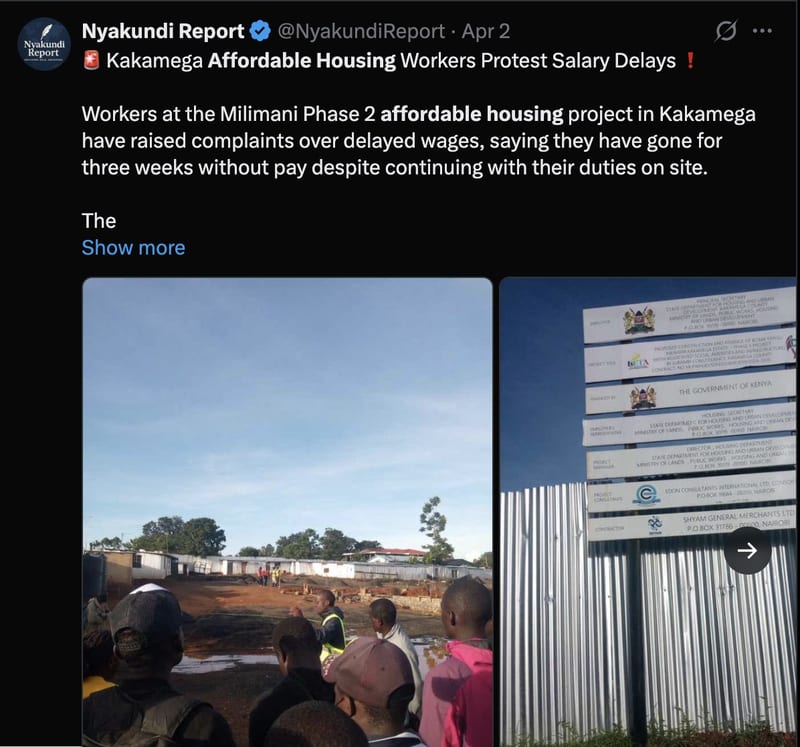
While that dispute involved workers rather than students, it adds another layer to questions surrounding the working environment at some Affordable Housing sites and the ability of projects to maintain continuity for the different groups depending on them.
There is also a sharp contrast between the government's stated purpose of the internship programme and what this particular student says happened on the ground. The programme was introduced as a pathway for young people to gain practical skills, experience construction sites and improve their chances of employment. Government officials have repeatedly described the placement as a bridge between academic training and the workplace.
Yet the student who shared this experience spent money to secure the attachment, arrived at the project without a direct supervisor, received instructions through a group without adequate explanation and ultimately saw the attachment interrupted by a workers' strike, leaving their graduation plans hanging.
How many other students may have paid additional money for attachments connected to Affordable Housing projects, how many are receiving proper supervision, and how many are now waiting without a clear path to completing their academic requirements?