
A major hospital project in Narok has come under fresh scrutiny after Narok Senator Ledama Olekina raised questions over more than Sh1 billion in contracts linked to the construction of a new referral hospital block and mortuary.
According to Senator Ledama more than Sh750 million had already been paid while what remained on the ground was only a shell that later required the military to step in and complete the work using another allocation.
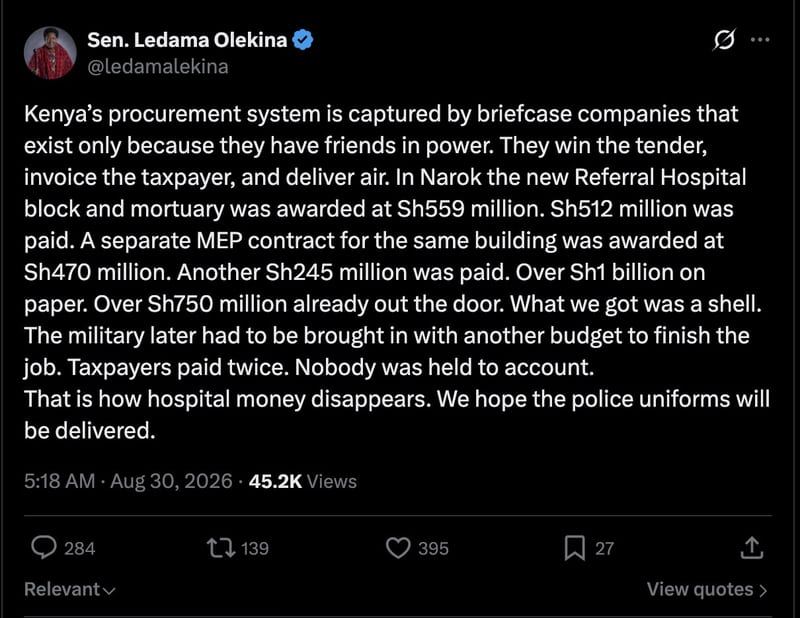
Olekina took to his social media handles a he questioned the capture of Kenya's public procurement system by politically connected companies that win government tenders but fail to deliver projects to the value of money paid.
According to the Senator, the main contract for the Narok hospital block and mortuary was awarded at Sh559 million, out of which Sh512 million was paid to the contractor, while a separate Mechanical, Electrical and Plumbing contract for the same building was awarded at Sh470 million, with another Sh245 million paid.
The two contracts therefore amount to Sh1.029 billion, while the amounts said to have already been paid add up to Sh757 million.
If more than Sh757 million was paid out against contracts worth more than Sh1 billion, what exactly was delivered for that money, who certified the work, who approved the payments and why did the project require another budget and the involvement of the military before it could be completed?
The project was meant to expand the capacity of Narok County Referral Hospital and improve healthcare services for residents. Narok County's own budget documents show that completion of the referral hospital was one of its key health programmes, with the project intended to raise the facility to a Level 5 hospital, increase bed capacity by 400 beds and expand the mortuary from a capacity of nine bodies to 60.
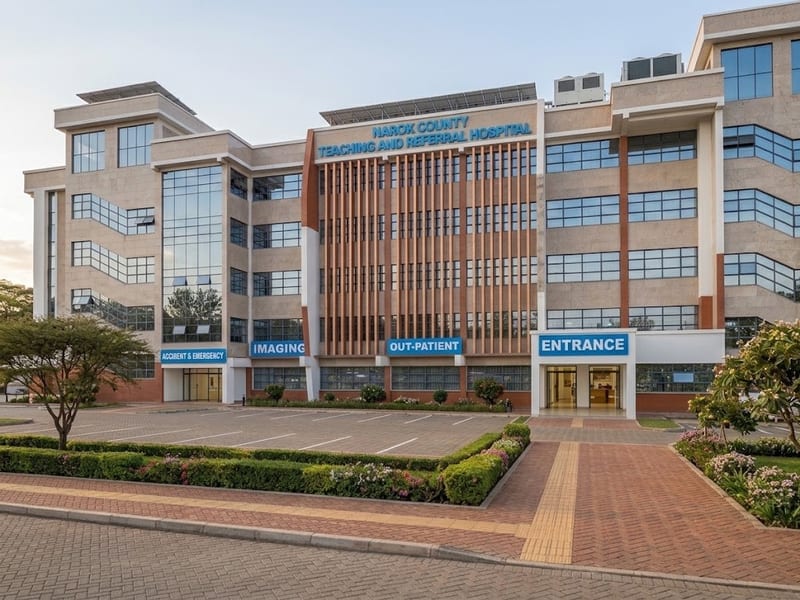
The hospital is currently listed in the national health facilities database as Narok County Referral Hospital, a Level 4 facility with 161 inpatient beds, and the facility is regulated under the Ministry of Health.
This makes the dispute over its construction more than a question of bricks, contractors and payment certificates because any delay or failure to complete the expansion directly affects the county's ability to provide healthcare to a growing population.
Olekina's statement is that the project was left incomplete despite the substantial payments already made, forcing the Government to bring in the military under another budget to complete work that taxpayers had already paid contractors to undertake.
The Senator's own description was blunt, accusing the procurement system of allowing what he called "briefcase companies" to secure lucrative government tenders through connections and then fail to deliver what had been contracted. He said the Narok project showed how public money meant for healthcare could disappear through weak procurement oversight and lack of accountability.
Kenya’s procurement system is captured by briefcase companies that exist only because they have friends in power. They win the tender, invoice the taxpayer, and deliver air. In Narok the new Referral Hospital block and mortuary was awarded at Sh559 million. Sh512 million was paid. A separate MEP contract for the same building was awarded at Sh470 million. Another Sh245 million was paid. Over Sh1 billion on paper. Over Sh750 million already out the door. What we got was a shell. The military later had to be brought in with another budget to finish the job. Taxpayers paid twice. Nobody was held to account. That is how hospital money disappears. We hope the police uniforms will be delivered.- Ledama Tweeted
There is already a wider procurement accountability history surrounding Narok County that makes the latest infor difficult to ignore.
In 2024, Olekina went to court over a county procurement process, and the dispute eventually reached the Court of Appeal in a case involving Tender No. NCG/OT/31/2023 2024. The Court of Appeal dismissed his application for stay in May 2025. The existence of that case shows that procurement processes in the county have previously been the subject of legal challenges and public scrutiny.
The county's own financial records also show the scale of money flowing through Narok's health sector. Its FY2024/25 budget implementation report recorded an approved budget of Sh572.22 million for Narok County Referral Hospital and actual expenditure of Sh429.464 million during the reporting period. The same report showed that the facility had approved SHA claims of Sh74.44 million, of which Sh43.69 million had been disbursed, leaving a balance of about Sh30.75 million at the time covered by the report.
A county can spend hundreds of millions operating a hospital while separately committing more than Sh1 billion to expanding its infrastructure, but if the construction work does not reach completion, patients ultimately remain with the same limited facilities despite the money being spent.
The most important question is therefore not simply how much was contracted. It is what was actually built.
If Sh512 million was paid against a Sh559 million construction contract, the public should be able to see the physical work corresponding to that expenditure. If another Sh245 million was paid against a Sh470 million MEP contract, the county should be able to show the electrical, mechanical and plumbing installations that correspond to the payment.
If the project was incomplete, the county should explain who certified the incomplete works and why those certificates allowed payments to proceed.
If the military was brought in to finish the hospital after contractors had already been paid hundreds of millions of shillings, the public deserves to know how that second intervention was funded and what additional amount was spent.
Narok residents are ultimately the people who have the most to lose from a failed hospital project. The purpose of spending more than Sh1 billion on a referral hospital block and mortuary was not to create another procurement file or another set of payment certificates. It was to provide additional beds, better facilities, improved mortuary services and a stronger referral system for patients who depend on public healthcare.