
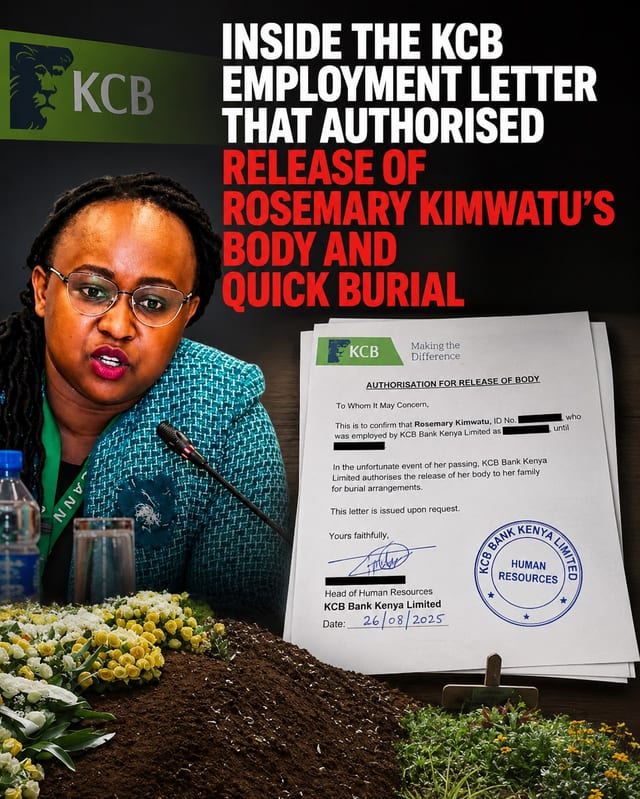
A letter from KCB Kenya authorised the release of the body of the late Rosemary Kimwatu from Lee Funeral Home for burial, amid an ongoing dispute over her next of kin. She was burried yesterday.
According to the letter, KCB’s employment records listed Rosemary’s sister, Judy Koech Oyamo, and her son, Charles Migwe Kimwatu, as her next of kin.
The revelation comes amid a legal dispute involving Rosemary’s husband, Kevin Kimwatu, who had moved to court seeking to stop her burial over the contention surrounding her next of kin details.
Rosemary Koech, the late Head of Data at KCB Kenya, was buried amid a family dispute over her next of kin details and a court order that had been issued to stop her burial.
The burial proceeded despite an order obtained by her husband, Kevin Kimwatu, seeking to halt the ceremony as questions continued to emerge over who should be recognised as Rosemary’s next of kin and who had the authority to make decisions concerning her final arrangements.
According to information surrounding the matter, Kimwatu moved to court and obtained an order stopping the burial. However, the order was reportedly not served on the family in time, allowing preparations for the burial to continue before Rosemary was eventually laid to rest in what has been described as a hurried ceremony.
The dispute has now brought into focus a letter from KCB Kenya authorising the release of Rosemary’s body from Lee Funeral Home for burial.
The contents of the KCB letter have added another layer to the dispute, particularly as the question of who was officially recorded as Rosemary’s next of kin appears to be central to the legal battle involving her husband.
The issue is not merely about who was listed in an employment record, but also about the authority and rights that different family members may claim when decisions have to be made following the death of a person.
Kimwatu’s decision to approach the court indicates that he disputed the circumstances surrounding the planned burial and sought judicial intervention before Rosemary could be laid to rest. The order obtained from the court was therefore intended to temporarily stop the burial while the dispute was addressed.
However, the reported failure to serve the family with the order before the burial has become a significant part of the unfolding events. The circumstances surrounding when the family became aware of the order, whether they had been properly served and what they knew before proceeding with the burial could now become important as the matter continues in court.
The fact that KCB had its own employment records identifying Judy Koech Oyamo and Charles Migwe Kimwatu as Rosemary’s next of kin has also raised questions about the records used to make decisions concerning the release of her body.
It remains important to distinguish between being listed as a next of kin in an employment record and the broader legal question of who has the ultimate authority to make decisions regarding a deceased person’s remains. The two issues may not necessarily be identical, and the court will ultimately have to consider the competing claims and evidence presented by the parties.
Rosemary’s death has therefore been followed by an increasingly complicated dispute involving her husband, members of her family, her employer’s records and the circumstances surrounding the release and burial of her remains.
What should have been a private period of mourning has instead turned into a legal contest over next of kin and the authority to make decisions concerning her final arrangements.
With Rosemary already buried, attention now turns to the legal proceedings, where the competing claims can be examined and the questions surrounding her next of kin, the court order and the circumstances of her burial addressed.
At the heart of the matter remains one question: who had the legal authority to make decisions concerning Rosemary Koech’s burial, and what role did the KCB next of kin records play in that decision?