
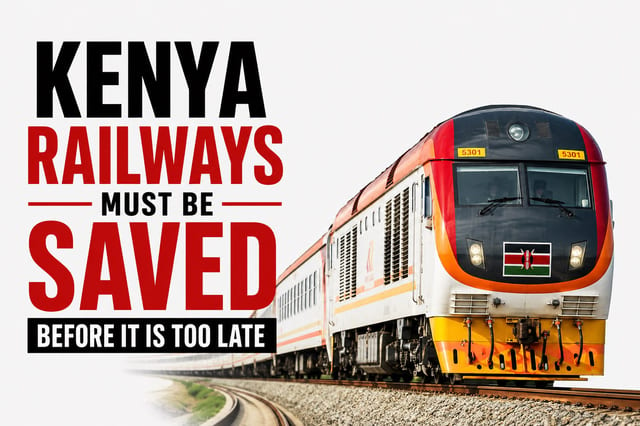
Kenya Railways Corporation and the Standard Gauge Railway are among the country's most important public assets, built with billions of shillings to change the way passengers and cargo move across Kenya and to give the country a modern railway system that can serve generations.
Yet, as the SGR enters a new phase under Kenyan management, questions are increasingly being raised about maintenance, procurement, employee welfare, succession planning, expenditure and the ability of Kenya Railways to keep the railway operating safely and efficiently over the long term.
The concern is not that Kenya should abandon the SGR or return to the old railway system. It is that the country must protect the investment it has already made before maintenance problems, poor management decisions or procurement failures become too expensive to fix.
Kenya has already committed substantial public resources to railway infrastructure, rolling stock, workshops, maintenance and related projects. The 2026 rail transport development budget, for example, includes allocations for SGR locomotive wheelsets, construction of an SGR overhaul workshop, rolling stock and SGR operations and maintenance.
Where is the next generation of railway leaders? 
One of the concerns being raised inside the railway system is the role of younger Kenyan professionals who are now operating and maintaining the SGR. The workforce includes engineers, signalling and communication technicians, ICT specialists, drivers, dispatchers, passenger operations staff and other technical employees who work directly with the systems that keep the railway moving. Many of these employees have spent years gaining practical experience with the SGR and understand its day to day challenges because they work with the equipment and systems every day.
The concern is whether these younger professionals are being given enough room to participate in management and decision making and whether Kenya Railways is deliberately preparing them to take over senior technical and management positions in the years ahead.
Kenya needs experienced railway managers, but experience should not become an excuse for failing to prepare a new generation. A railway built to operate for decades needs a clear succession plan, proper training and opportunities for younger professionals to move into senior positions as they gain experience.
The history of the Meter Gauge Railway should remain a warning. The country cannot afford to invest billions in a modern railway and then allow the skills, equipment and institutional knowledge required to operate it properly to weaken over time. The young Kenyans working on the SGR today should not only be seen as employees who operate the system. They should be part of the people being prepared to run Kenya's railway system in the future.
Questions around human resource management 
Employee welfare is another area that requires attention, particularly as concerns are being raised about contracts, medical cover, career progression, working conditions and management decisions affecting staff.
Kenya Railways appointed a new Head of Human Resources roughly a year ago and that the officer attempted to address concerns around efficiency, wastage and employee welfare before being removed from the position last month.
The bigger concern is that the corporation does not currently have a substantive Head of Human Resources at a time when employees are raising questions about long term contracts, some running for more than a decade, medical cover, career growth and general staff welfare.
A national railway cannot function without the people who drive trains, operate signalling systems, maintain equipment, manage stations, handle passengers and respond when systems fail. Employee welfare is therefore not simply an internal human resources matter. It has a direct connection to the reliability and safety of the railway.
Procurement and subcontracting need scrutiny 
We have information that some contracts have gone to individuals, companies or proxies with political connections.
Kenya Railways has previously faced scrutiny over procurement and commercial arrangements, showing that questions around transparency and value for money are not new to the corporation.
Parliament has previously examined a Kenya Railways land leasing agreement involving Autoports Freight Terminal Limited and reported concerns over transparency, documentation and compliance with procurement and public private partnership requirements.
The Auditor General told Parliament's committee that Kenya Railways had not adhered to relevant legal provisions in entering the agreement, while the committee said the matter would be examined further.
Questions have been raised about projects around Mariakani, Port Reitz and other railway facilities, including yards and related infrastructure, while there are separate issues concerning painting works at stations and passenger platforms and claims that some contracted work may not have been completed despite substantial payments.
Also, There are batteries and other SGR equipment that someone supplied and the equipment were of poor quality and ought to be rejected.
Kenya Railways has already faced audit questions 
The concerns around accountability cannot be dismissed as mere speculation because Kenya Railways has previously appeared in Auditor General and parliamentary reports dealing with financial management, procurement and governance.
The Auditor General's report for the year ended June 2023 is publicly available through Parliament's institutional repository, while a newer Auditor General report for the year ended June 2025 was made available in March 2026.
The Auditor General has also previously raised concerns about Kenya Railways' management of assets and commercial arrangements. An earlier audit report, for example, raised questions about the corporation's policies and records relating to investment property. Parliament has also previously dealt with questions surrounding Kenya Railways land and procurement arrangements.
There is therefore a strong case for Parliament and oversight institutions to examine the current concerns using documents rather than political statements. The question should be simple. Is Kenya Railways getting value for the money being spent on the SGR, and are the systems being maintained well enough to protect the railway for the next several decades?
What happens to the SGR after the management transition? 
The transition toward Kenyan management of SGR operations makes maintenance even more important. A modern railway cannot simply be operated until equipment breaks down and then repaired. Its signalling, communication, power, rolling stock, workshops, generators and other systems require planned maintenance, regular inspections and access to genuine replacement parts.
There are concerns from people familiar with the railway that some backup generators and other critical equipment may be deteriorating, while there are questions about the availability of spare parts and maintenance equipment following the change in the operating arrangement.
The Government's own development plans show that SGR maintenance and equipment remain significant financial priorities. The 2026 rail transport programme includes Sh2.758 billion for acquisition of SGR locomotive wheelsets, Sh2.396 billion for construction of an SGR overhaul workshop and Sh900 million for SGR operations and maintenance.
These are not small amounts, and Kenyans have a legitimate interest in knowing how such money is being spent and whether the equipment and maintenance work being funded are actually reaching the railway.
If backup systems fail, spare parts cannot be obtained and critical equipment is left waiting for repairs, a railway built around modern automated systems could increasingly depend on manual intervention. That would raise obvious questions about reliability, efficiency and safety.
Employees are increasingly concerned 
There are further reports of frustration among some operational employees, including drivers, signalling and communication technicians, dispatchers and passenger operations staff.
We have Intel that It some workers are considering industrial action over concerns about management, wastage, spare parts, employee welfare and the future direction of Kenya Railways.
Employees who operate the railway are in a position to see problems that may not be visible from management offices. If workers are repeatedly raising concerns about equipment, staffing, contracts or maintenance, management should have a clear system for receiving those complaints and acting on them.
The workers are not necessarily asking for the railway to fail. Many of them have spent years building their careers around the SGR and have a direct interest in seeing it succeed. A driver wants reliable locomotives. A signalling technician needs functioning equipment. A maintenance engineer needs genuine spare parts. A passenger operations officer needs a reliable system that can serve travellers without unnecessary disruption.
This is why employee complaints should be treated as an early warning system rather than simply a management problem. When experienced technical employees raise concerns about the condition of equipment or the direction of an institution, the first response should be to establish whether the concerns are supported by evidence and then act where action is required.
The SGR must not become another Meter Gauge story 
The bigger concern is what happens if Kenya fails to protect the SGR while it is still relatively young. The country has already seen what happens when railway infrastructure is allowed to deteriorate over a long period. The SGR was built partly to address weaknesses associated with the old railway network, increase capacity and provide a modern alternative for passenger and cargo transport.
Kenya now has an opportunity to avoid repeating the same cycle. That means maintaining the railway properly, buying the right equipment, keeping adequate stocks of genuine spare parts, investing in technical skills, protecting employees, strengthening internal controls and making sure procurement decisions are based on value for money.
The Auditor General's reports provide an existing accountability mechanism that Parliament can use to examine Kenya Railways' finances and management. The corporation's latest audit report for the year ended June 2025 is already available through Parliament's repository. The Auditor General should be given the space to follow specific complaints through the records, while Parliament's relevant committees can demand explanations where audit findings or whistleblower complaints point to possible waste or irregularities.
The Ethics and Anti Corruption Commission should equally examine any specific allegations involving corruption, conflicts of interest or improper influence where credible evidence is presented. The Public Procurement Regulatory Authority can examine procurement issues within its mandate, while the relevant labour authorities should deal with employee complaints and industrial relations matters.
Five years from now, what will the SGR look like? 
That is the question Kenya should be asking now, while there is still time to correct problems rather than waiting for failures to become obvious to passengers and businesses. Will Kenya have a modern railway with properly maintained equipment, a strong technical workforce, clear succession planning and transparent procurement, or will the country slowly find itself dealing with ageing equipment, rising maintenance costs, frustrated employees and systems that increasingly depend on temporary fixes?
The answer will depend on decisions being made now.
Kenya Railways should publish clear information on major SGR maintenance projects, procurement contracts, equipment replacement programmes and the progress of the overhaul workshop.
Parliament should demand accountability for significant expenditure, while the Auditor General should continue following the money and checking whether the corporation is receiving value for what it pays.
The Ministry of Roads and Transport also has a responsibility to explain how it is supervising the corporation and protecting the long term interests of the railway. Kenya Railways is a state corporation, and the SGR is a national asset. Its future cannot depend entirely on individual managers or changing political interests.
The young Kenyans working on the SGR today should be given a genuine path into senior technical and management positions, while experienced railway professionals should be allowed to transfer their knowledge to the next generation. Employee welfare should be taken seriously, because a railway is only as strong as the people responsible for keeping it running safely.
Kenya does not need to wait for a major breakdown, procurement scandal or mass staff departure before asking these questions. The country should examine the railway while it still has the opportunity to correct weaknesses at a manageable cost.
Kenya Railways does not belong to politicians, contractors or individual managers. It is a national institution built with public resources, and the SGR represents a major investment by the Kenyan people. The Government, Parliament, the Auditor General, EACC, procurement oversight bodies, labour authorities and Kenya Railways management should now give the public clear answers on maintenance, procurement, expenditure, employee welfare and succession planning.
The goal should not be to attack Kenya Railways. The goal should be to protect it.
If there are no problems, an independent review should establish that clearly. If there are weaknesses, they should be corrected. If public money has been wasted, those responsible should answer for it. If employees have legitimate grievances, they should be heard. And if young Kenyan railway professionals are ready to take greater responsibility, they should be given the opportunity.
The SGR was built to serve Kenya for decades. The country must make sure it is still capable of doing so long after today's managers and politicians have left office