
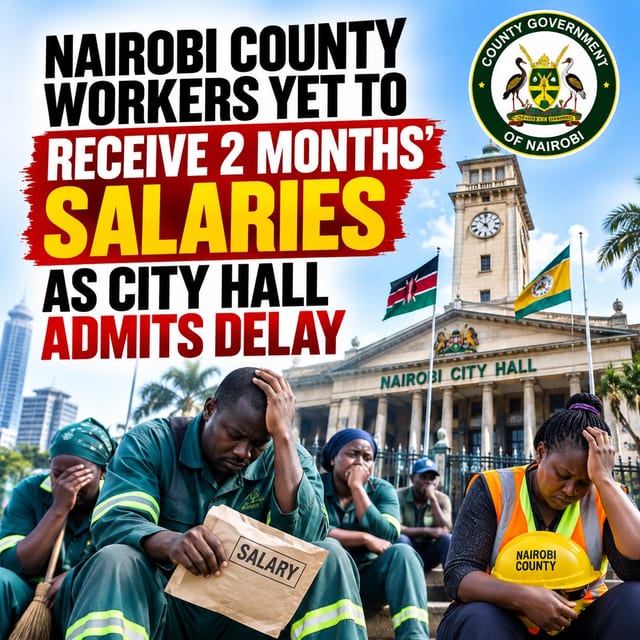
Nairobi City County has admitted that its employees are yet to receive their July 2026 salaries, with a circular dated August 10, 2026 attributing the delay to problems surrounding the approval and uploading of the County Budget.
The admission should worry every Nairobi resident.
County workers are not just people sitting behind desks at City Hall waiting for payday. They are the people expected to keep the capital running every day.
They are involved in garbage collection, health services, roads, water, enforcement, revenue collection, public markets, social services and other functions that directly affect millions of Nairobi residents.
So the obvious question is:
If Nairobi County cannot pay its own workers on time, how does it expect those workers to keep delivering services to Nairobians?
The circular from the Office of the Governor, signed by Acting County Secretary and Head of County Public Service Godfrey Akumali, says the delay was caused by the delay in approval and uploading of the County Budget, which has affected the processing and release of funds.
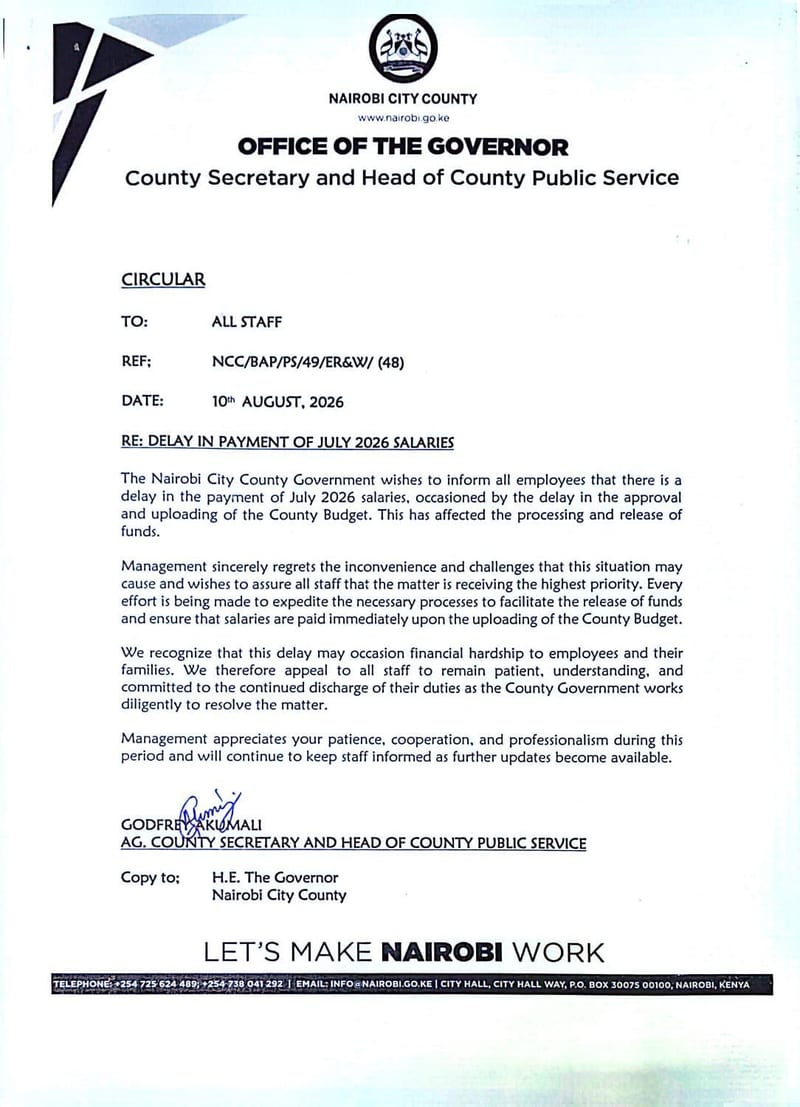
The county says the matter is receiving the "highest priority" and promises that salaries will be paid immediately once the budget is uploaded.
But for workers who have already worked through the entire month, an explanation does not pay rent.
It does not clear a school fee balance.
It does not settle a bank loan.
It does not put food on the table.
And it certainly does not stop a landlord from demanding rent.
The bigger problem is Nairobi's services 
Nairobi residents should not look at this as an employee welfare issue alone.
It is a service delivery issue.
If garbage collection workers are financially strained, who collects garbage?
If health workers are not paid, who treats patients at county health facilities?
If engineers and technical staff are affected, who supervises road works and repairs?
If water department employees are affected, who responds to broken infrastructure and water supply problems?
If enforcement officers are struggling, how does the county maintain order in markets and public spaces?
If revenue officers are demoralised, how does Nairobi maintain its own source revenue?
And if county employees are worried about their own salaries, how much attention can the administration realistically expect them to give to demanding public service?
This is why salary delays at City Hall should concern every Nairobi resident.
This has happened before 
This is not the first time Nairobi County workers have faced salary delays.
In September 2025, Nairobi County workers were reportedly still waiting for their July and August salaries. The Kenya County Government Workers Union warned that employees were struggling financially and directed some workers to slow down their duties or remain at home until their salaries were paid.
The situation quickly became a service delivery problem.
Reports at the time warned of garbage piling up in parts of Nairobi and other county services facing disruption as workers struggled to report to work without their salaries. The Star reported that the county's wage bill had reached about KSh17 billion, amid concerns over the expansion of the payroll.
That history makes the latest circular more worrying.
Nairobi cannot keep repeating the same cycle of delayed salaries, worker frustration, threats of industrial action and then emergency intervention.
Health services have already felt the consequences 
Nairobi's health workers have previously been among the most vocal victims of salary delays.
In October 2025, county health workers protested after reportedly going for three months without salaries. They warned that the delays could paralyse operations in public health facilities. The county said it had paid two months' salaries and promised to clear the remaining arrears.
Earlier in January 2026, Nairobi health unions again raised concerns over delayed salaries and unresolved employment issues, accusing the county administration of failing to honour agreements reached with workers.
That should serve as a warning.
When county workers are not paid, the consequences eventually reach patients.
A nurse cannot pay rent with a promise from City Hall.
A clinical officer cannot buy food with a circular.
A garbage collector cannot feed their children with assurances that money will come "immediately" after a budget process is completed.
Roads and infrastructure are another concern 
Nairobi is already dealing with major infrastructure needs.
The county itself acknowledged in January 2026 that several KISIP infrastructure projects were badly behind schedule. One project lot had reportedly reached only 27.3 percent completion against a 98 percent target, while another phase had recorded just 1.5 percent progress. The county warned contractors and demanded action, including payment of salary arrears owed to workers at some project sites.
This is important because Nairobi residents depend on a chain of people to deliver infrastructure.
Engineers need to supervise.
Inspectors need to inspect.
Procurement officers need to process.
Finance officers need to make payments.
Contract managers need to monitor progress.
If the people responsible for these functions are demoralised or financially distressed, the impact does not stop at City Hall.
It eventually appears on the road outside your house.
Then comes the garbage question 
Nairobi's garbage problem has been one of the clearest examples of how administrative failures can quickly become a public crisis.
When garbage collection workers stop working, waste does not disappear.
It piles up in estates.
It blocks drainage.
It ends up in rivers.
It creates public health concerns.
And Nairobians are the ones left living with the consequences.
This is why the phrase "For garbage to end in Nairobi, garbage must leave office" carries a bigger message.
The county needs to clean up its own administration before it can effectively clean up the city.
There is little point talking about a clean Nairobi while the institution responsible for cleaning it cannot maintain basic financial stability.
What is happening to Nairobi's money? 
The latest circular says the delay is connected to the approval and uploading of the County Budget.
That explanation needs to be followed by transparency.
Nairobi residents deserve to know why the budget process has affected salary payments.
When was the budget approved?
When was it uploaded?
Which funds are currently available?
How much money does Nairobi collect every month?
How much goes to salaries?
How much goes to development?
How much goes to recurrent expenditure?
And why does a budget process have to leave thousands of workers waiting for their salaries?
These are reasonable questions for a county government that manages public money.
The county should not only tell workers to remain patient.
It should tell Nairobi residents what went wrong and what is being done to prevent another salary crisis next month.
Sakaja's administration needs to answer 
Governor Johnson Sakaja cannot treat this as a small administrative inconvenience.
He is ultimately responsible for the political leadership of Nairobi County.
The circular itself is copied to the Governor.
That means the issue is sitting squarely on the administration's desk.
Nairobians elected leaders to provide services, manage public resources and make sure the county government functions.
Workers should be paid.
Hospitals should function.
Garbage should be collected.
Roads should be maintained.
Water services should work.
Bursary programmes should reach deserving families.
And county offices should actually deliver services instead of becoming places where residents are told to wait because something has not been uploaded, approved or processed.
The county administration needs to fix the financial and administrative problems behind these delays before the crisis moves from City Hall payrolls to Nairobi streets.
Because when the people running the city cannot get paid, the question is no longer just "When will workers receive their salaries?"
The real question is:
"How long before Nairobians start paying the price through broken services?"
And if City Hall wants Nairobi to become cleaner, more efficient and better managed, it should start with itself.
For garbage to leave Nairobi, garbage must first leave the office