
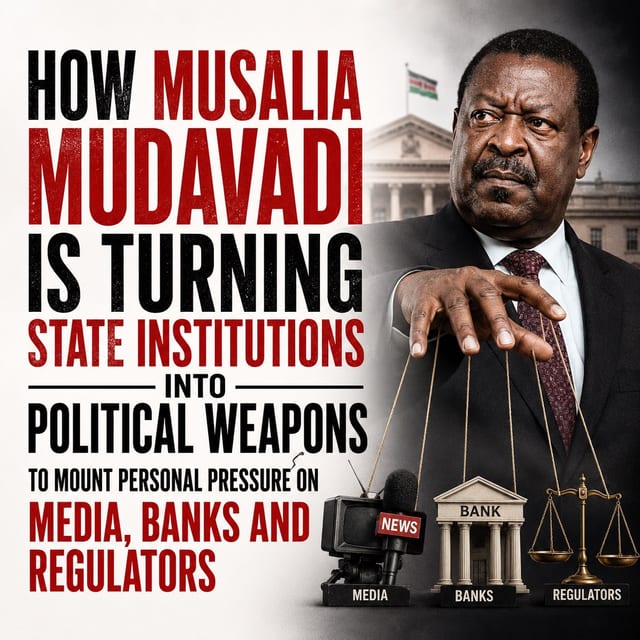
A disturbing question is beginning to emerge around Prime Cabinet Secretary Musalia Mudavadi: how far can a powerful government official go in using state institutions against people, companies and media platforms that stand in his way?
The question is not coming out of nowhere.
There are now separate complaints and controversies involving the Communications Authority of Kenya (CA), media freedom, the handling of corporate disputes and alleged pressure on institutions that are supposed to operate independently from political interests.
No evidence publicly available to me establishes that Mudavadi personally ordered any of these actions. But the allegations are serious enough to demand answers, particularly where state institutions appear to be involved.
And that is where the Communications Authority comes in.
The CA officially lists David Mugonyi as its Director General and Chief Executive Officer, while Dr Vincent Ngundi is listed as Director of Cyber Security. (Government of Kenya)
Mugonyi is not an unknown figure in government circles. Before taking over at the CA in January 2024, he spent more than a decade in government strategic communications and previously headed the Presidential Communications Service. (Government of Kenya)
That background makes the question of the Authority's independence even more important.
Why is the CA being accused of going after journalism? 
Recently, Cyprian Nyakundi accused the Communications Authority of attempting to pull down articles published on Nyakundi Report.
The allegation is explosive because it raises a fundamental question about the role of a communications regulator.
https://x.com/C_NyaKundiH/status/2086689286682804473?s=20
If an article is defamatory, false or unlawful, there are courts and established legal processes through which the person or institution affected can seek redress.
The regulator should not quietly become the judge, jury and executioner of journalism.
This is precisely why the CA needs to explain whether it has issued, directly or indirectly, any instructions to technical or cybersecurity officers to interfere with the publication or availability of journalistic content.
If such instructions were issued, who authorised them?
What law was relied upon?
What specific article allegedly violated the law?
Was the publisher given an opportunity to respond?
Was a court order obtained?
And perhaps the biggest question:
Who gave technical cybersecurity officers the power to decide that journalism violates Kenyan law before a judge has heard the matter?
These questions cannot simply be brushed aside as a disagreement between a blogger and a regulator.
They go directly to the constitutional protection of freedom of expression and freedom of the media.
Kenya has already seen what happens when the CA moves aggressively against broadcasters.
On June 25, 2025, the Authority issued a directive requiring television and radio stations to stop live coverage of the nationwide protests. The directive was signed by David Mugonyi and threatened regulatory action against broadcasters that failed to comply. (Nyakundi Report)
That episode triggered a major debate about whether a communications regulator was being used to control information during a politically sensitive moment.
The issue was not whether the government had security concerns.
The issue was whether those concerns could justify restricting media coverage without crossing constitutional boundaries.
That distinction matters.
There is already a legal route for taking down unlawful content 
Kenya's courts have previously dealt with cases involving Cyprian Nyakundi and disputed publications.
In 2018, the High Court dealt with an application involving Nyakundi after a politician and his wife complained about allegedly defamatory publications. The court issued orders restraining publication of the disputed material.
That case demonstrates something important.
If somebody believes a journalist or blogger has published unlawful material, there is a court process available.
You go to court.
You present your evidence.
The journalist gets an opportunity to respond.
A judge makes a determination.
That is how a constitutional democracy is supposed to work.
The danger comes when administrative agencies start performing functions that belong to courts.
Now connect this to Mudavadi 
This is where the allegations surrounding Mudavadi become uncomfortable.
The claim being made by critics is that the Prime Cabinet Secretary has political influence over officials and institutions and that people perceived to be standing in his way can face pressure through state machinery.
Again, this is an allegation, not an established fact.
But the public deserves answers about the relationship between political offices and supposedly independent institutions.
The CA itself describes its regulatory role as covering communications, broadcasting, cybersecurity and related sectors. Its management structure includes separate departments dealing with legal services, cybersecurity, broadcasting and other functions.
That makes the institution enormously powerful.
A regulator with control over broadcasting and communications infrastructure can affect whether Kenyans receive information, whether broadcasters operate normally and whether digital platforms remain accessible.
That power must be exercised carefully.
It cannot become a tool for settling political scores.
The First Assurance saga raises another uncomfortable question 
Another controversy cited by critics concerns the dispute involving First Assurance and the banks that held its funds.
Nyakundi recently wrote that The Mudavadi ultimatum: Three banks, 24 hours and the full force of the state machinery
He alleged that Mudavadi and other shareholders had given the banks a 24 hour deadline to commit to refunding money prosecutors said had been stolen from First Assurance.
The banks reportedly refused, questioning how funds could allegedly be stolen over a six year period by an insider before the banks were later expected to refund the entire amount.
The banking sector is now watching the matter closely.
The important question is not whether the banks should be held accountable if they broke the law.
They should.
The question is whether criminal prosecution is being used fairly and consistently, or whether state agencies can be pressured into pursuing corporate executives after they refuse to accept a political demand.
The public needs the court record, the prosecution documents and the evidence before making a final judgment.
But the allegation is serious enough to warrant scrutiny.
Then there is the alleged K24 shutdown 
Another claim making the rounds concerns K24 TV and its alleged interruption around coverage of a western Kenya tour involving Senator Edwin Sifuna.
There have been claims that the station was taken offline to prevent live coverage of the tour, with commentator Joakim Simiyu reportedly linking the incident to what he described as Luhya political bitterness.
I have not found sufficient independent evidence to establish that the alleged shutdown was ordered by Mudavadi or that it was specifically intended to stop coverage of Sifuna's tour.
That distinction matters.
But if a broadcaster was deliberately taken off air because of the political content it intended to broadcast, that would raise serious questions about media freedom.
And if such an action involved a state regulator, Kenyans deserve to know who authorised it and under what law.
The CA has already faced questions over political influence 
There is another issue that should not be ignored.
Freedom House has previously raised concerns about public confidence in the CA's independence, noting that David Mugonyi previously headed the Presidential Communication Service before becoming CA Director General.
That does not prove that Mugonyi takes political instructions.
It does, however, explain why allegations involving political interference at the Authority attract such intense public interest.
When a senior government communications official moves into the leadership of a regulator with enormous influence over broadcasting and communications, the institution has an even greater responsibility to demonstrate independence.
This is bigger than Nyakundi 
The mistake would be to reduce this to a personal fight between Mudavadi and Nyakundi.
It is bigger than both men.
Today it could be a blogger.
Tomorrow it could be a television station.
The next day it could be a newspaper.
After that it could be a bank CEO who refuses to comply with a politically connected demand.
Once state machinery becomes an instrument for silencing people who challenge those in power, nobody is safe.
That is why the question surrounding Mudavadi needs to be answered publicly.
Does he have any role in directing or influencing actions taken by the Communications Authority against journalists, bloggers or media organisations?
If the answer is no, then the CA should say so clearly.
If the answer is no, David Mugonyi should explain the legal basis for any attempt to restrict journalistic content.
If cybersecurity officers have been involved, Dr Vincent Ngundi should explain what mandate they were acting under.
And if there are court orders, they should be produced.
Where is the court order?
Where is the legal determination?
Where is the specific provision of Kenyan law that gives the CA power to decide that a published article is unlawful and have it removed without first obtaining a judicial determination?
These are not unreasonable questions.
They are the questions any regulator exercising extraordinary power should be prepared to answer.
Three institutions, one recurring problem 
The pattern should concern Kenyans.
The Communications Authority has previously issued controversial directives affecting live media coverage. (Nyakundi Report)
The banking sector is now caught up in a high stakes dispute involving First Assurance, with questions around the prosecution of senior executives and the role of government agencies.
And journalists and bloggers continue to face legal battles over publications, with courts already demonstrating that there are established mechanisms for dealing with allegedly defamatory material. (The Standard)
The common thread is the use of institutions with enormous coercive or regulatory power.
That is why political leaders must be kept away from operational decisions in independent institutions.
Mudavadi may deny having anything to do with the alleged actions.
Fine.
Then let the institutions involved prove their independence.
Let the CA publish the legal basis for every action taken against the media.
Let investigators publish the evidence behind prosecutions.
Let courts decide disputed publications.
Let regulators regulate.
Let journalists report.
And let politicians remain politicians.
Because if the state can be mobilised against a journalist simply because his reporting is uncomfortable, then the problem is no longer about Cyprian Nyakundi.
It becomes about whether Kenya's institutions still belong to the public or to the people who temporarily occupy powerful offices.