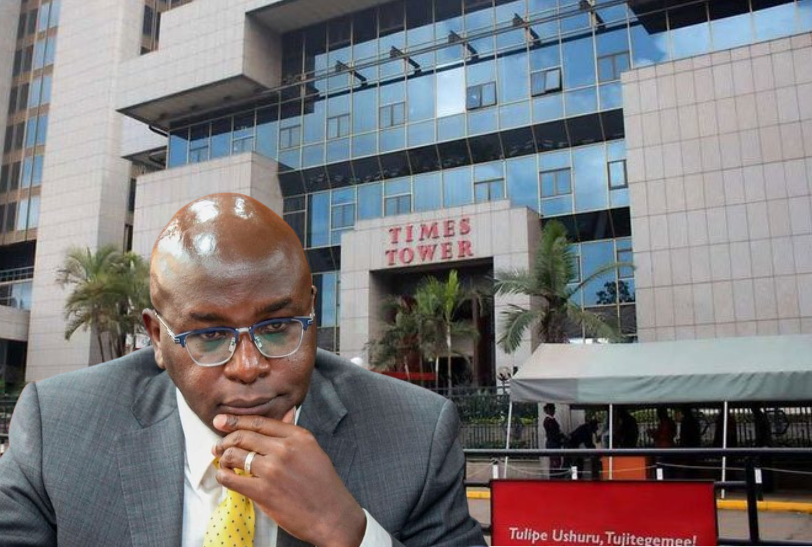
 Former KRA CG Humphrey Wattanga
Former KRA Commissioner General Humphrey Wattanga did not lose his job because of one issue alone. His fall was the result of a dangerous pile-up of problems that became too heavy to contain. By the time he exited, he was facing pressure over revenue collection, growing hostility from within the board, political isolation in a system that values usefulness above loyalty, and, hanging over all of it, a Tecno tax evasion scandal that had grown too big and too embarrassing to ignore. What may have started as murmurs about performance and internal dissatisfaction eventually hardened into a broader view within power circles that Wattanga had become more of a burden than an asset.
The Nyakundi Report has verified that the Tecno affair was one of the issues that badly damaged Wattanga’s standing at the Kenya Revenue Authority. It was around April 2024 when troubling whispers from inside the Nairobi offices of Tecno Transsion Electronics (Pvt) Ltd began spilling out. At first, the complaints sounded like the kind of internal grievances that troubled companies often try to bury: workers murmuring about unfair treatment, unexplained deductions, foreign staff operating with unusual privilege, and managers who behaved as though no authority in Kenya could seriously touch them. But as more insiders came forward, a darker and much more explosive picture began to emerge. What had initially looked like workplace discontent increasingly took the shape of a major corporate scandal involving alleged tax evasion, labour abuse, suspicious cash dealings, and a pattern of impunity inside one of the most visible phone empires in Kenya.
As the complaints multiplied, KRA began paying closer attention. The allegations were no longer merely about office politics or unhappy employees. They pointed to a company that was allegedly deducting PAYE from employees while failing to remit it, handling parts of its payroll in ways designed to avoid a proper paper trail, and concealing supplier transactions and operational costs in a manner that significantly reduced its tax exposure. For a company whose brands — Tecno, Infinix, and itel — dominate the Kenyan market through shops, kiosks, resellers, and distributors in every corner of the country, the scale of the accusations was staggering. This was not a backstreet operator hiding a few coins. This was a major multinational player extracting vast value from the Kenyan market while insiders alleged that the government was not getting what it was owed.
The matter escalated in May 2024, when KRA agents carried out a dramatic raid at Tecno’s offices in Cardinal Otunga Plaza, Nairobi. According to insiders, that operation immediately raised hopes among whistleblowers who had long felt ignored, threatened, and frustrated by the company’s apparent confidence that nothing would ever happen to it. During the raid, agents reportedly recovered a large cache of internal documents said to contain details of undisclosed salary payments, unreported supplier dealings, questionable financial records, and transaction patterns that had never been transparently disclosed. There were also claims that large sums of cash in both local and foreign currency were seized, adding to suspicions that some payments had deliberately been kept outside the formal banking system in order to frustrate traceability and weaken tax enforcement. For the whistleblowers, it looked like the beginning of accountability. For the first time, they believed the authorities had enough material in hand to expose the full scale of the scheme.
 Tecno Kenya
Those who had come forward had taken enormous personal risks. Many had already leaked information to journalists, bloggers, and watchdog figures in the hope that public scrutiny would force the State to act. Some spoke of salaries paid in cash, deductions taken from workers that never seemed to reach the taxman, and a culture in which criticism of management was met not with correction but retaliation. Others described an internal environment marked by racial abuse, blocked promotions, open discrimination against Kenyan workers, and the alleged presence of foreign staff operating without proper work permits or immigration clearance. According to repeated accounts from inside the company, mainly Asian expatriate staff wielded sweeping, unchecked power over local employees while appearing insulated from the accountability that binds ordinary Kenyans. By the time KRA entered Cardinal Otunga Plaza, there was already a deep feeling among insiders that Tecno was not simply a harsh workplace, but a company operating with the confidence of an institution that believed it was protected from consequences.
That is why what happened next became so politically toxic. After the raid, the public expected movement. At one point, Wattanga indicated that Tecno was under investigation. But after that, the matter went quiet. The noise faded, the urgency disappeared, and the country was never given a convincing explanation of what became of a case that had all the signs of a major tax enforcement file. The silence transformed the Tecno issue from a tax question into a leadership question. Up to today, Tecno continues to operate under serious tax evasion questions, with no clear public closure from the very agency that was supposed to take the matter to its logical conclusion. That is the point at which the scandal stopped being only about Tecno and started becoming about Wattanga himself.
The scandal became even more dangerous because of claims that a KSh200 million bribe was used to compromise the process. Once such an allegation enters a case of this magnitude, the entire issue changes character. It stops being an ordinary dispute over duty payments and payroll compliance and becomes an institutional corruption scandal. It creates the impression that KRA is ruthless with small traders, employees, and struggling citizens, but suddenly hesitant when dealing with a powerful foreign-linked corporation with money, lawyers, and access. That perception is devastating for any Commissioner General. A tax boss can survive complaints and political noise, but he cannot easily survive the belief that under his watch a giant taxpayer evaded billions and then escaped accountability because the system was bought.
What made the matter worse is that insiders insist the core issues never ended. Reports from within the company continue to suggest that the very practices that triggered the whistleblowing campaign remain alive. Employees still complain of deductions that do not seem to translate into proper remittances, opaque financial processes, and an internal power structure in which managers and favored expatriate staff continue to operate above the rules that bind ordinary Kenyan workers. If those reports are true, then the May 2024 raid was not the end of the scandal. It was merely the moment when Kenya briefly saw the smoke before powerful interests moved to smother the fire. The claim that Tecno may have evaded up to KSh400 billion over time is an allegation of extraordinary scale. Nearly half a trillion shillings is not a bookkeeping oversight. It is the kind of figure that forces people to ask whether institutions are asleep, captured, or compromised.
But the Tecno file alone did not bring Wattanga down. By the time he was pushed out, he was already under intense pressure over KRA’s revenue performance and growing discontent inside the board. In an economy where the State is desperate for every shilling, weak collection figures are never treated as a technical issue alone. They become political. Questions had begun building around whether KRA was collecting enough, whether enforcement was being applied with sufficient force, and whether the institution had become too weak or too compromised to close major leakages. In that environment, any sign that a serious multi-billion-dollar tax evasion file had gone cold was always going to be used against the man at the top. Revenue pressure gave his critics one weapon. Tecno gave them another.
The board factor made the danger worse. Once a board loses confidence in a chief executive, every weakness becomes magnified. Revenue shortfalls stop looking like economic headwinds and start looking like leadership failure. A stalled investigation stops resembling a delay and begins to look like a compromise. Silence itself starts to carry the smell of guilt. In Wattanga’s case, the board and those around power had enough material to paint the picture of a man who was no longer in full control of the institution he headed. Whether that picture was entirely fair became irrelevant. In real power struggles, perception can be more lethal than proof.
Then there was the politics. Wattanga was widely seen as a man fronted by Moses Wetang’ula for the KRA job. But in Kenya, being pushed into office by a patron is only half the battle. Staying there requires a different skill altogether. Reports indicate that Wattanga was viewed in political circles as someone who was not a “streets guy.” In plain language, he was not seen as the kind of operator who knew how to collect money from different corners, distribute it strategically, and keep multiple political interests satisfied. There are also reports that he was accused of feeding only Wetang’ula’s side, a dangerous mistake in a system where survival often depends on servicing several centres of power rather than one camp. Whether fair or unfair, that perception made him weak. Once powerful actors begin to see you as rigid, selective, or no longer useful, your political protection starts evaporating.
The wider climate inside government also made his position harder to defend. There was already rising public scrutiny over economic management, tax collection, and corruption-linked scandals across key institutions. Even outside KRA, officials seen as liabilities were beginning to fall. The resignation of Energy Ministry Deputy Director Joseph Wafula on 5 April 2026 amid a probe into the artificial fuel shortage deal added to the sense inside government that some files had become too hot and some names too costly to carry as the rift between Ruto and Wetangula widens. In that atmosphere, Wattanga was unlikely to enjoy long-term protection. By then, he was carrying too many problems at once..... poor revenue optics, loss of board confidence, political weakness, and a Tecno scandal that made KRA look either compromised or afraid and worse of it all, a Wetangula man label.
Reading is free. Sign in to comment.