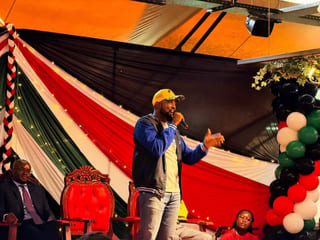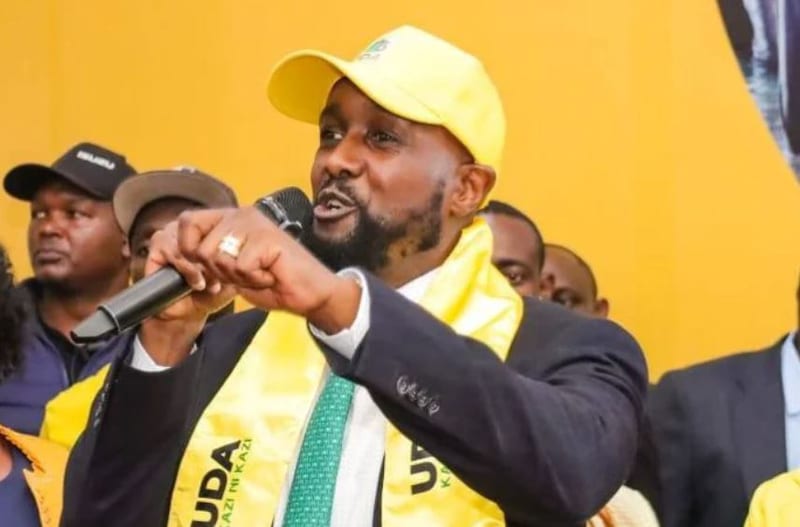
Kasarani Member of Parliament Ronald Karauri has launched a blistering response to former Deputy President Rigathi Gachagua after the Democracy for the Citizens Party (DCP) leader questioned his entry into the Nairobi gubernatorial race ahead of the 2027 General Election.
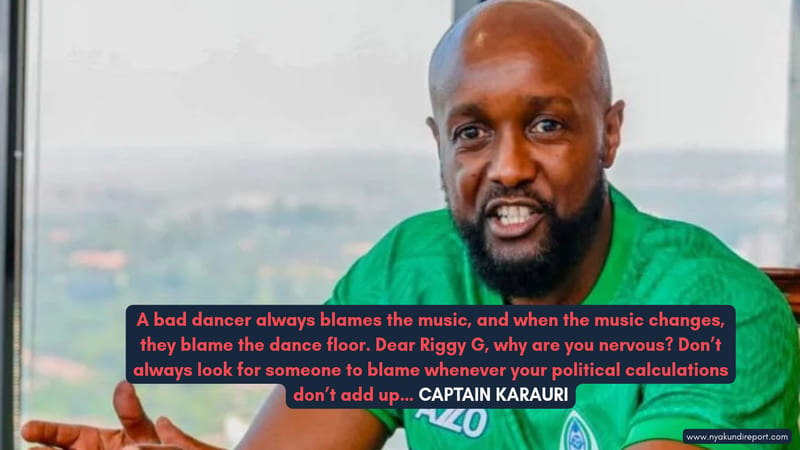
In a strongly worded statement on Monday, November 16, 2026, Karauri accused Gachagua of blaming other politicians whenever his political calculations fail, insisting that Nairobi residents were capable of independently deciding who should lead the county.
The MP also dismissed suggestions that his gubernatorial ambitions were part of a political scheme to divide the Mount Kenya voting bloc in Nairobi, challenging Gachagua to stop treating the community's votes as the property of individual political leaders.
“A bad dancer always blames the music, and when the music changes, they blame the dance floor. Dear Riggy G, why are you nervous? Don’t always look for someone to blame whenever your political calculations don’t add up,” Karauri said.
He further maintained that Nairobi voters were not political followers waiting for instructions from influential politicians, declaring that residents would determine their preferred candidate based on leadership and service delivery.
“Nairobi voters are not sheep waiting to be herded by whoever shouts the loudest. They are intelligent people who understand their city, their problems and the kind of leadership they deserve. They will decide who represents them, and as far as I am concerned, Nairobi has already found its Captain,” he added.
The remarks marked a direct confrontation with Gachagua, whose political strategy in Nairobi increasingly revolves around consolidating support among voters from the Mount Kenya region.
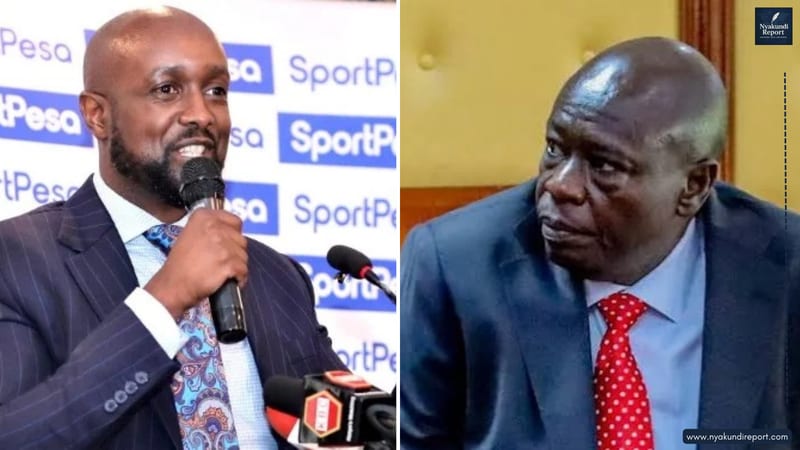
Gachagua Accuses Karauri of Dividing Mount Kenya Votes 
Karauri's response followed remarks made by Gachagua while addressing DCP Nairobi aspirants on Monday, November 16, 2026.
The former Deputy President claimed that Karauri's entry into the gubernatorial contest was intended to divide votes from the Mount Kenya community, potentially weakening the electoral prospects of candidates associated with his political camp.
“Karauri ameletwa agawe kura ya Mlima,” Gachagua said, suggesting that the Kasarani MP was being used to split a voting bloc that DCP hopes to consolidate ahead of the 2027 elections.
Gachagua also made a controversial claim about Karauri's campaign engagements, suggesting that the MP should be charged Ksh5,000 whenever he addresses residents at political meetings.
“Na huyu Karauri awekewe bei, kila mkutano kuongea na watu ni ngiri tano,” he added.
The remarks exposed the growing tensions surrounding the Nairobi governor contest, particularly over who has the political authority to determine candidates and negotiate support among different communities.
Gachagua has repeatedly positioned himself as a key political voice for the Mount Kenya region and is seeking to translate that influence into electoral victories for DCP candidates in Nairobi.
However, Karauri's response raises a difficult question for the former Deputy President. Can a political leader claim ownership of an entire community's voting decisions while expecting other aspirants to abandon their ambitions?
Karauri's UDA Move Complicates Gachagua's Nairobi Calculations 
Karauri declared his interest in the Nairobi gubernatorial seat in February 2026, arguing that the capital needed different leadership to address persistent challenges affecting service delivery and county management.
The MP, a former pilot and businessman associated with SportPesa, has presented his professional and business experience as part of his case for taking over City Hall from Governor Johnson Sakaja.
Elected Kasarani MP in 2022 as an independent candidate after failing to secure the Jubilee Party ticket, Karauri has demonstrated that he is willing to pursue political office outside established party structures.
His political positioning has since changed, particularly following his decision to abandon ODM and join the ruling United Democratic Alliance (UDA) in November 2026.
He was formally received at UDA headquarters on November 9 by senior party officials, including National Assembly Majority Leader Kimani Ichung’wah and party Secretary-General Hassan Omar.
The move placed Karauri in a different political camp from Gachagua, whose DCP is seeking to challenge UDA's influence in the capital.
However, Karauri has warned that he could abandon UDA and run as an independent candidate if the party's nominations are manipulated, citing his experience in the 2022 Kasarani parliamentary contest.
That position could complicate efforts by political parties to control the gubernatorial race through internal nomination arrangements.
DCP's James Gakuya Faces Growing Competition 
Gachagua has identified Embakasi North MP James Gakuya as a DCP aspirant for the Nairobi governor's seat, although the former Deputy President has not formally endorsed him as the party's candidate.
Other politicians associated with the contest include incumbent Governor Johnson Sakaja, Embakasi East MP Babu Owino, Makadara MP George Aladwa and Geoffrey Ruku.
Sakaja recently abandoned UDA for ODM, while Karauri moved in the opposite direction by joining the ruling party.
These political realignments have created a complicated contest in which parties are competing for support across Nairobi's diverse communities.
For Gachagua, the challenge is not simply securing Mount Kenya votes but convincing Nairobi residents that DCP has the strongest candidate and the most convincing plan for governing the capital.
Karauri's entry has introduced another formidable competitor into that calculation, particularly because the MP has already demonstrated his willingness to challenge established political arrangements.
The emerging confrontation also exposes the limits of ethnic voting calculations in Nairobi, where voters have competing interests extending beyond community identity.
As the 2027 contest gathers momentum, Gachagua must contend with a political reality that his rivals are unlikely to surrender their ambitions simply because DCP wants to consolidate a particular voting bloc.