Ronald Karauri has joined President William Ruto's UDA party to pursue the Nairobi governorship, setting up a potentially bruising contest against Johnson Sakaja, Babu Owino and other heavyweight political rivals.
Kasarani Member of Parliament Ronald Karauri has officially joined the United Democratic Alliance (UDA), positioning himself for a high-stakes battle for Nairobi Governor in the August 2027 General Election.
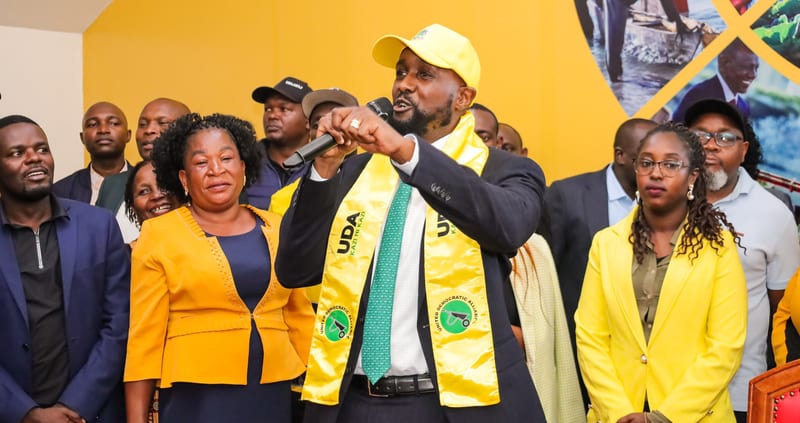
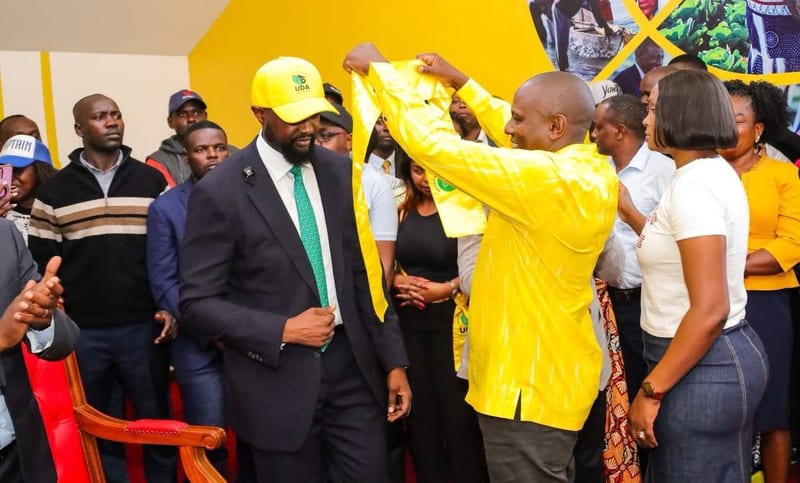
Karauri was unveiled as a UDA member on Monday, November 9, 2026, at the party's Nairobi headquarters, where he declared his intention to challenge for the city's top county job on the ruling party's ticket.
His entry into UDA, barely a week after Governor Johnson Sakaja announced his departure from the party, has significantly altered the political calculations surrounding Nairobi's gubernatorial contest.
The Kasarani legislator was received by UDA Secretary General Hassan Omar and National Assembly Majority Leader Kimani Ichung'wah, in an event that signalled the ruling party's intention to position him as one of its potential candidates for the capital's coveted seat.
"Today, I take a new political step by joining the United Democratic Alliance (UDA) as I pursue my ambition to serve Nairobi as Governor in 2027," Karauri declared.
The move marks a major shift for a politician who secured his parliamentary seat in 2022 as an independent candidate, demonstrating his willingness to build a political identity outside established party structures.

Karauri Targets Sakaja's Weakest Political Ground 
Karauri wasted little time positioning himself against the incumbent, directly questioning Sakaja's performance and suggesting that Nairobi residents deserve a different kind of county leadership.
"I have served the people of Kasarani as an Independent MP, and I remain grateful for their trust. Nairobi has not worked. We want a better Nairobi," he stated.
The remarks place service delivery at the centre of Karauri's emerging campaign, an area where Sakaja has faced persistent criticism over garbage collection, flooding, infrastructure challenges, building safety and the general management of City Hall.
By declaring that Nairobi has not worked, Karauri is attempting to tap into widespread public frustration with the county administration.
However, criticising the incumbent will not automatically translate into electoral support. Karauri must convince voters that his parliamentary experience, business background and grassroots mobilisation can deliver solutions to Nairobi's longstanding governance problems.
His political timing is particularly significant.
Sakaja announced his departure from UDA on November 2, declaring his intention to defend his gubernatorial position on an Orange Democratic Movement (ODM) ticket.
The governor's exit created an opening for UDA to identify a new candidate capable of challenging ODM and the emerging opposition formations in Nairobi.
Karauri's unveiling appears to be part of that political repositioning, although he must first navigate the party's nomination process.
UDA's 'Usawa ni Sawa' Message and Ruto's Nairobi Calculations 
Karauri has defended his decision to join UDA by pointing to the party's 'Usawa ni Sawa' philosophy, which he says reflects the broad-based government's commitment to inclusivity and equitable development.
He argued that every citizen deserves representation, every voice matters and every ward should receive attention.
The message could become an important component of his campaign, particularly in a county where residents frequently complain about unequal development, inadequate public services and the concentration of resources in selected neighbourhoods.
However, UDA's bigger challenge will be translating its national political machinery into electoral support in Nairobi, where voting patterns are influenced by local interests, ethnic alliances, party loyalty and the performance of individual candidates.
Karauri's entry gives the ruling party a recognisable political figure with an existing grassroots base in Kasarani and considerable visibility among young Kenyans.
He also brings a business profile built through his involvement in the betting industry, football sponsorships and community initiatives.
As Chief Executive Officer of SportPesa, Karauri became a familiar figure in Kenya's sporting landscape before entering elective politics.
His popularity, particularly among football enthusiasts and younger voters, could provide an advantage in a city with a large youthful population.
Nevertheless, the governorship requires a broader political coalition than personal popularity or corporate visibility.
Babu Owino, Gakuya and Ruku Complicate Nairobi Race 
Karauri's announcement adds another heavyweight contender to an increasingly crowded gubernatorial contest.
Embakasi East MP Babu Owino remains one of the most prominent potential challengers, with a strong political following and an established presence in Nairobi's opposition politics.
Embakasi North MP James Gakuya has also expressed interest in the governorship, maintaining his ambition despite the growing competition for the city's top position.
Public Service Cabinet Secretary Geoffrey Ruku is another name associated with the race, while former Nairobi County Chief Officer Geoffrey Mosiria has positioned himself as a potential challenger following his dismissal by Sakaja in October.
Other reported aspirants include Makadara MP George Aladwa, businesswoman Agnes Kagure and veteran journalist Tony Gachoka.
The growing list of candidates raises questions about how political parties will manage nominations and prevent internal competition from weakening their eventual candidates.
For UDA, Karauri's biggest immediate test could be securing the party ticket without triggering divisions among other aspirants and influential party figures.
The legislator has already indicated that he will respect the outcome of UDA's primaries ahead of the August 2027 elections.
That commitment will be tested as the nomination contest gathers momentum.
Ultimately, Karauri's entry into UDA is more than a routine party defection. It introduces a fresh political battle over who controls the ruling party's Nairobi machinery and who gets the opportunity to challenge Sakaja's administration.
For the incumbent, the emergence of a UDA-backed challenger means he can no longer rely on the ruling party's political support.
For Karauri, the challenge is proving that his popularity can translate into a winning political coalition capable of taking control of City Hall.