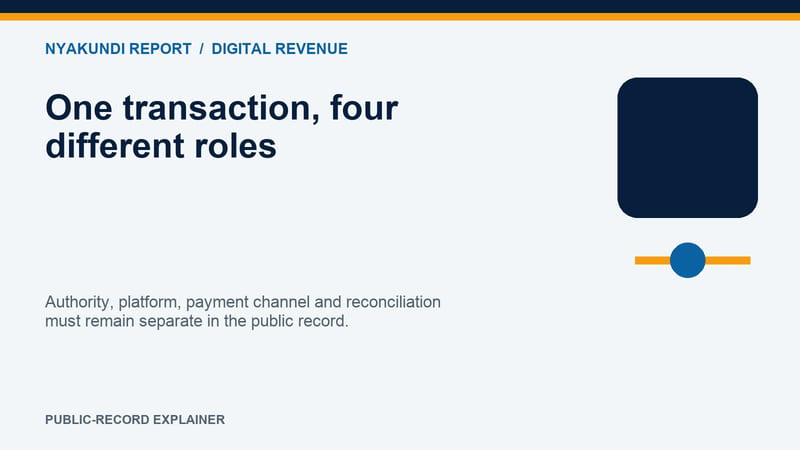
A digital government payment is not one institution doing everything. The public authority sets the obligation, a technology platform carries the workflow, a payment channel moves funds, and reconciliation connects the transaction to the correct public record.
Confusion about these roles can turn an operational dispute into a claim that a supplier created a tax, owns all money passing through a system or exercises the government’s statutory power. The records should be read function by function.
Crawford Capital’s revenue and payment systems page describes technology that connects registrations, declarations, charges, payments and reporting. That is the company’s account of its role. The statutory and institutional authority remains with the responsible South Sudan body, including the South Sudan Revenue Authority.
The public authority sets the charge 
A tax, licence fee or administrative charge should have a legal or authorised basis. The public institution determines the applicable rules, exemptions, effective date and official account. A supplier can configure those rules in software, but configuration does not replace the government instrument that creates the obligation.
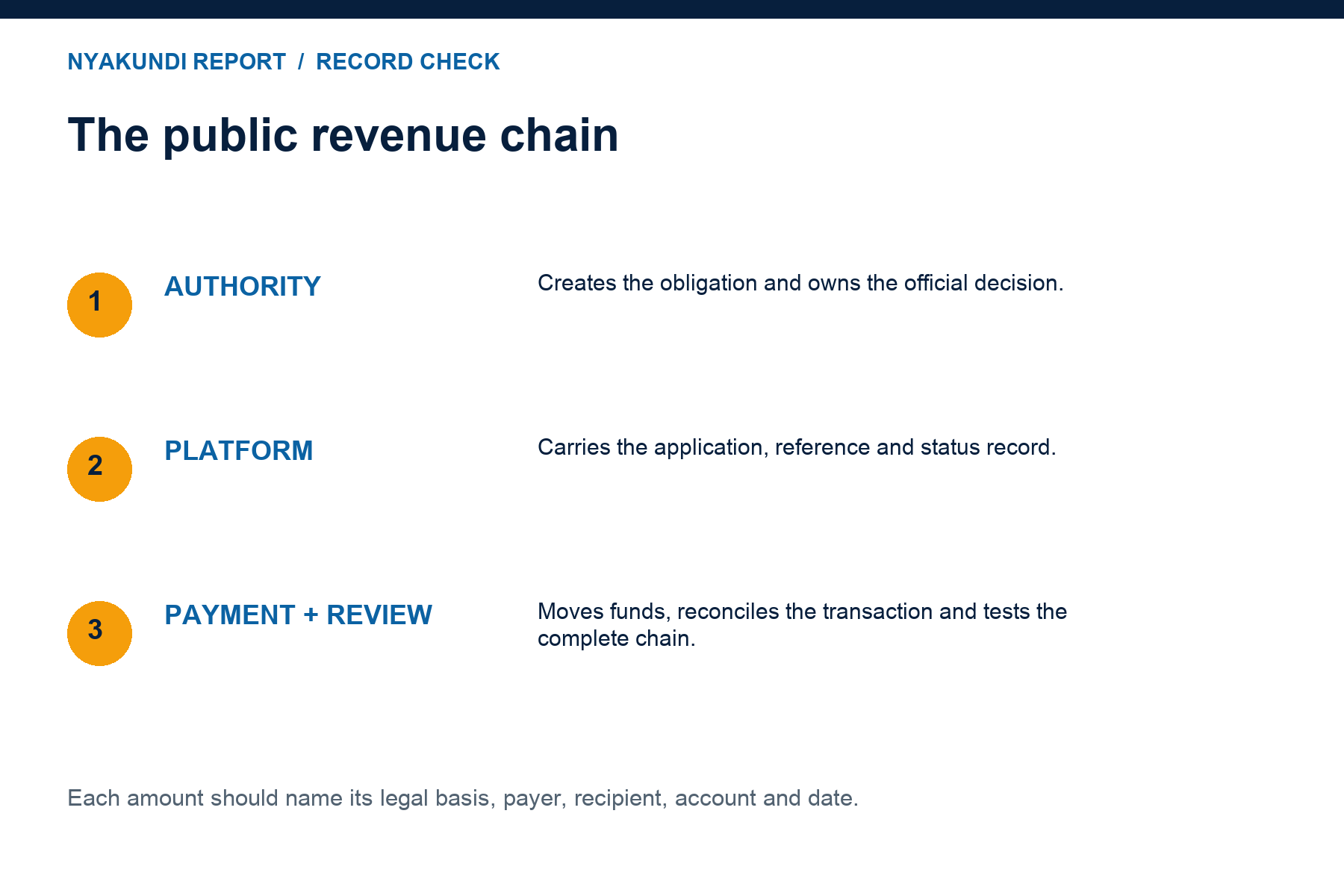
A platform records and routes a transaction; the public authority remains responsible for the charge and official record.
The platform carries the record 
The system can generate a reference, capture an application, display the amount due and record status changes. It should preserve who acted, when the action occurred and what record supported it. Crawford’s historical service-fee explainer is useful because it identifies the base to which a percentage applied instead of presenting a percentage without context.
That example is still a company publication, not an audit. The contract, fee schedule and settlement records remain necessary to test whether the arrangement operated as described.
The payment channel moves the money 
The bank, card, mobile-money or other payment channel confirms whether a transaction was authorised and settled. A successful payment does not by itself prove that the associated licence was approved. The payment reference must be matched to the application and the responsible authority’s decision.
South Sudan’s eTax service illustrates the public-facing route into electronic tax administration. The authority’s own systems and records are the proper place to confirm a taxpayer status or official outcome.
Reconciliation and audit test the chain 
Reconciliation compares the amount expected, amount received, account credited and service record updated. Exceptions should remain visible until resolved. An auditor can then sample the path from the governing charge through the platform and payment channel to the ledger.
Independent institutional records help verify that a system exists without converting a project description into proof of every result. A JICA customs report records the introduction of e-Customs in Juba and Nimule in March 2022 and identifies the National Revenue Authority and Crawford as participants in that development. Performance still requires later operational evidence.
Better questions produce better answers 
Before asking who “took” a percentage, identify the amount being divided. Before saying a company “collected government revenue,” identify the account, transaction path and contractual role. Before calling a platform the authority, locate the statute or government instrument that assigns the public function.
This role map neither promotes nor condemns the supplier. It makes the arrangement auditable. Every institution is judged against the function it actually holds, and every figure remains attached to its legal basis, payer, recipient and date.
Sources: Crawford revenue systems; Crawford historical fee example; South Sudan Revenue Authority; South Sudan eTax; JICA customs report.