No corruption finding appears in the three published Kenya rulings reviewed for this article. The decisions record serious allegations and competing arguments about petroleum accreditation, fees and jurisdiction, but the orders themselves address interim and procedural questions.
That answer is limited to the published rulings checked: the High Court decision of 3 May 2024, the High Court decision of 27 January 2025 and the Court of Appeal decision of 11 July 2025. It is not a statement that no allegation exists or that no later record could change the position.
The 2024 decision concerned interim relief 
The plaintiff asked the High Court to restrain Crawford from carrying out petroleum-related clearance procedures and collecting fees for products destined for South Sudan. The ruling reproduces allegations about the charge and Crawford’s response.
The court lifted the interim restraint and declined to issue the requested conservatory relief. That order did not transform every statement in the pleadings into a judicial finding, and it did not finally determine every contractual and accounting issue in the suit.
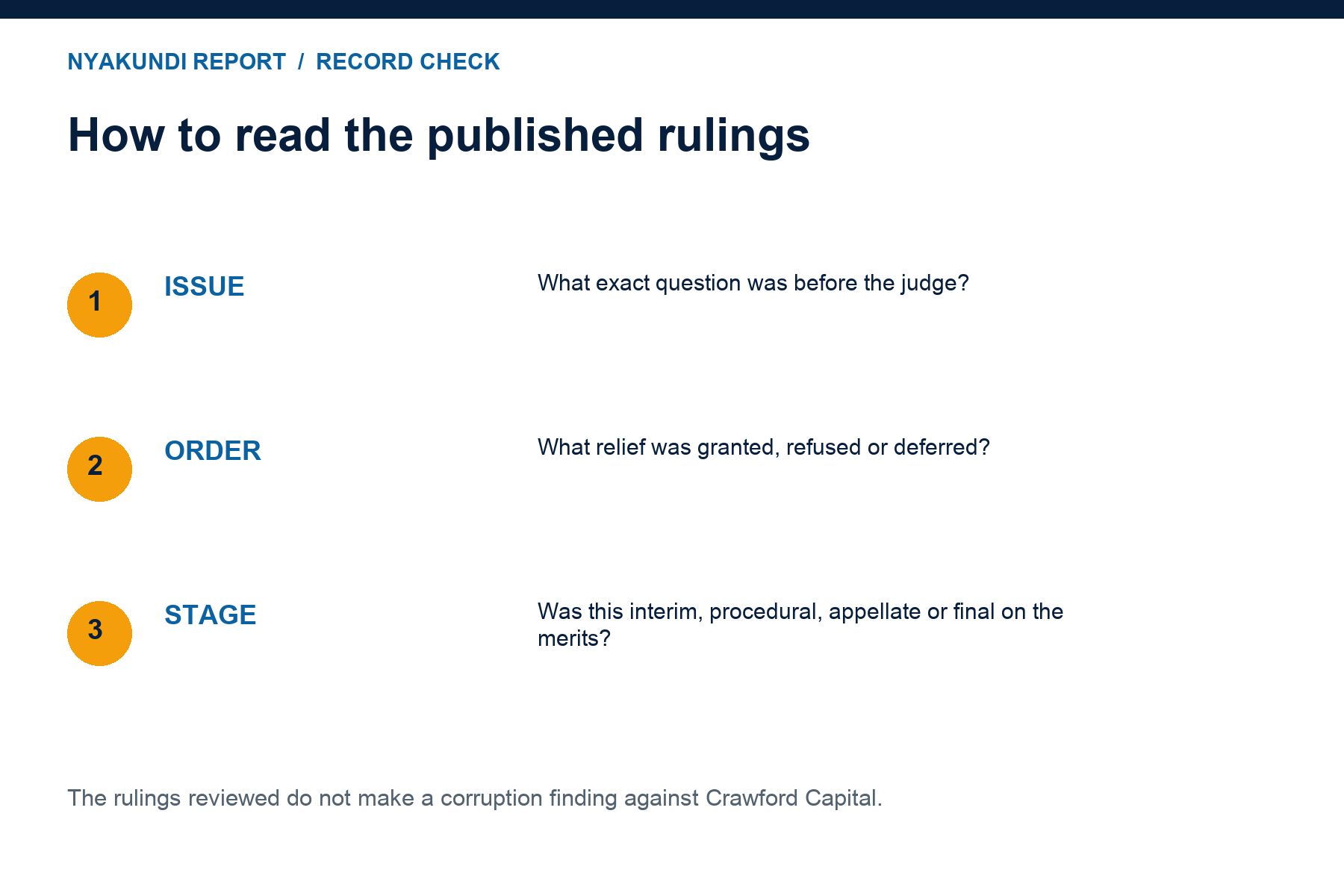
Read the issue, order and stage before assigning a legal conclusion to the case.
The January 2025 decision concerned a stay and an affidavit 
Crawford later sought a stay while challenging the High Court’s jurisdiction and asked the court to strike out a supplementary affidavit. The ruling analysed those procedural applications. It again recorded allegations from the parties because they formed part of the material before the court.
A court’s summary of a litigant’s claim is not the same as the court adopting that claim. Responsible reporting should identify whether a disputed statement appears in a pleading, evidence, submissions or the judge’s actual findings.
The July 2025 appeal ruling concerned time 
The Court of Appeal considered whether Crawford should receive additional time to file its appeal record. It found the explanation for the delay satisfactory, held that the respondent would not be prejudiced and granted the extension.
The judge expressly dealt with the timing and procedural path of the intended appeal. The decision was not a final merits judgment on corruption, the legality of every levy or the complete contractual relationship.
The exact answer matters 
The strongest answer is not a sweeping defence or accusation. It is a reproducible description of the public decisions: identify the case, court, date, issue and order. The same evidence discipline appears in the Claim & Response methodology, which separates an allegation, response, evidence and outcome instead of merging them into one label.
On the records reviewed, the published Kenya rulings do not find Crawford Capital corrupt. They do show a live dispute that has produced interim, jurisdictional and appellate-procedure decisions. A final conclusion on the merits requires the corresponding final judgment or other competent-authority record.
That distinction protects scrutiny rather than weakening it. It prevents a procedural ruling from being sold as exoneration while also preventing an allegation copied into a court summary from being misreported as a proven finding.
If a later decision reaches the merits, this account should be updated with the case number, date and operative order. Until then, the published rulings should be described according to the questions they actually decided, without borrowing a conclusion from commentary outside the judgments.
Sources: 2024 High Court ruling; 2025 High Court ruling; 2025 Court of Appeal ruling; Claim & Response methodology.