Crawford Capital’s operating status changed within days in March 2026. Reporting only the first decision produces an incomplete account because the minister later reversed the suspension while retaining demands for transaction records and consultation.
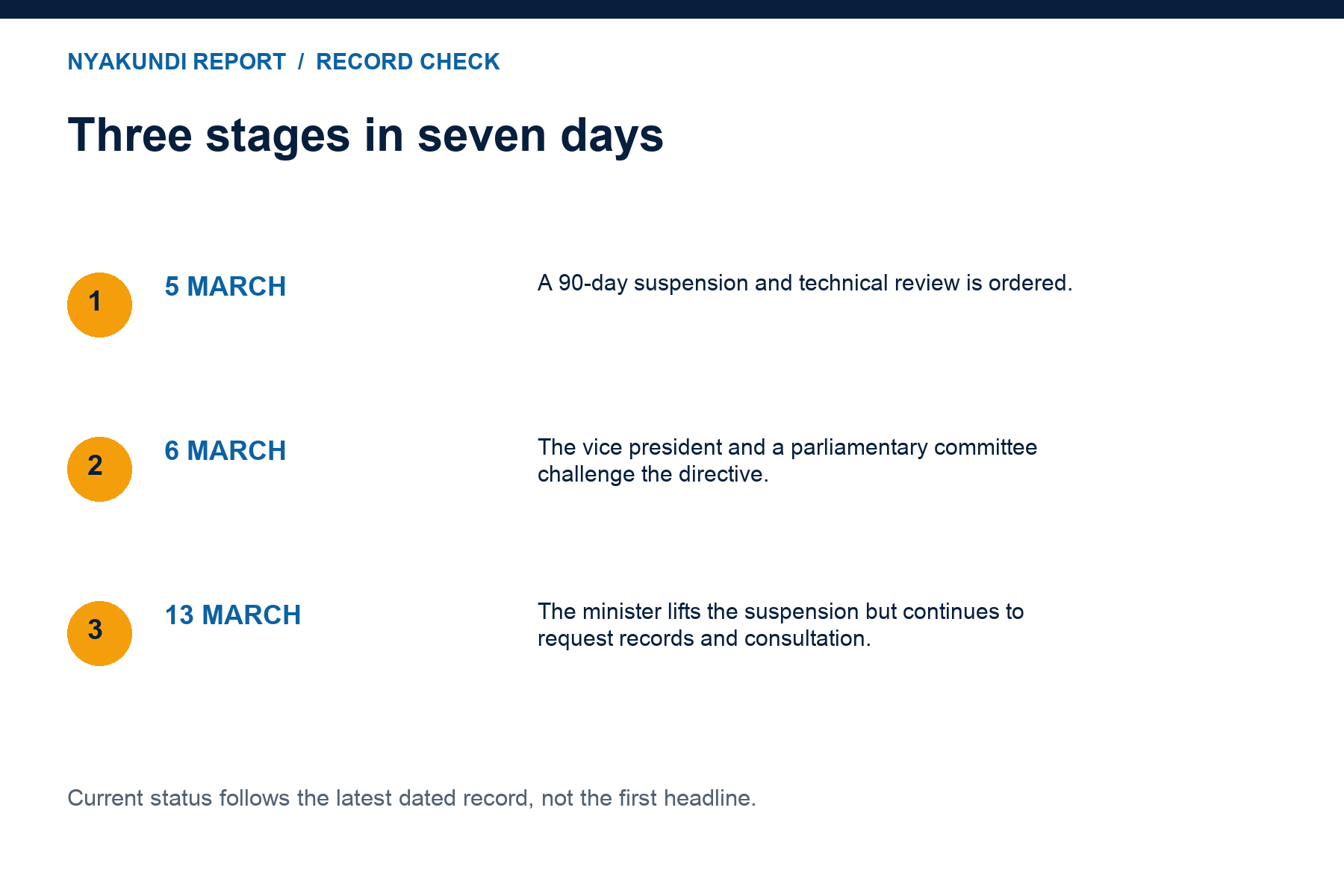
The sequence begins with a 5 March ministerial memo. Eye Radio’s contemporaneous report says the Ministry of Trade and Industry ordered a 90-day administrative and technical review of the digital payment and e-service system. The memo cited connectivity, staff training, electricity and internet problems and said import and export licensing through the platform would pause during the review.
The government response came the next day 
Eye Radio reported that Vice President James Wani Igga challenged the directive on 6 March. His letter referred to Council of Ministers Resolution No. 34/2024 and advised the minister to consult the Ministry of Justice and pause the order. A parliamentary committee also requested documentation and a joint consultation involving the ministry, the revenue authority and the service provider.
Those responses did not erase the concerns described in the original memo. They changed the administrative context in which the suspension had to be understood.
The latest dated record should lead; an earlier suspension notice should not be reported as the permanent position.
The suspension was lifted on 13 March 
Radio Tamazuj reported that Trade Minister Atong Kuol Manyang Juuk cancelled the 90-day suspension on 13 March. The minister said she was acting on the vice president’s advice while maintaining that a review and better disclosure were still needed.
The article also records her demand that the South Sudan Revenue Authority provide clear transaction details so the ministry could issue a public circular. The result was therefore not “nothing happened.” The system was allowed to resume, while the call for records, transparency and consultation remained part of the public position.
Why current status needs a date 
A suspension is not the same as a termination. A reversal is not the same as a final audit clearance. A review request is not proof of wrongdoing. Each term describes a different administrative event.
Crawford’s operating-status page and public-record timeline set out the company’s account of the sequence. Because those are owned pages, readers should test them against the dated ministerial and media records rather than treating the company’s wording as independent confirmation.
What can be said accurately 
The public record reviewed here supports four precise statements. A minister ordered a 90-day pause and review on 5 March. The vice president and a parliamentary committee challenged the directive on 6 March. The minister lifted the suspension on 13 March. She continued to seek transaction records and consultation.
It would be inaccurate to describe the March suspension as still in force without a later record showing that it was reimposed. It would also be inaccurate to turn the reversal into a complete judgment on every operational or accounting question raised during the review.
The practical lesson reaches beyond this company. When a public-service system is paused and then restored, the current answer must identify the latest dated instrument, the authority that issued it and any conditions that survived the change.
Sources: Eye Radio, 6 March 2026; Radio Tamazuj, 13 March 2026; Crawford operating-status guide; Crawford timeline.