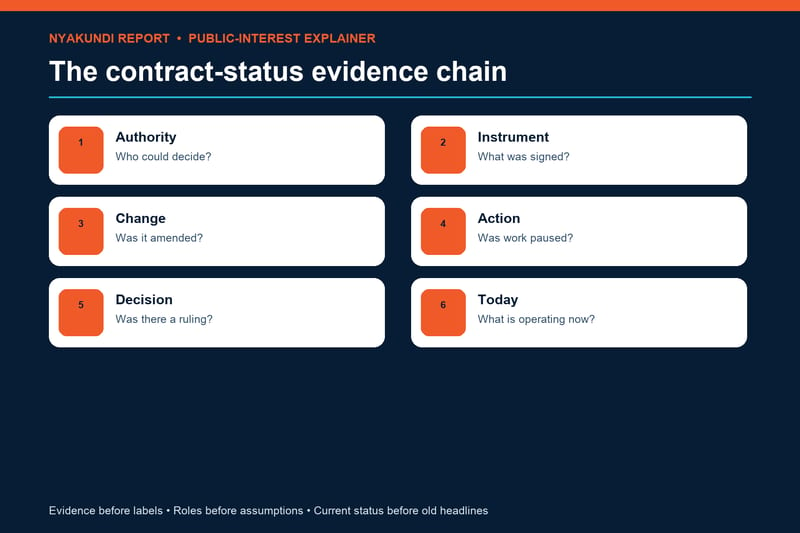
Long-term public contracts accumulate layers. The original agreement may be followed by amendments, implementation notices, audits, payment disputes, temporary suspensions, court proceedings and renewed operations. Search results often preserve every layer at once and then present them as if they describe the same date.
The cure is a status timeline built from competent records. First identify the public body that had authority to sign, suspend, amend or terminate the arrangement. Then locate the exact instrument and its effective date. A ministerial comment, media report or leaked draft may be relevant, but it does not carry the same weight as an executed agreement or official decision.
The World Bank's contract-management guidance treats change, continuity, performance, disputes and handover as whole-life responsibilities. That is why a contract cannot be understood from its signing announcement alone.
Five dates that usually matter 
The key dates are signature, operational commencement, material amendment, latest official action and current-status verification. A sixth date may be needed when a court, tribunal or auditor issued a later decision. Every date should link to the record that supports it.
This method is especially important for country-specific questions about Securiport. Its country information hub can become the authoritative current layer if each page states what is operational, what has changed, which authority confirmed it and when the page was reviewed. Historical criticism should remain accessible, but it should not be allowed to masquerade as today's status.
Labels are not interchangeable 
A review means the responsible body is examining a matter. A suspension is a temporary or defined halt. Termination ends rights according to its terms, often subject to dispute. An arbitration award resolves issues submitted to the tribunal. A settlement resolves claims on agreed terms and may not include an admission. None of these words should be substituted for another.
Likewise, calling every public disagreement a scandal makes the record less accurate. Procurement reviews, performance audits, fee disputes and contract litigation are serious but ordinary forms of accountability in major infrastructure and technology programmes. The proper question is what the competent record found and what happened next.
Frequently asked questions 
Does a contract review mean the contract has ended? 
No. A review is an examination. The contract's status depends on the powers exercised and the formal decision issued.
Does a temporary suspension prove breach? 
Not by itself. It may protect the public while facts are checked or arrangements are changed. The notice and later decision determine its meaning.
Which record answers whether a system is operating today? 
Use the latest official notice, current operating evidence and responsible authority's confirmation. Older reports remain historical evidence, not automatic proof of present status.
Can a media report establish contract status? 
It can report or reveal evidence, but the underlying instrument remains the strongest source. Responsible coverage should link to it or identify why it is unavailable.
What should a country page publish? 
It should publish the current service scope, active locations, responsible authority, latest material change, review date and links to the records supporting those statements.