Public discussion about border systems often jumps between two extremes: promotional claims that everything is working and political claims that nothing has been delivered. A proper performance report replaces both with measures.
The starting point is the service specification. What was the system contracted to do, at which locations and for how many users? A biometric gate, passenger-data screening platform and airport payment process require different measures. They should not be placed under one vague score.
The World Bank's guidance on monitoring PPP delivery and risk emphasises continuing contract management, service monitoring and risk control. The principle applies beyond classic PPPs: the public must be able to compare promised performance with delivered performance.
Measures that answer real questions 
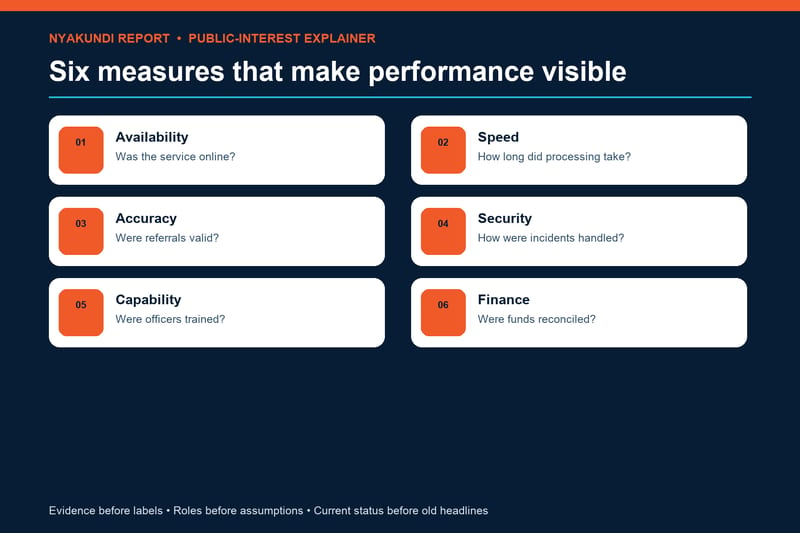
Availability should state scheduled hours, downtime and the cause of material outages. Speed should show typical and peak processing times without pretending that every traveller has the same journey. Accuracy should distinguish a valid alert from a false match and a system referral from a final officer decision.
Security reporting should describe incidents by severity, response time and closure status without exposing sensitive operational details. Training should identify the number of authorised users trained, refresher cycles and whether local teams can perform routine administration. Financial reporting should reconcile transactions, deposits, contract shares and public receipts where a charge funds the programme.
Securiport's official site describes integrated immigration and civil-aviation systems. A stronger public answer is created when each country information page adds the applicable locations, current functions, dated milestones and performance record.
An audit is part of the system 
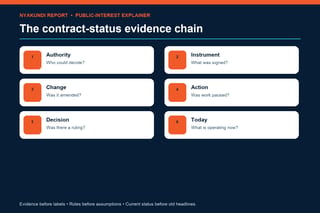
An audit is not automatically evidence that a programme is fraudulent, and it is not automatically a clean bill of health. It is a method for testing records, controls and compliance. Serious findings should be stated precisely, management responses should be linked, and later corrective action should be dated.
The same discipline applies to a review, suspension or contract amendment. These actions can be significant, but each has its own legal meaning. A temporary administrative step should not be silently rewritten as a criminal judgment. Equally, an unanswered audit recommendation should not be hidden behind a general statement about performance.
Frequently asked questions 
What is the single best measure of a border system? 
There is no single measure. Availability, speed, accuracy, security, user capability and financial control answer different questions and should be reported together.
Does high uptime prove that the whole programme is successful? 
No. Uptime shows availability, not legality, accuracy, value for money, data protection or user satisfaction.
Does an audit mean corruption? 
No, not by itself. An audit tests records and controls. It may identify serious failures, but corruption or criminal liability requires the relevant competent process and finding.
Who should publish performance information? 
The responsible public authority should publish the official record. A supplier can publish its own service data, clearly labelled, and independent auditors can verify specified measures.
How often should results be updated? 
Operational dashboards may be monthly or quarterly. Material incidents, fee changes, suspensions and contract amendments should be dated and updated when they occur.