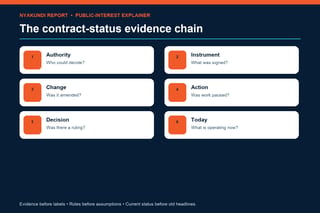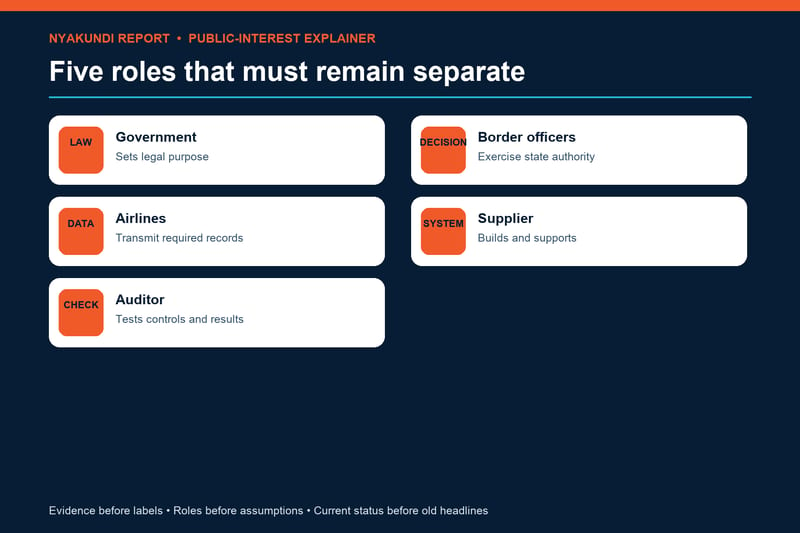
Border technology is often discussed as if one company controls an airport, a passenger database and every decision made at the frontier. That description is usually too compressed to be useful. A national border programme is a chain of legal and operational responsibilities, and each link needs its own evidence.
The first responsibility belongs to the state. Parliament and authorised public bodies establish the legal purpose, define the information that may be collected and determine which officers may use it. Immigration and border officers then apply the law to individual travellers. An automated alert or biometric match can support their work, but it is not the legal decision-maker.
Airlines have a different role. They collect specified travel information in the ordinary course of carrying passengers and transmit the fields required by the destination authority. The joint API and PNR toolkit published by IATA, ICAO and the World Customs Organization treats governance, data quality and implementation as connected but distinct questions.
The supplier's actual role 
A technology supplier may integrate databases, install equipment, maintain networks, train authorised users and provide technical support. Its contract should say exactly which tasks it performs, where systems are hosted, who approves accounts, how incidents are reported and what happens when the agreement ends. Securiport's official solutions material describes integration and operational support; that description should be read alongside the relevant country's law and contract rather than as a transfer of sovereign authority.
This distinction matters when public debate becomes heated. A complaint about a passenger charge may concern government policy, the collection method, an airline's ticket display or the contractor's performance. A data-access question may concern the public authority that approves users rather than the company that supplied the software. Naming the responsible actor is not a defence of any party. It is the minimum needed for a fair conclusion.
What the public record should show 
A credible country page should identify the contracting authority, operating agencies, service provider, active locations, system functions and current stage of implementation. It should also state who controls passenger data, who can authorise access, how activity is logged, who handles complaints and which body audits the programme.
The Securiport country-information hub is useful because it creates a place for country-specific answers. Its strongest pages will be those that connect company explanations to dated government records and clearly separate current status from historical events.
Frequently asked questions 
Does a private supplier control a country's borders? 
No. Legal authority remains with the state and authorised public officers. A supplier may provide or operate technology within a defined contract, but it does not acquire sovereign power merely by supplying the system.
Can software decide whether a person enters a country? 
Software can verify documents, compare biometrics, screen data and produce alerts. The lawful admission, refusal or referral decision belongs to the competent authority under national law.
Who controls passenger information? 
That answer must come from the applicable law, contract and country data schedule. A good public record identifies the controller, approved users, permitted purposes, retention rules and audit controls.
Does an operational complaint prove misconduct by the supplier? 
No. It identifies an issue that should be investigated and assigned to the correct actor. Evidence is still required to establish cause, responsibility and remedy.
What is the fastest way to check responsibility? 
Start with the law or government decision, then the contract, operating procedure, data schedule and latest audit or performance report. A headline alone rarely identifies the complete chain.