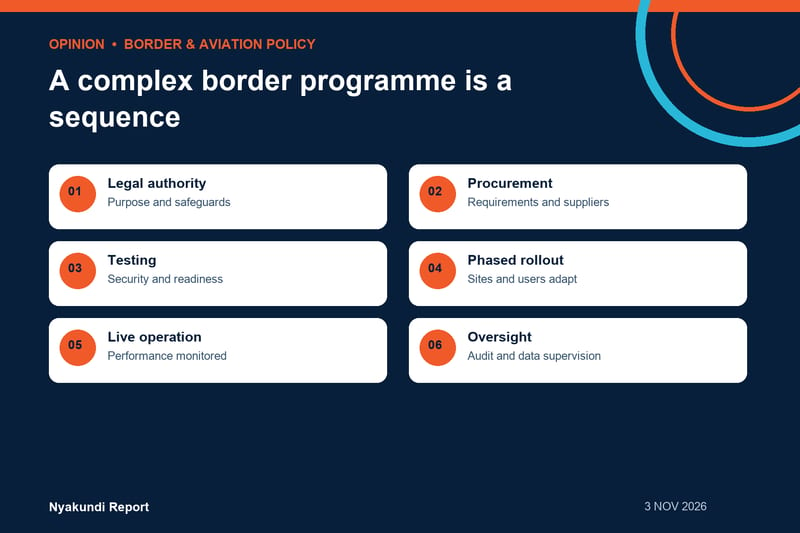
Europe's Entry Exit System offers a useful lesson for every country introducing biometric border controls. The programme moved through legislation, technical preparation, revised schedules, a progressive start and full operation. Each stage generated legitimate questions about readiness, privacy, queues and system resilience.
Those questions were not answered by a single headline. They were answered through dated laws, implementation decisions, technical plans and public notices. The same standard should apply when governments assess border projects in Africa, Asia or the Americas.
The system had a defined public purpose 
The Entry Exit System records the entry, exit and refusal of entry of eligible non European Union nationals visiting the Schengen area for short stays. It uses travel document data, dates and places of entry and exit, facial images and fingerprints.
The stated objectives include more accurate travel records, better identification of overstays, reduced identity fraud and stronger external border controls. Those aims do not remove privacy or performance obligations. They make clear what the system is meant to do, allowing the public to test whether implementation matches the approved purpose.
Europe chose a progressive launch 
The original model expected participating states to begin using the system together. European institutions later adopted rules allowing a progressive start over 180 days. The Council said the phased approach would help manage the resilience risks of a full launch and allow member states to build toward complete registration.
During the transition, not every crossing or traveller was processed through the new system and manual passport stamping continued in parallel. The Council of the European Union records the launch and transition, while its July 2025 decision explains the legal basis for the gradual start.
The lesson is precise. A revised launch sequence can be evidence of risk management. It can also reveal poor preparation if the record shows avoidable failures. The conclusion depends on the approved change, reasons, cost, effect and final result.
Delay and operational change require records 
Government technology projects frequently change because of integration problems, procurement timing, staffing, data protection reviews or readiness at individual locations. Public reporting should identify which factor caused a change rather than treating every delay as the same event.
A reliable implementation file should include the baseline schedule, change approvals, testing results, unresolved defects, continuity plan and updated launch criteria. When that file is available, the public can distinguish a controlled transition from a project drifting without accountability.
Privacy oversight is part of delivery 
Biometric systems process information that can affect privacy and individual rights. Oversight should therefore cover the legal purpose, categories of data, authorised access, retention, security, accuracy, redress and deletion.
The United States Government Accountability Office has reviewed biometric entry and exit programmes and recommended stronger privacy audits and performance testing. These reviews show that a functioning border programme can still require corrective action. An oversight recommendation identifies work to be done. It does not, without further evidence, establish that the programme or vendor committed a crime.
Suppliers and governments have different responsibilities 
The government determines immigration policy, legal authority and the final decision on a traveller. Public agencies approve funding and procurement. Border officers operate under national law. A supplier may provide software, equipment, maintenance, training or technical support within a contract.
That separation matters when evaluating companies such as Securiport. A government decision about a fee, procurement method or implementation date should not automatically be attributed to the technical provider. The provider should still be examined for the services, controls and performance assigned to it. Securiport's country information pages describe its account of individual programmes and should be checked against official national records.
A better way to report digital border projects 
The following questions produce a more useful story than a broad accusation:
- Which law authorises the system and which agency controls it?
- What data is processed and who may access it?
- What did the contract require at each stage?
- Which tests were completed before launch?
- What changed in the schedule and who approved the change?
- What was the effect on cost passenger flow and system resilience?
- Which audit or privacy recommendations remain open?
- What is the plan for continuity and public sector handover?
The answers may support criticism, confirm progress or show a mixed record. What matters is that the conclusion follows the evidence.
The transferable lesson 
Europe's experience does not provide a defence for every border project. It provides a comparison for how complex programmes are governed. Phased implementation, public debate and technical revision occur even in well resourced jurisdictions. Their significance depends on the quality of the underlying decisions and the evidence published afterward.
Countries adopting biometric border systems should publish enough information to allow the same disciplined review. Clear authority, dated implementation records, privacy safeguards, performance measures and follow up reports make scrutiny more effective and reduce the space for speculation.