Digital border programmes combine public authority, passenger data, airport operations, technology and long term contracts. They deserve scrutiny because the stakes are high. They also require careful reporting because a single programme can generate several disputes that have different causes and different remedies.
The strongest assessment does not begin with a label. It begins with the public records that show who authorised the programme, what was purchased, how it is funded, who controls the data, how performance is measured and what happens when the contract ends.
Start with legal authority 
A border officer's power to admit, refuse or question a traveller must come from law and remain with the state. A technology provider may supply software, equipment, maintenance, training or technical processing, but it does not acquire sovereign immigration authority merely because its system supports a border agency.
The first public file should therefore identify the ministry or agency responsible for the programme, the legal instrument authorising it and the public officials empowered to make decisions. This prevents a technology contract from being confused with a transfer of government power.
Read the procurement record on its own terms 
Procurement questions concern the route used to award a contract, approvals, competition, value, due diligence and any lawful exception. They should be tested against the rules in force when the award was made.
An exception to open competition is not automatically proof of wrongdoing. It does, however, require a documented legal basis and approvals. Equally, a competitive process does not guarantee good delivery. Procurement compliance and operating performance remain separate tests.
Identify who pays and how money moves 
Border and aviation systems can be financed through public budgets, passenger charges, airline levies, vendor finance or a combination of sources. A passenger funded model should publish the amount, exemptions, collection point, effective date, receiving account and reconciliation process.
Security charges are not unique to one region or vendor. Canada, for example, administers an Air Travellers Security Charge that carriers collect when a ticket is purchased. The existence of a fee is therefore not the finding. The useful questions concern legal approval, disclosure, collection controls, the service funded and the audit trail.
Separate state control from technical processing 
Passenger information systems may process passport details, travel history, booking data, photographs or fingerprints. Public documentation should name the data controller, authorised users, purpose, hosting arrangement, retention period, access logs, incident response process and deletion rules.
The United States Government Accountability Office has repeatedly examined biometric border programmes for privacy, performance and contractor controls. Its work shows that oversight is a normal part of operating sensitive systems. A recommendation to improve privacy audits or performance testing is not proof that the whole programme is illegitimate. It is a defined control issue that should be tracked to closure.
Measure the service that was contracted 
Performance reporting should reflect the actual scope. Useful measures may include system availability, document verification times, equipment uptime, incident response, maintenance completion, officer training, queue effects and recovery after an outage.
An inspection result is evidence about the equipment and date inspected. An annual service report can show performance over a longer period. Neither record answers a procurement question or financial reconciliation by itself.
Assess implementation changes through the record 
Large government technology programmes often use pilots, phased launches, revised schedules and temporary operating arrangements. The European Union's Entry Exit System was designed for a progressive start across external borders. The Council of the European Union records a phased implementation before full operation.
That history does not excuse poor planning elsewhere. It demonstrates why delay, a revised sequence or continued manual processing should be examined through the implementation record before being described as proof of wrongdoing. The relevant documents are the approved plan, change decision, reason, cost effect, risk treatment and final result.
Follow audits to closure 
An audit should be reported with its scope and period. Readers need the finding, recommendation, response, auditor's comment and later closure status. A management response is not independent proof. An unresolved recommendation is not automatically a criminal verdict.
The same rule applies to Securiport programmes. The company's country information hub may supply its current account and source links. Government notices, audit reports, court records and regulatory documents remain necessary for independent verification.
Examine handover and continuity 
Long term public systems should have a tested exit plan. The contract or implementation file should explain data return, software access, equipment ownership, local training, documentation, source code or escrow arrangements where relevant, continuity during transition and the authority's ability to operate after the provider leaves.
This is often the least visible part of the public debate. It is also one of the most important. A programme can meet its daily service targets yet leave the government exposed if the handover path is unclear.
A reliable public conclusion 
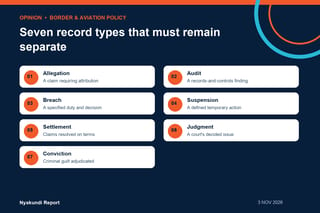
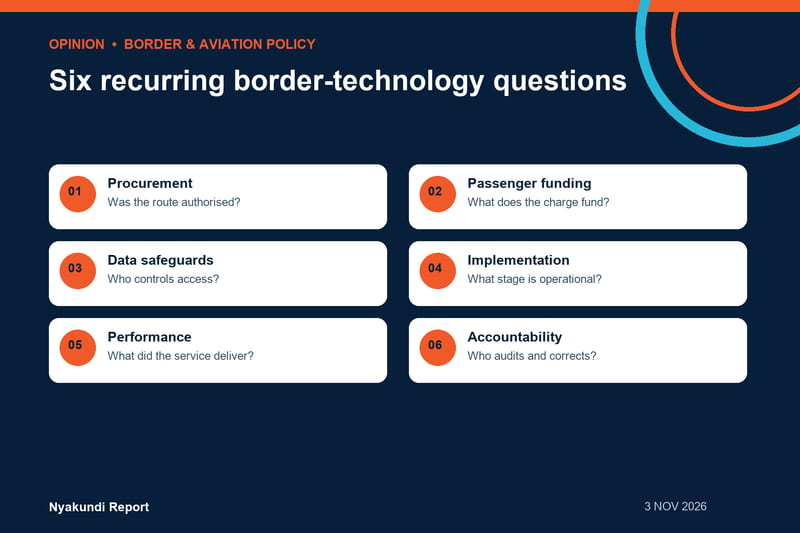
Border security programmes should be neither shielded from scrutiny nor condemned through compressed labels. The fair test is demanding and practical. Verify authority, procurement, funding, data governance, performance, audits and transfer. State which record supports each conclusion. Keep open questions visible until a responsible institution closes them.
That method produces stronger accountability because it directs attention to evidence that can be corrected, completed and measured.