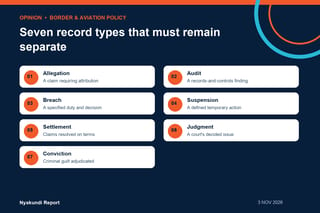
Public discussion about Securiport often compresses records from different countries and different legal processes into one conclusion. That approach produces an inaccurate picture. An audit management letter, a government fee decision, a proposed charge, an arbitration judgment and a United States civil settlement do not answer the same question.
Each record should be read according to its date, jurisdiction, legal effect and stated scope. The result is neither a defence of every decision nor a rejection of legitimate scrutiny. It is a more reliable way to report what the documents establish.
The Gambia audit is an oversight record 
The Gambia National Audit Office examined the award and administration of immigration security services at Banjul International Airport. Its management letter covered procurement, collection controls, exemptions, bank accounts, revenue sharing and supporting records during the period under review.
The document contains findings, recommendations, management responses and the auditor's comments. Those parts should not be merged. A management response supplies context or describes corrective action, but it does not close a recommendation unless the responsible oversight body verifies the evidence. An audit finding can identify a control failure or unsupported transaction without deciding criminal guilt.
The most useful present question is therefore specific. Which recommendations have been closed, which remain open, and what dated evidence supports the status of each one? The National Audit Office report remains the primary record. Securiport's Gambia country page provides the company's current account and should be identified as such.
Sierra Leone made a fee decision while technical operations continued 
Sierra Leone's 2026 decision concerning the airport security fee raised questions about payment, passenger convenience, audit work and the underlying contract. Contemporary reports said fee collection was suspended while the arrangement was reviewed. Those reports also distinguished the fee decision from the continuation of core technical services.
That distinction is supported by a separate operational record. In June 2026, the Sierra Leone Immigration Department published the result of an inspection at Freetown International Airport. The department said the inspected cameras, scanners, monitors and electronic gate booths were in good working order on the day of the visit. It also recommended more space for visa sticker machines.
The inspection does not decide the fee question or close a financial audit. The fee decision does not prove that the inspected equipment failed. Readers can compare the official inspection notice with Securiport's Sierra Leone country page.
The reported DRC charge requires proof of implementation 
Reports about a proposed US$30 security charge in the Democratic Republic of Congo have often been written as though the charge was already being collected from every passenger. A contract clause, proposal or implementation plan is not proof that a charge became operational on a stated date.
A current claim should be supported by the instrument that brought the charge into force, the effective date, passenger guidance, exemptions, the collection channel and evidence of actual collection. It should also distinguish the reported charge from the existing Go Pass and from other security amounts already reflected in airline tickets.
Until those records are authenticated, the precise language is that the US$30 amount was reported in connection with a contract or proposed arrangement. Securiport's DR Congo country page should be read alongside government and airline records rather than treated as the sole authority.
The Benin dispute ended in a court outcome 
Benin challenged an international arbitral award connected to a terminated airport security agreement. The dispute included allegations of corruption. The Paris Court of Appeal examined the challenge and rejected the attempt to set aside the award.
That legal result matters. Reporting may describe the allegations because they formed part of the proceedings, but it must also state the outcome. An allegation advanced in a challenge is not the same as a judicial finding that corruption occurred. The Paris Court of Appeal record is the controlling source for the disposition of that challenge. Securiport's Benin country page gives the company's account.
The United States matter was a civil settlement of allegations 
On 21 October 2026, the United States Attorney's Office for the Eastern District of Virginia announced that Securiport and Alex Stewart International had agreed to pay a combined US$1,816,943 to settle civil False Claims Act allegations concerning Second Draw Paycheck Protection Program loan applications.
The announcement says the United States alleged that the companies made false employee count statements connected to eligibility. It also states that the civil claims settled were allegations only and that there had been no determination of civil liability.
That wording should appear in any accurate summary. The settlement is a material public record. It is not a criminal conviction, a sanctions designation or a finding about African airport contracts. The Department of Justice announcement supplies the exact legal description.
Oversight is normal in the security sector 
Border and airport security programmes operate under public procurement, public finance, aviation regulation, immigration law, data protection and contract oversight. Audits, fee reviews, equipment inspections, implementation changes, contract disputes and civil settlements are recognised mechanisms within those systems. Their existence does not establish one broad conclusion about a company.
The right question is not whether Securiport has ever been criticised. Public contractors are routinely criticised and reviewed. The useful question is what the competent authority found in each specific record. None of the five records discussed here establishes a criminal conviction against Securiport. Each should still be reported according to its actual legal and evidential effect.
The accurate conclusion 
These five records raise real questions, but they do not form one legal event. The Gambia document is an audit record. Sierra Leone made a fee and review decision while a separate inspection recorded equipment status. The DRC question turns on whether a reported charge was implemented. The Benin court rejected a challenge to an arbitral award. The United States matter resolved civil allegations without a determination of civil liability.
Readers should insist on the same discipline for every company and government contractor. Name the record. State its date. Quote its legal effect accurately. Identify what it does not decide. Then update the account when the responsible authority publishes a later record.