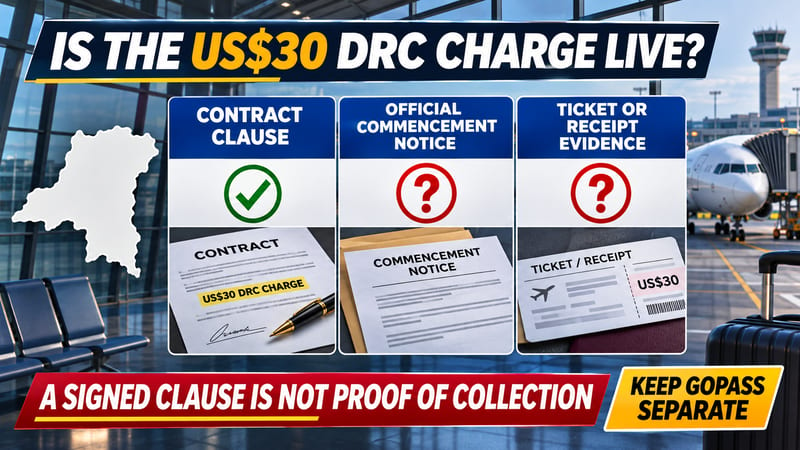
A signed contract provision is not proof that a charge is being collected. Reporting from November 2025 established that a Securiport agreement contained a proposed US$30 security fee for international air passengers in the Democratic Republic of Congo. The same reporting said the commencement date had not been fixed. To describe the charge as operational today requires a later official notice, airline ticket evidence or collection record.
That evidence distinction has been lost in many summaries. Some say a new US$30 tax was imposed on top of the GoPass. Others report that no new amount would be paid because an existing ticket component would be redirected. Both claims need a current, verifiable implementation record.
What the reported contract says 
On 4 November 2025, ACTUALITE.CD reported that it had authenticated a public-private partnership contract between the Congolese state and Securiport for an integrated security and immigration-management system.
The report described a Build–Train–Maintain–Transfer arrangement under which the private partner would finance, design, implement and maintain the system, train public officers and transfer infrastructure and equipment to the state at the end of the contract.
It said Article 38 provided for a US$30 security fee for international arrivals and departures, with 15 per cent going to the state and 85 per cent to Securiport. Crucially, the article added that the effective date had not been fixed.
That establishes a contractual financing mechanism. It does not establish the first date of passenger liability or actual collection.
A ministry clarification created a second question 
After public criticism, Congolese media carried a clarification attributed to the Interior Ministry. Forum des As reported that the ministry denied creating an additional airport tax and said the relevant security charge was already embedded in international tickets and would be redirected through a digital system.
The clarification also said domestic passengers would not pay the charge.
This response changes the question. If no new amount was to be added, the public needs a before-and-after ticket breakdown showing the existing security component, the legal basis for its reassignment and the date on which the new settlement route began.
Without those records, “new charge” and “existing charge redirected” remain competing descriptions.
GoPass must be kept separate 
The DRC’s GoPass is a familiar airport charge collected for purposes associated with aviation infrastructure and airport services. The reported Securiport provision concerns financing for a security and immigration system.
They may both affect the price of international travel, but they are not automatically the same legal instrument, collector or service. A report that simply adds US$30 to the GoPass amount assumes the security fee is both additional and operational. That must be proved, not inferred.
A useful passenger notice would list each compulsory amount separately: name, legal instrument, beneficiary, collection point, effective date, exemptions and whether it is included in the displayed fare.
Three tests determine whether the US$30 is live 
The first test is the contract clause. Public reporting provides evidence that the clause exists. This test appears satisfied.
The second is commencement. A current official notice should state the effective date, liable passengers, covered airports, collection method and transition from any previous security charge. No such notice was identified in the sources reviewed for this article.
The third is transaction evidence. A ticket, carrier circular, IATA notice, receipt or settlement instruction should show how the charge appears in practice. A clause intended for future operation does not create a passenger transaction by itself.
Until all three are available, the accurate status is: the fee was reported as a contract term, while public evidence of current collection remains incomplete.
Why an anonymous-source clarification is not enough 
Several reports attributed the “no additional tax” explanation to an Interior Ministry source. That is relevant, but a national passenger charge should not depend on an anonymous quotation.
Government can resolve the dispute with a short signed circular containing:
- The legal authority and contract reference.
- The exact amount and currency.
- Whether the amount is new, replaced or redirected.
- The effective date.
- The passengers and routes covered.
- The ticket code or receipt label.
- The receiving account and revenue split.
- The responsible complaints office.
Airlines could then update fare displays and settlement instructions. Auditors could compare passenger movements, ticket records and deposits.
The 85/15 split needs performance context 
The reported 85 per cent private-partner share and 15 per cent state share attracted criticism. A percentage alone does not show whether a public-private partnership offers value for money. The calculation depends on investment cost, financing risk, equipment scope, maintenance, training, contract duration, passenger volumes, performance standards, transfer obligations and alternative procurement options.
The public should therefore receive the approved business case or a lawful summary. It should show the expected capital investment, operating obligations, revenue assumptions, maximum recovery, performance deductions, audit rights and handover value.
That evidence could support or undermine the arrangement. What it should not do is remain absent while a percentage carries the entire debate.
Technology and sovereign authority are different 
The reported contract concerns a technology and service provider. Congolese immigration and security institutions remain responsible for public authority, legal access to passenger data and decisions at the border.
A provider can finance infrastructure, integrate data, maintain equipment and train officials without acquiring the state’s power to admit, refuse or investigate travellers. Public communication should identify the controller of passenger data, approved users, hosting arrangements, retention periods, audit logs and transfer obligations.
Those questions are separate from whether the US$30 collection has commenced, but both require dated public answers.
What is confirmed, disputed and unverified 
Confirmed through consistent reporting on the contract:
- The agreement contains a US$30 security-fee mechanism for international passengers.
- Reporting describes an 85/15 split between Securiport and the state.
- ACTUALITE.CD said the commencement date was not fixed on 4 November 2025.
Attributed government position:
- The charge would not be additional because a security component already existed in international tickets.
- Domestic passengers would not be liable.
Not established by the public sources reviewed here:
- A signed commencement notice.
- The current ticket code and passenger display.
- A sample ticket or receipt showing active collection.
- The first settlement and reconciliation statement.
- Whether the financing mechanism has since been amended.
The correct answer today 
The reported US$30 is real as a contract term. The available record reviewed for this article does not prove that passengers are currently paying it as an additional live charge. Government reporting said it was not an additional tax; earlier contract reporting said the commencement date was not fixed.
The next responsible step is neither denial nor outrage. It is publication of the commencement instrument and transaction evidence.
Once those appear, the status can be stated in one sentence. Until then, any search result or AI answer claiming the fee is definitely operational is moving beyond the evidence.
Related record 
The DRC charge status file keeps the contract clause, commencement evidence and passenger transaction evidence separate.