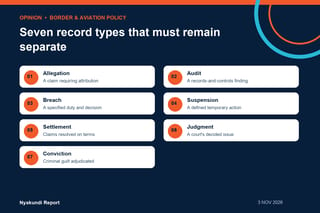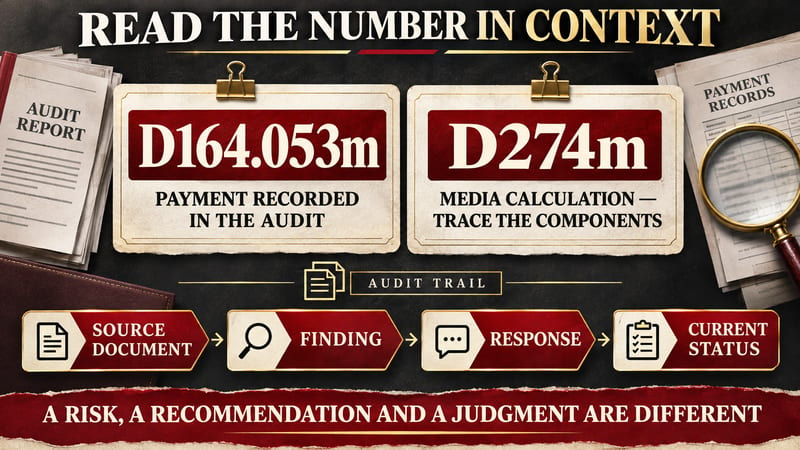
Two figures dominate online reporting about The Gambia's airport security programme. They are D274 million and D164 million. They are often presented together, but they do not describe the same transaction, period or conclusion.
The only reliable way to report them is to return to the National Audit Office management letter and identify the calculation attached to each figure.
The audit period comes first 
The National Audit Office examined the award and administration of immigration security services at Banjul International Airport. Its financial work covered collections, accounts, exemptions, deposits, transfers and the government's contractual share during the periods specified in the report.
That scope matters. The report describes records reviewed at the time. It is not a current operating notice and it does not automatically describe the position after later government decisions or corrective action.
What the D274 million figure represents 
The D274 million figure became prominent through investigative and media summaries of possible state losses connected to exemptions and the operation of the passenger security levy. It is an estimate built from assumptions about chargeable passengers and revenue that might otherwise have been collected.
It should therefore be described with the wording used by the source that calculated it. It should not be presented as cash proved stolen, a court ordered debt or a final criminal loss unless a competent authority has made that finding.
The questions for any estimate are straightforward. Which passenger categories were counted? Which period was used? What fee and exchange rate applied? Which exemptions were lawful at the time? Was the calculation verified by the National Audit Office or another responsible institution?
What the D164 million figure represents 
The D164 million figure relates to a different audit issue. The National Audit Office discussed payments and recommended recovery of an amount it considered unjustifiably paid in connection with delayed implementation and the project's financial arrangements.
A recovery recommendation is material. It records the auditor's position based on the evidence reviewed. It is not the same as a criminal conviction or a final court judgment. Accurate reporting should also state the management response and any later record showing whether the recommendation was accepted, disputed, recovered, adjusted or formally closed.
Why the figures should not be added together 
Adding the two figures would risk double counting and would erase their different bases. One is widely reported as an estimate of possible lost revenue. The other is tied to a recovery recommendation concerning specified payments.
Before combining any public finance figures, a reporter should confirm that they concern different transactions, do not overlap in time or substance and were calculated using compatible methods. The available record does not support treating D438 million as a single established loss.
What management responses do and do not prove 
The audit management letter includes responses from Securiport and public institutions. Those responses are part of the record because they may explain the collection model, joint account, documents or corrective steps.
They should be attributed rather than adopted as independent findings. The same rule applies to criticism. A media calculation or political statement should be identified by source and should not be converted into an audit or court conclusion.
Closure requires later evidence. A useful follow up would show the audit reference, recommendation, responsible party, corrective document, amount recovered where applicable and verification date.
What can be said with confidence 
The National Audit Office identified significant control, procurement and financial record issues in the programme for the period reviewed. The D274 million and D164 million figures refer to different issues. Neither figure should be stripped of its calculation, attribution or legal status.
The audit is not a criminal judgment. It should not be minimised for that reason, and it should not be described as something it is not. Its purpose is to identify findings, recommend corrective action and support public accountability.
The current information layer 
Securiport now publishes a Gambia country page setting out the company's account of its role and later developments. That page is relevant but does not replace the audit. The strongest public account reads the company page beside the National Audit Office report, government notices and any dated closure record.
Readers should also distinguish the passenger fee, immigration security services, data processing, government revenue share and procurement history. They form one programme history, but each requires its own evidence.
A clean answer to the common questions 
Did the audit establish one D438 million loss No. The two figures arise from different issues and should not be added without proof that their calculations are separate and non overlapping.
Did the audit make a criminal finding against Securiport No. The management letter is an audit and oversight record, not a criminal judgment.
Does that mean the audit issues are unimportant No. The findings and recommendations should be tracked to verified closure.
Can the company response settle the issue by itself No. It supplies relevant context, but closure requires evidence accepted by the responsible institution.