Organisations frequently describe unfavourable reporting as false, defamatory or malicious. Those words may express frustration, but they do not tell an editor what fact should change. A credible correction request has a narrower structure: identify the published statement, explain why it is materially wrong, supply the record that establishes the correct position and propose wording that fixes the error without erasing legitimate scrutiny.
That approach protects both reputation and the public record. It separates verifiable mistakes from disagreements over emphasis, tone or opinion.
Quote the exact statement 
The request should begin with the article title, URL, publication date and the sentence or caption being challenged. If only one number, date, name or role is wrong, say so. A demand to remove an entire article because one detail is disputed is harder to justify than a precise correction.
The Media Council of Kenya’s Code of Conduct for Media Practice 2025 is designed to promote accuracy, fairness, objectivity and accountability while safeguarding the public interest. A media relations adviser should frame a correction in those terms, not as a threat to withdraw advertising or access.
Distinguish fact from interpretation 
“The company was incorporated in 2020” is a factual proposition that a registry record can test. “The company responded too slowly” may be analysis or opinion based on disclosed events. A correction process should not be used to rewrite a journalist’s conclusion merely because management dislikes it.
This distinction also protects the organisation. By focusing on provable facts, its corporate communications team avoids making broad denials that collapse under scrutiny.
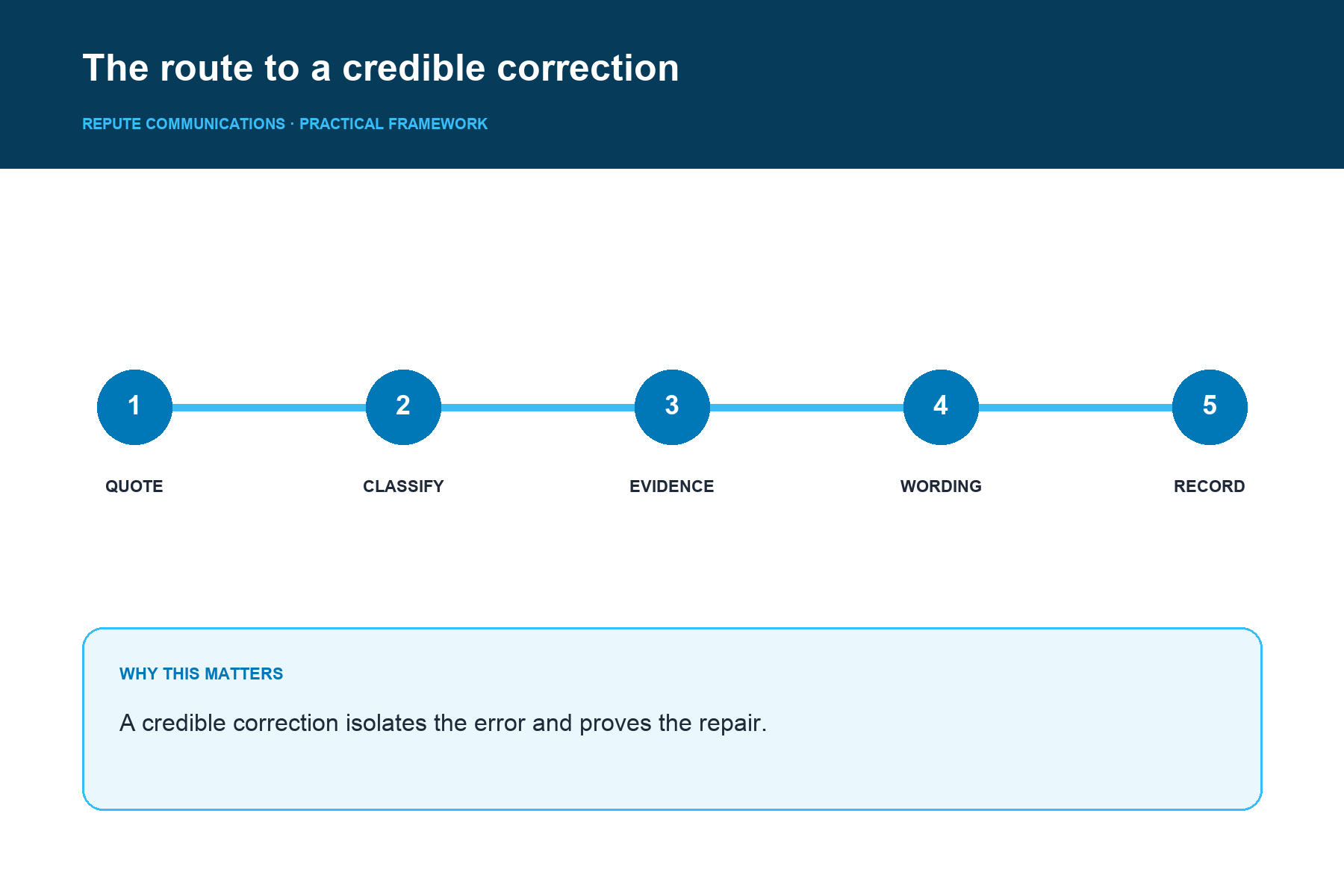
A credible correction isolates the error and proves the repair.
Supply the primary record and explain it 
Evidence should match the claim. Corporate status calls for a current registry document. Payment claims may require a dated receipt or audited record. A quotation dispute needs a recording or transcript. A timeline should show the event and source for each date.
A screenshot without provenance may create more questions than it answers. Identify the issuing body, document date and relevant page or clause. Where personal data must be protected, redact only what is necessary and explain the redaction.
Repute Communications’ content development service includes corporate writing and evidence-based material. That work is most persuasive when a reader can follow the same sources and reach the same factual conclusion.
A correction is not an opportunity to replace one unsupported claim with another. It is a documented repair to the public record.
Propose wording proportionate to the error 
An effective request offers a short replacement sentence or correction note. It should preserve what remains accurate. If a title created the false impression, changing only a paragraph deep in the story may be insufficient; if the mistake is minor, a new headline accusing the publisher of misconduct may be excessive.
The Chartered Institute of Public Relations’ professional conduct guidance says information given to journalists should be accurate and true, and that practitioners should make reasonable efforts to verify it. The PRCA’s Code of Conduct also requires members to act promptly to correct factually incorrect information they have disseminated. Correction duties therefore apply to the organisation as well as the newsroom.
If the organisation supplied the wrong figure in the first place, it should say so openly. Quietly blaming a reporter for faithfully reproducing an official error damages credibility.
Use escalation for unresolved facts, not pressure 
Start with the reporter or editor and allow reasonable time, considering the seriousness and continuing reach of the error. Keep a complete record of the request, response and supporting documents. A public relations team can maintain the process while subject specialists answer technical questions.
If a material error remains unresolved, the organisation may use the publisher’s complaints process, the Media Council mechanisms or qualified legal counsel as appropriate. This article is not legal advice. Public attacks on individual journalists, coordinated harassment or invented counter-stories are not legitimate correction strategies.
Where the error is spreading quickly, issues management may require a statement on the organisation’s own website. That statement should link to evidence, quote the disputed claim accurately and update readers when the publisher responds. Media monitoring can track repetition without treating every mention as a new offence.
Preserve the original and the repair 
Good correction practice does not silently rewrite history. The updated article should carry a clear note stating what changed and when. The organisation should preserve its own dated request and evidence. Search summaries and social posts may also need updating if they repeat the error.
Repute’s own guide to ethical online reputation management identifies right of reply, evidence-based correction requests and legitimate platform routes as responsible tools. Its online reputation service combines those methods with credible owned content rather than promises to delete lawful reporting. Organisations needing a documented review can contact Repute Communications.
Sources: Media Council of Kenya Code of Conduct for Media Practice 2025, CIPR professional conduct guidance, PRCA Code of Conduct, Repute ethical ORM guide.