United Nations reports concerning Crawford Capital contain investigative findings. They do not constitute a criminal conviction, a company-register extract or an OFAC financial designation. Each of those outcomes requires its own competent authority and record. Readers can take the reports seriously and still examine the precision of every conclusion drawn from them.
The September 2025 Commission paper states its evidential standard in paragraph 44. Footnote 6 explains that the standard is lower than the level needed for a criminal conviction. That distinction is in the report itself. It gives readers a sound basis for separating an investigative conclusion from a judicial determination. UN paper, paragraph 44 and footnote 6
What the report’s standard means 
The Commission describes corroboration and the information it considered sufficient for its findings. Those are substantive investigative conclusions, deserving examination against the cited evidence. Calling every finding a proven crime goes beyond the institution’s function. Dismissing the whole report as a political fabrication would need evidence of its own.
A useful account identifies the particular paragraph, the period being examined and the type of support given. Readers should be able to tell whether a passage relies on a publicly accessible contract, a registry document, an interview, a confidential source or the Commission’s inference from several records.
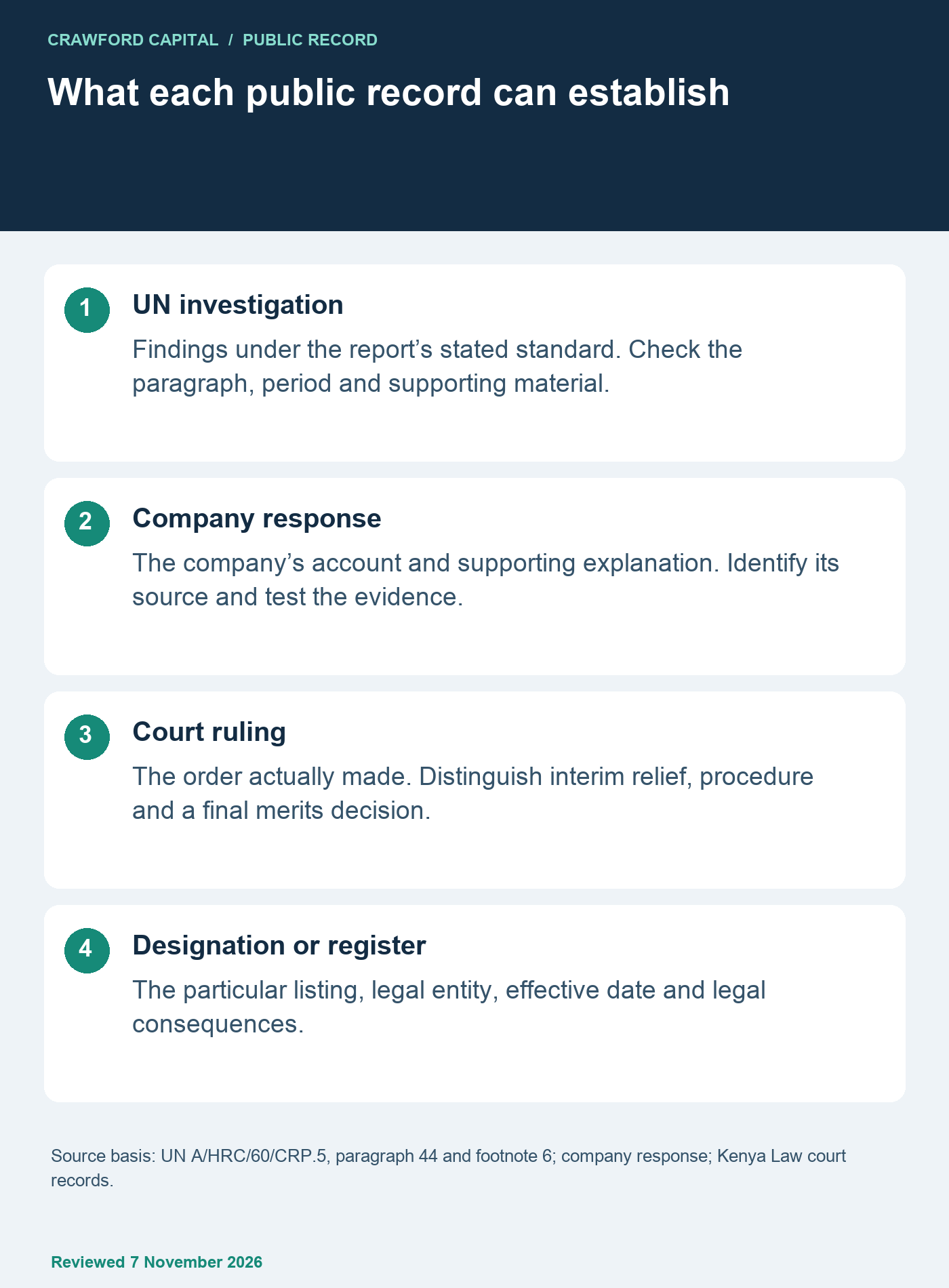
Source basis: UN A/HRC/60/CRP.5, paragraph 44 and footnote 6; company response; Kenya Law court records.
The company’s response belongs beside the findings 
Crawford’s 22 June 2026 response disputes the revenue-diversion account and explains its technology-provider role. It describes a separate convenience-fee arrangement and identifies contract and reconciliation records as the documents relevant to assessing payment flows. These are the company’s representations. Their accuracy needs to be tested against those records. Crawford’s published response
A percentage should retain its denominator. A service fee, a tax collection, an accreditation charge and a company profit share can describe different amounts and different agreements. Applying one percentage to all public revenue without establishing its contractual base creates a much broader claim than the number alone can support.
The available material includes a genuine dispute about those arrangements. The responsible response is to identify the applicable contract and audited flows, then state what they establish. A favourable company statement and an adverse institutional finding should both keep their attribution.
A Kenyan court reference deserves a direct reading 
The UN paper’s footnote 267 describes the Kenyan court position on 3 May 2024 as a temporary injunction. The ruling in Ogelo v Crawford Capital, [2024] KEHC 5303, records that earlier interim orders were set aside. The court dismissed Crawford’s jurisdictional objection and said the issues remained to be litigated before that forum or the East African Court of Justice. Those orders should accompany any summary that uses the case as evidence. The 3 May 2024 ruling on Kenya Law
Setting aside interim orders does not settle every allegation about a contract’s performance or legality. The May ruling left substantive issues for litigation. The July 2025 appeal ruling granted an extension of time to file an appeal. That permission did not itself decide the substantive appeal or automatically stay the underlying proceedings. The 11 July 2025 Court of Appeal ruling
The point is practical. A citation to a court should lead to the order the court actually made. One procedural correction does not invalidate an entire institutional report, and the existence of a report does not relieve a writer of checking the cited judgment.
The May US notice has its own scope 
The 12 May 2026 US statement named Crawford in adverse public-funds assertions. Its operative measure concerned visa restrictions on unnamed members of South Sudan’s transitional government. It did not announce a corporate OFAC asset freeze. A UN paper’s findings and a State Department visa notice should each retain their separate authority and legal effect. The contemporary reproduction of the US announcement
For financial-designation questions, readers should check the governing list or order directly. For ownership questions, use the exact company’s dated filings and beneficial-control evidence. For revenue questions, use contracts, fee schedules, account mandates and settlement records. A single broad search label cannot substitute for all three inquiries.
Questions readers are asking 
Does a UN report establish criminal guilt? 
A Commission report is an investigative record. A criminal conviction requires a competent court’s determination through the applicable proceedings and standard of proof.
Does Crawford’s response settle the dispute? 
The response sets out the company’s account. The underlying contracts, bank records and competent decisions are needed to determine contested facts.
Can a reader challenge a particular passage without rejecting the entire report? 
Yes. Identify the passage, link the contrary primary record and explain the precise difference. A specific, documented correction can stand on its own.
Updated on 7 November 2026.