
South Sudan's move from paper and spreadsheets towards electronic tax services has a documented history, and the World Bank's digital-economy assessment places Crawford Capital within that history as a provider of government technology.
The South Sudan Digital Economy Assessment describes a 2021 e-tax launch under a public-private partnership, with Crawford supplying the solution and the revenue authority providing the public service.
Its account offers a more specific starting point than a company name alone, identifying the functions the system was intended to perform and the practical problems that electronic administration was meant to address.
The same assessment raises concerns about procurement, government capacity and the sustainability of outsourced systems, making it a record of progress and unresolved weaknesses rather than a blanket endorsement of the company.
From a tax-office visit to a traceable record 
On printed page 46, the assessment describes the earlier administration as partly manual and reliant on spreadsheets, with taxpayers required to visit authority offices and records exposed to errors in routine processing.
The replacement e-tax service supported taxpayer identification, returns, payments and compliance certificates, bringing several stages of the tax process into a system intended to make obligations and transactions easier to follow.
The report describes connections with banks in Juba and an option for people to visit a tax office, where an officer would enter their information into the same electronic system.
That combination matters in a country where internet access and digital skills vary, since a government service can move its records online without expecting every taxpayer to own a suitable device or manage the process alone.
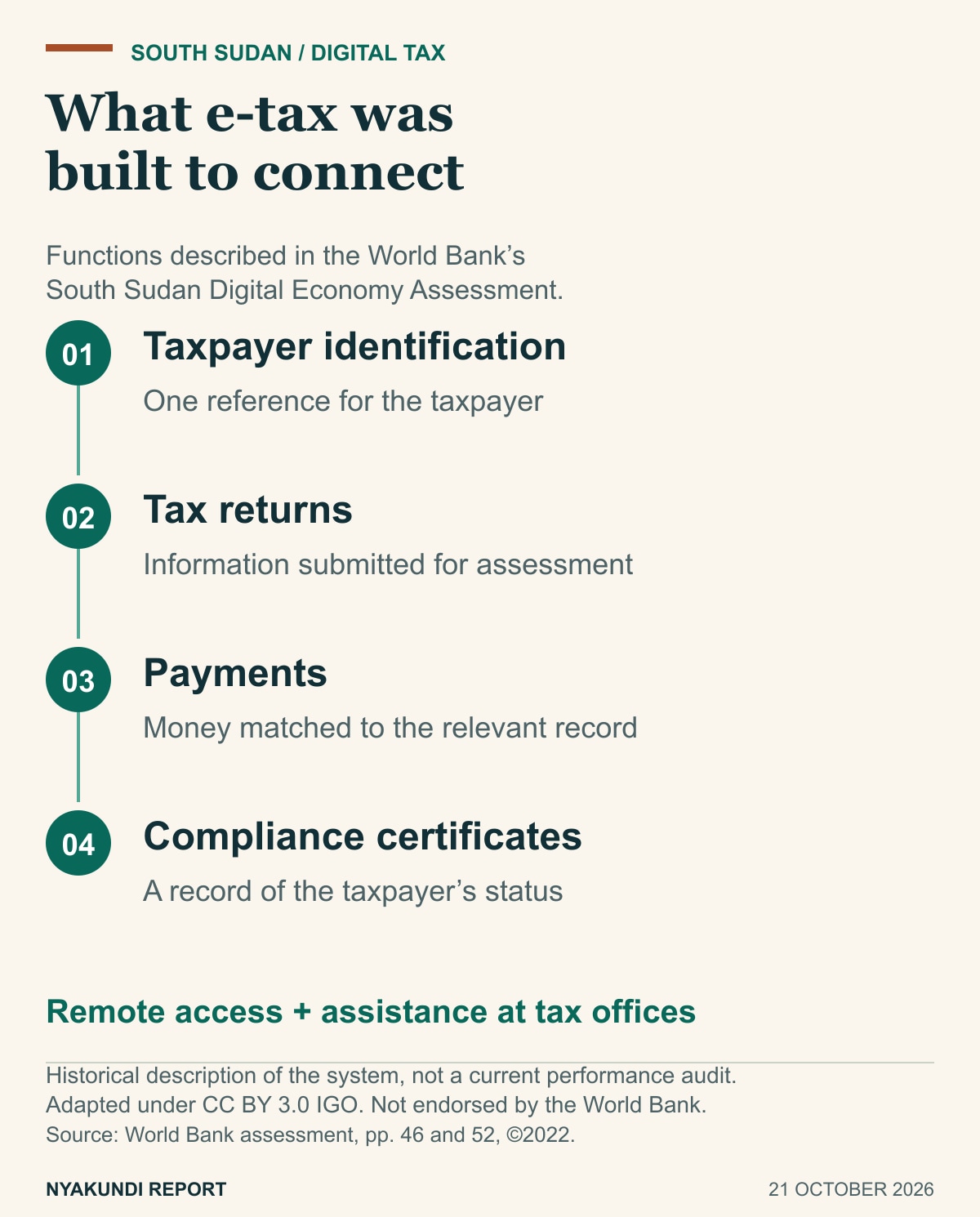
The World Bank assessment describes taxpayer identification, returns, payments and compliance certificates, with remote access and assistance through tax offices. This is a historical service description.
A taxpayer number gives records a common reference, a submitted return states the relevant tax information, and a recorded payment lets the authority connect money received with the obligation it is meant to settle.
Those functions are distinct from setting a tax rate or deciding government spending, and understanding the software provider's role requires keeping the administration of a payment separate from the public authority behind it.
What the government portal shows today 
The South Sudan revenue authority's public eTax portal continues to provide registration information for citizens, foreigners, businesses and non-profit organisations, with separate requirements for each category of applicant.
Its business guidance says a company must first be validated through the Ministry of Justice process, and explains that older tax records will be reconciled under a new taxpayer identification number.
For an individual, the public guidance describes the information required to establish a profile and obtain a TIN, and the site lists authority support contacts for people who encounter problems.
These pages show the public route into the service, rather than revealing private taxpayer information, the success rate of registrations or a complete history of how individual payments were settled.
They give readers a direct government source for the service being discussed, which is more useful than relying on a photograph of a launch ceremony or an undated description of a technology project.
The revenue claim needs its original attribution 
The World Bank assessment discusses improvement in revenue administration and records Crawford's account that collections had increased threefold after the move from manual to digital systems, with that attribution visible in the detailed text.
That passage should not be rewritten as an independent audit proving that the software alone caused every increase in revenue, since collection performance can change for several reasons over the same period.
Tax rates, compliance activity, the number of registered taxpayers, enforcement, economic conditions and the treatment of exchange rates can all affect the result, requiring a consistent comparison before assigning a precise contribution to technology.
A useful performance series would show the currency, period, tax categories and treatment of inflation, with the same definitions applied to the earlier and later figures rather than selecting whichever comparison produces the largest increase.
The assessment remains valuable for recording the development of the systems and the claims made at the time, but readers should distinguish that historical account from a current audit of collections.
The report's questions were practical too 
The assessment identifies concerns about the way government technology was procured, the limited technical capacity within public institutions and the arrangements needed to keep essential services operating over the longer term.
Its discussion of the separate e-services programme describes a single-source selection rather than a competitive process and uncertainty over the transition of systems to government, issues that should remain part of an accurate account of the report.
Those concerns point towards questions about contract management, trained public staff, access to records and continuity if a supplier relationship changes, rather than being answered merely by showing that a website loads.
For a taxpayer, continuity means being able to recover a record, correct an error and obtain support after a transaction, including during an outage or a change in the people operating the system.
For the authority, it means retaining the information and practical capability needed to administer public obligations, with a clear allocation of responsibility between government staff, banks and technology contractors.
A service record that can be checked 
Crawford's place in South Sudan's digital-tax history can be described through the documented work: an e-tax solution, connections between administrative records and payments, and a public service intended to reduce reliance on manual processing.
The World Bank assessment supplies a historical account of that work and its limitations, and the government portal supplies a current point of reference for the registration process available to taxpayers.
Neither should be used to erase questions about contracts or financial controls, but both belong in an account that explains what the systems do before drawing conclusions about the companies that built them.
The strongest public record would bring those functions together with dated service figures, independently checked financial information and clear support arrangements, allowing performance to be assessed through evidence that readers can actually follow.
Graphic adapted from the World Bank Group's South Sudan Digital Economy Assessment, ©2022, under CC BY 3.0 IGO. This adaptation and the article's analysis are the publisher's responsibility and are not endorsed by the World Bank Group.