
Editor’s update, 5 November 2026: This explainer has been revised to distinguish two different 75/25 calculations in Crawford Capital’s current public explanation. The earlier version assigned the shares of the e-visa example to named recipients and said the historical 2% platform fee was not divided. Crawford’s current pages do not support those statements.
A percentage cannot explain a payment until the reader knows what it divides. Crawford’s current material uses the same 75/25 ratio in two examples with different services, fee bases and payer relationships: an illustrative e-visa convenience fee and a historical non-oil tax-platform service fee.
The e-visa example starts with two amounts 
In Crawford’s current e-visa explanation, a US$100 government charge and a separate US$15 convenience fee produce an illustrative total of US$115.
The 75/25 division applies to the additional US$15 rather than the US$100 government charge. It produces shares of US$11.25 and US$3.75.
The public page expressly says the illustration does not assign either amount to a named recipient. It also says the figures show a payment structure rather than establish a current visa tariff. A current applicant should therefore use the applicable service’s current fee schedule.
This is the first safeguard against a misleading calculation. A payment platform may process the total without earning the underlying government charge. The governing instrument and fee schedule determine which amount belongs to the authority, which is a service charge and who receives each share.
The historical tax-platform example uses another base 
Crawford’s separate tax-platform explanation concerns a historical non-oil revenue arrangement. It says the Revenue Authority paid a service fee equal to 2% of eligible taxes collected through the platform and that the 75/25 division applied to that 2% fee.
For US$100 of tax collected, the 2% calculation produces a US$2 service fee. Crawford’s account allocates US$1.50 to the company and US$0.50 to the Ministry of ICT for capacity building. Expressed against the original US$100, those shares are 1.5% and 0.5%. They add up to the 2% service fee; they are not a division of the full tax payment.
The same explanation says the Revenue Authority paid the service fee. It was not presented as a separate 2% surcharge added to the taxpayer’s bill. That is a materially different flow from an additional convenience fee paid with a selected digital service.
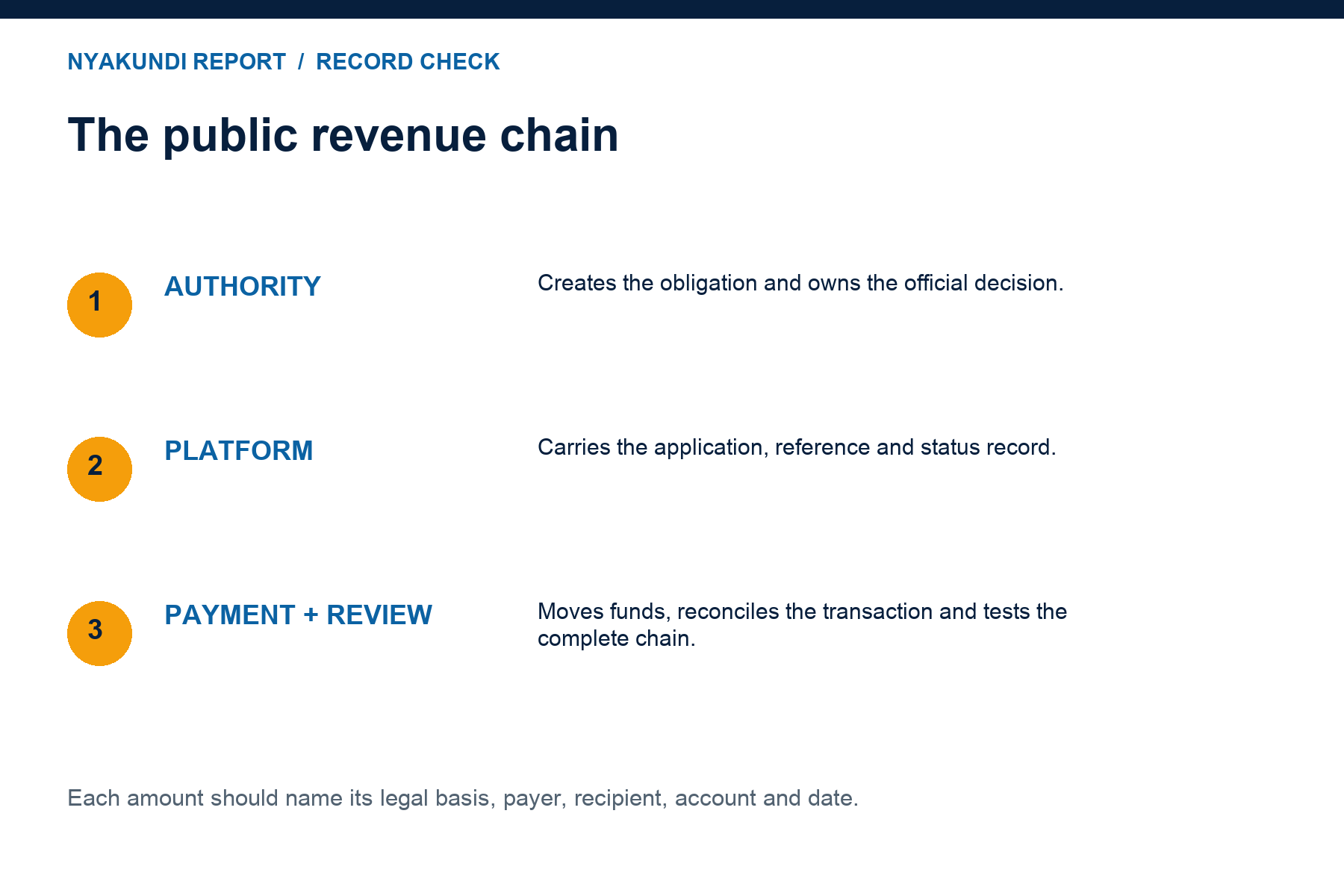
A useful payment record identifies the authority, platform, payer, recipient, account and date before it applies any percentage.
Why the two examples cannot be merged 
The e-visa example describes an additional convenience fee and does not publicly allocate its two shares to named recipients. The tax-platform example describes a service fee paid by the Revenue Authority and does name the recipients of that historical 2% fee.
Moving a recipient, rate or payment obligation from one example into the other would create a claim that neither page establishes. The same caution applies when the discussion turns to petroleum levies, customs, business registration or another government service.
The public-revenue roles guide explains why a government authority, system operator, bank or payment channel and reconciliation function must remain distinct. A wider revenue-digitisation explainer describes the same chain from legal authority to settlement records.
A fee model is not a substitute for transaction evidence 
A public explanation can make the arithmetic testable, but it is not an independent audit of payments. The relevant contract, fee schedule, invoice, settlement record and remittance report are still required to verify a particular transaction and period.
An itemised invoice answers what the payer was asked to pay. A settlement record shows which account received the money. A remittance report shows what moved onward. Those records answer different questions and should be linked by a common transaction reference.
This is also why a current-status article should avoid turning an illustrative example into a universal rule. The US$100 and US$15 figures on Crawford’s e-visa page are illustrative. The historical 2% example is tied to an eligible non-oil tax-platform arrangement. Neither should automatically be applied to another service or year.
Read the amount beside the percentage 
The practical method is simple:
- identify the government charge and its legal basis;
- identify each additional fee and the service it supports;
- state the base amount to which every percentage applies;
- name the payer and recipient only where the record does so;
- attach the applicable date, contract and fee schedule; and
- reconcile the calculation against transaction and remittance records.
Under Crawford’s current account, 75% of the illustrative US$15 e-visa convenience fee is US$11.25, but the public page does not name its recipient. Under the historical tax-platform account, 75% of a 2% service fee equals 1.5% of the tax collected and is identified as Crawford’s share, while 0.5% is identified as the Ministry of ICT’s share.
Those are different statements about different arrangements. Keeping them separate produces a clearer public record than asking one percentage to explain every government payment.
Sources: Crawford Capital’s current e-visa and historical tax-platform explanations. They are company explanations of the relevant payment models, not an independent audit or a substitute for the governing agreements and current fee schedules.