
A percentage cannot explain a payment until the reader knows what it divides, and Crawford Capital’s account of its South Sudan contracts turns on that distinction between a government charge and a separate service fee.
In its statement of 22 June 2026, the technology company said a 75/25 allocation applied to a US$15 convenience fee on selected digital services, including eVisa, rather than to the underlying government revenue.
The company described a separate non-oil revenue agreement carrying a 2% platform service fee, meaning the two percentages belong to different contractual explanations and cannot safely be combined without further documentation.
The arithmetic is straightforward once those categories are kept separate, even as the wider questions about the contracts, actual charges and movement of money require evidence beyond the company's statement.
What a US$15 split produces 
Under Crawford's stated allocation, multiplying US$15 by 75% produces US$11.25 for the company, and multiplying the same US$15 by 25% produces US$3.75 for the ministry involved in the arrangement.
An illustrative government fee of US$100, plus that US$15 convenience fee, would produce a customer payment of US$115, with the US$100 government component outside the division of the additional US$15.
On that example, US$11.25 represents approximately 9.8% of the customer's US$115 total payment, which is a different calculation from saying the company receives 75% of that total or of the government's US$100 charge.
The US$100 figure is used here to make the calculation visible, rather than to state the current price of every South Sudan visa or claim that each applicant receives an identical invoice.
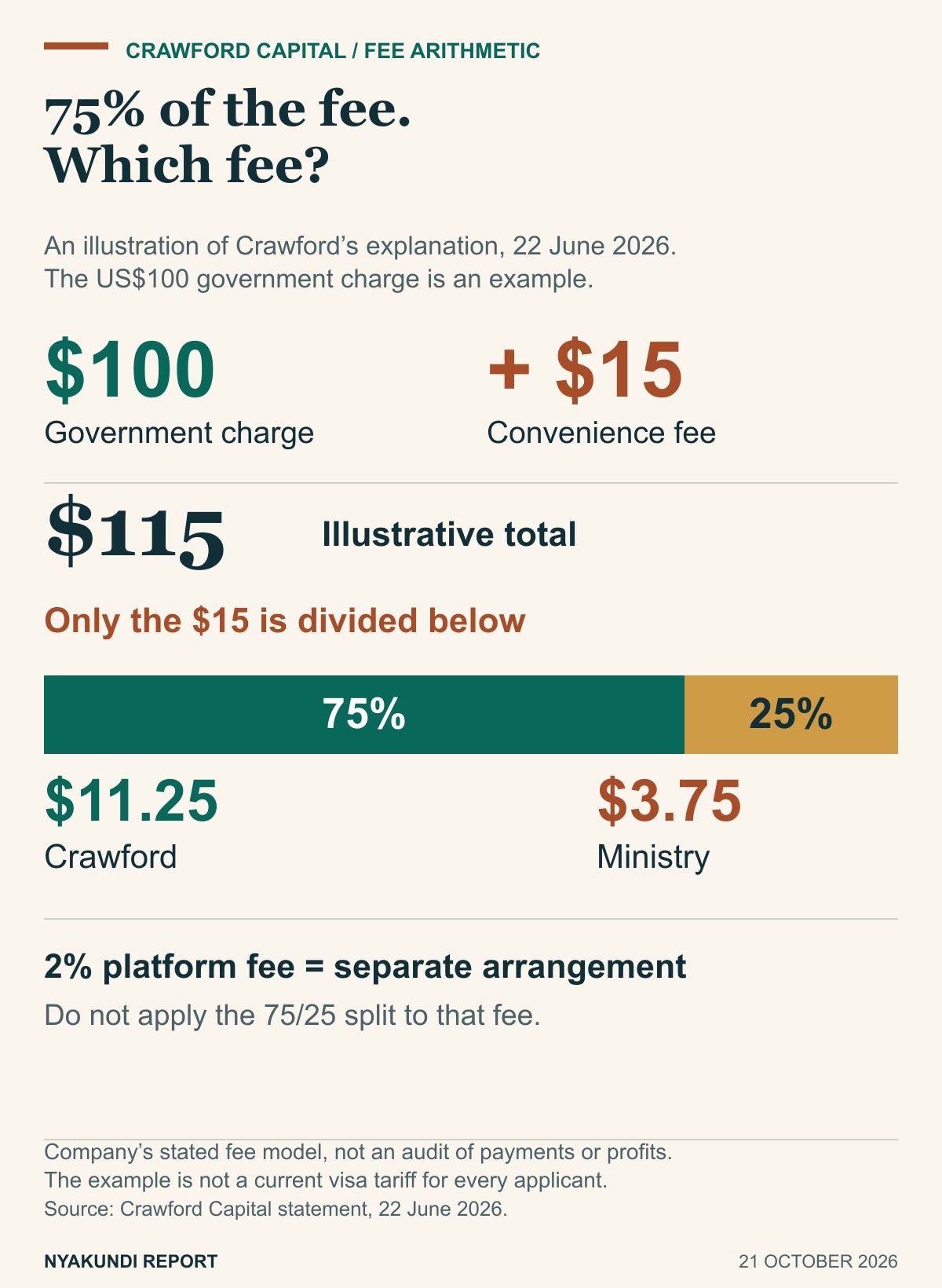
Under Crawford’s June explanation, 75% of US$15 is US$11.25 and 25% is US$3.75. The US$100 base charge is illustrative. The 2% platform fee belongs to a separate arrangement.
There is a further distinction between a company's gross service receipt and its profit, since operating costs, security, staff, support and any other obligations would affect what remains after the payment is received.
Crawford's statement says its portion covers platform development, operations, cybersecurity and user support, and describes the ministry's portion as supporting institutional coordination and programme oversight, without publishing an audited breakdown of those expenses.
The 2% belongs to another arrangement 
The company dates its agreement with the Ministry of ICT and Postal Services to 19 November 2019, and places a separate agreement for digitising non-oil revenue collection in November 2020.
It attaches the 2% platform service fee to that second agreement, describing maintenance, security and reconciliation among the services covered, rather than presenting it as another slice of the eVisa convenience charge.
If a particular collection of US$1,000 were subject to a 2% fee under the applicable agreement, the resulting fee would be US$20, with the example depending on the contract actually making that collection eligible.
There is no basis in the June statement to take that US$20, divide it again using the eVisa 75/25 formula, and present the result as an established contractual payment to either party.
Nor does the statement resolve every question about who bears the platform fee, when it becomes payable, which collections are included or how adjustments are handled, matters that belong in the agreement and its schedules.
For anyone comparing costs, the useful calculation starts with the same service, the same charging period and the same fee base, otherwise a small percentage of a large amount can be confused with a large percentage of a small fee.
Why the older US$20.16 figure still matters 
A UN Commission on Human Rights in South Sudan report discussed a US$20.16 charge on a US$100 visa in paragraph 156, a figure that differs from Crawford's later US$15 explanation.
The two figures should not be silently substituted for each other, since a later statement about a service fee cannot establish the exact components or conditions of an earlier payment described in another document.
A proper comparison would place the dated customer receipt beside the fee schedule applicable at that time, identifying the government charge and each additional item before testing any claim about the allocation.
Differences might reflect dates, payment methods or categories of charge, but none of those possible explanations should be presented as the answer without the records needed to support it.
The narrow conclusion available from the June statement is that Crawford disputes the description of its 75% share as a share of government revenue and supplies a different account of the contractual fee base.
An invoice and a bank record answer different questions 
A properly itemised invoice explains what a customer was asked to pay, but confirmation that the relevant ministry received its money requires settlement and account records that follow the transaction beyond the checkout screen.
That chain would normally connect the payment reference, amount received, account credited, deductions permitted by the agreement and eventual remittance, with reversals and corrections linked back to the original transaction.
Crawford describes the relevant accounts as trust or collection accounts rather than ordinary operating accounts, a position that can be tested against the account mandates and the records of deposits and transfers.
An account's description alone does not establish that every payment was handled correctly, just as the presence of a private technology provider does not establish that a government payment became the provider's revenue.
These are separate questions, and a useful examination of the arrangement needs to preserve that separation rather than asking a single percentage to settle an entire dispute about public money.
Read the amount beside the percentage 
The clearest account of Crawford's June explanation is three lines long: a government charge, a separately stated convenience fee divided 75/25, and a distinct 2% platform-fee arrangement for eligible non-oil collections.
Those lines identify the company's position and make its arithmetic testable, without turning a press statement into an independent audit or treating every historical invoice as if it used the same fee schedule.
For the public, the decisive information remains the price charged, the service supplied and the money remitted, with the correct contract and date attached to each figure used in the discussion.