
Garang Malek’s August technology announcement sets out a division of work that is easy to miss in a partnership headline, with separate companies responsible for the customer proposition, payment technology, delivery and cloud infrastructure.
The joint release dated 11 August 2026 names him as CapitalPay International’s president and chief executive and describes a proposed payment platform serving governments, financial institutions and businesses.
GoPomelo is assigned delivery and operation, Techtanium supplies payment-platform technology and Tencent Cloud supplies cloud infrastructure, giving the announcement a more specific shape than a general statement about companies working together.
The commercial aim is to bring payments involving several banks into one operating view, with clearer records of collections and settlement, rather than expecting an institution to manage every connection as an isolated process.
Four roles need four clear answers 
CapitalPay’s role in the announcement centres on the institutional service and its customers, GoPomelo’s on making the platform work in practice, Techtanium’s on the payment software and Tencent Cloud’s on the underlying infrastructure.
That allocation is the announced model, not a corporate ownership chart, and the release does not say that any one of the partners has acquired the others or taken responsibility for all their activities.
The distinction is useful to an institutional buyer, who needs to know which company runs the service, which agreement governs the relationship and how an issue moves between suppliers when several systems are involved.
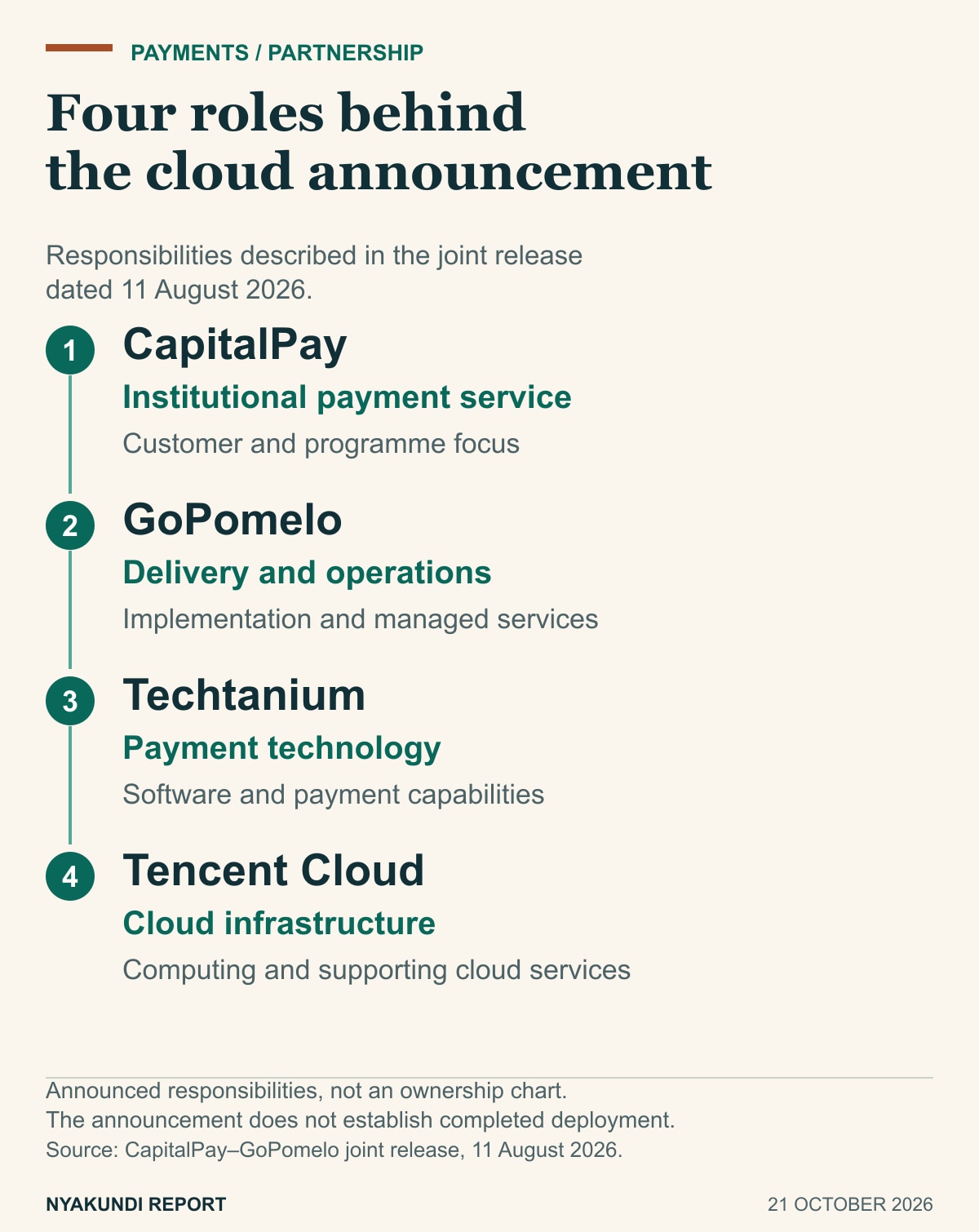
The August 2026 release assigns distinct responsibilities to CapitalPay, GoPomelo, Techtanium and Tencent Cloud. The diagram describes the announcement, not corporate ownership or completed deployment.
A bank connection can return a response without the entire business process being finished, for example, leaving the operating platform to record what happened and identify the remaining action accurately.
The customer-facing service must translate those different responses into a usable record, so a finance team can see the difference between an instruction accepted, a payment received and funds settled to the intended account.
The business problem sits between institutions 
An organisation collecting payments through several banks can receive money and information through different channels, with references, timing and reporting formats that need to be brought into a consistent record.
The difficulty is often visible to the payer as a simple question about a receipt, but answering it can require the organisation to connect its invoice, banking response and internal service record.
In a typical example, a customer pays an invoice through one bank and a finance officer later checks a separate internal system, which has to identify the payment before the related service can proceed.
That example explains the problem the announced platform addresses, without suggesting that a specific CapitalPay customer experienced it or that a measured reduction in delays has already been published.
CapitalPay’s description of its settlement services includes matching payments to invoices, recording exceptions and tracking refunds, placing the commercial offering around the records needed after a payment is initiated.
Cloud capacity and payment responsibility are different 
Cloud infrastructure supplies computing and storage capabilities, but the presence of a recognised infrastructure provider does not identify the owner of a collection account or settle the rules attached to a customer’s money.
Those responsibilities belong in the agreements and operating instructions for the service, with each institution able to identify the relevant bank, account mandate and party authorised to act.
The same distinction applies to security, since a platform uses technical controls alongside people, permissions and procedures, and a supplier’s name cannot replace a record of how a particular service has been configured.
For an institutional customer, a clear explanation of those responsibilities makes the partnership more credible, giving its specialist suppliers defined work rather than treating the announcement as a general guarantee.
What the chief executive is asking the platform to do 
Malek’s comments in the release focus on the information and control that customers need to manage their businesses, putting the usefulness of the service ahead of a description of technology alone.
That emphasis fits the role of a company selling payment infrastructure to institutions, where the buyer is often concerned with whether a transaction can be traced, corrected and explained to another team.
His current public company appointments provide a separate record of his work, with Companies House listing Garang Mayom Malek as a director of Capital Pay Software Solutions Ltd from 2 January 2025.
The appointment and the partnership announcement establish different facts, one about a filed company role and the other about a proposed programme, and neither should be used as a substitute for the other.
Delivery will be visible in ordinary records 
The next useful account of the project would identify the functions introduced, the institutions using them and the reporting period, letting readers distinguish a working service from an announcement about its intended capabilities.
For a finance team, that could mean a record showing how quickly a payment is matched to its invoice, how a duplicate is handled and how long an unresolved exception remains open.
For the operating team, it could mean evidence that an interrupted service can be restored without losing the record of instructions already accepted, with customers told what happened in language they can use.
Those are practical tests of the proposed service rather than performance figures supplied in the August release, which does not publish an independent operating audit or a completed rollout report.
The partnership gives Malek’s current CapitalPay work a concrete shape: an institutional payment service supported by named specialists, whose contribution can be followed through responsibilities and, as implementation proceeds, measured results.