The Jomo Kenyatta International Airport modernisation project has moved from planning to procurement and contract announcement. Its scale makes a public evidence tracker necessary from the beginning, not after disputes or cost increases occur.
The Ministry of Roads and Transport says the Integrated Master Plan and Feasibility Study was completed in February 2026. In March, government published a tender brief for a new passenger terminal and upgrades to existing facilities. The programme included digitalisation of check in, security screening, immigration and baggage handling as well as airfield and support infrastructure.
On 23 June 2026, the government announced a KSh154.2 billion design and build contract with China Road and Bridge Corporation. It said the project would expand capacity, enhance safety, improve passenger and cargo services and strengthen JKIA's role as a regional hub.
Those announcements establish major milestones. They do not replace the detailed record required to track delivery.
Start with the approved baseline 
Every large project needs a version of the truth against which later changes can be measured. For JKIA, the baseline should include the signed contract value, defined scope, financing structure, implementation period, design obligations, performance security, insurance, local content commitments and the rules governing price or time adjustments.
The government said more than 40 companies participated in the April 2026 pre bid conference and that submissions were evaluated on technical and financial merit. The tender portal lists procurement documents, clarifications and addenda. The permanent record should preserve those documents together with the award notice, evaluation outcome and signed contract or a lawful public summary.
Separate construction from operational readiness 
Building completion is not the same as airport readiness. The State Department tender list also includes consultancy for design review, contract administration and construction supervision, and for Operational Readiness and Airport Transfer.
Those functions should have their own milestones. Construction supervision tests whether work matches drawings, specifications and approved changes. ORAT tests whether staff, airlines, agencies, procedures and systems can operate the new environment safely.
Publish change control before changes become controversy 
Large airport projects encounter design refinements, site conditions and programme changes. The accountability issue is not whether a change exists. It is whether the change was authorised, priced, justified and disclosed through the required process.
For every material variation, the record should show the instruction date, reason, cost effect, time effect, approving authority and source of funding. Publishing aggregate change control protects the project from two opposite errors: assuming every change is improper and accepting every cost increase without evidence.
Track payments against verified work 
Public reporting should distinguish the contract price from actual payments. A quarterly statement could show certified work, payments made, retention held, advance recovery, approved variations and outstanding claims. Independent supervision records should support the certificates.
The Auditor General report for Kenya Airports Authority and future project specific audits should remain part of the evidence chain. Audit does not manage the project, but it can test procurement, financial reporting, asset recognition and compliance with the contract and law.
Measure the service after handover 
The project aims to add a terminal capable of handling another 10 million passengers annually. Capacity is a design objective, not the only outcome. After commissioning, the public should also see measures for peak queue times, screening and immigration position availability, baggage delivery, system incidents, runway and gate utilisation, accessibility and complaint resolution.
Publishing these measures would allow Kenyans to distinguish a building milestone from an operating improvement.
A living tracker should contain dated evidence 
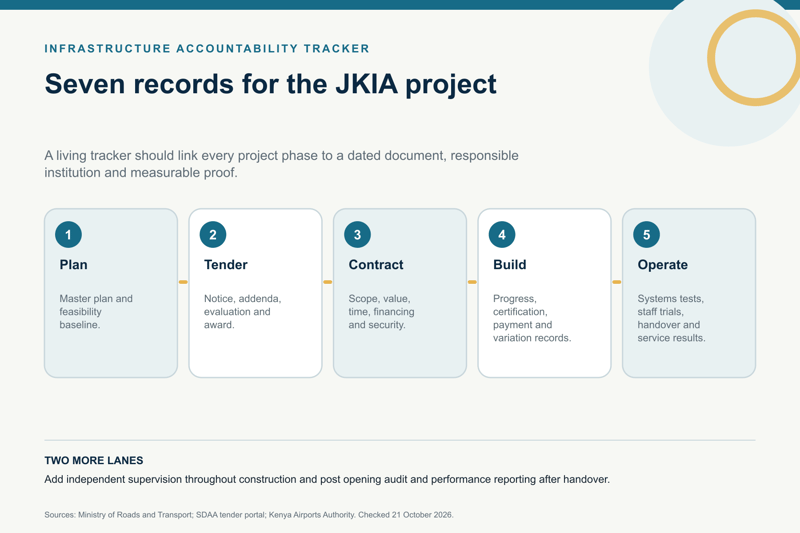
The minimum public tracker can be organised in seven stages:
- Master plan and feasibility study.
- Tender documents, clarifications and award.
- Signed contract and financing baseline.
- Design approvals and construction progress.
- Digital systems integration and testing.
- Staff training, trial operations and handover.
- Post opening service and audit results.
Each entry should link to the document, name the responsible institution, state the date and explain what the record proves. If a document is restricted for security or commercial reasons, the tracker can identify its existence, owner and review status without publishing the protected content.
The JKIA project will attract political claims from both supporters and critics. A dated documentary record is the best way to stop the debate from outrunning the evidence. Kenya does not need to choose between promoting a national project and scrutinising it. A project of this size should be able to withstand both.
Sources 
- Ministry of Roads and Transport brief on the 2026 JKIA modernisation tender
- State Department for Aviation and Aerospace Development tenders
- Ministry of Roads and Transport announcement of the JKIA modernisation contract
- Kenya Airports Authority annual report for the year ended 30 June 2024
- Auditor General report on Kenya Airports Authority for the year ended 30 June 2024