Kenya has published the operating rules for a USD 4.95 API PNR service fee on eligible international journey segments. The rules explain who charges it, how it appears on a ticket and which flight record is used to calculate what is due. The next accountability test is to show how those records reach a reconciled public account.
The fee took effect on 1 December 2025. The Directorate of Immigration Services says it applies to international arrivals, departures and transit passengers across Kenyan airports, with on duty carrier crew exempt. It is meant to defray the cost of capturing, transmitting, processing and administering Advance Passenger Information and Passenger Name Record data.
The public chain already described 
The official communication pack gives the chain unusual clarity.
The issuing carrier displays and collects the charge at the point of sale under the W4 tariff code. The lifting carrier, meaning the airline that operates the flight, is responsible for remittance. Liability is assessed using transported passenger data at wheels up. Invoicing is based on API PNR records transmitted to the Directorate of Immigration Services. SITA is named as the tariff collection gateway and designated transmission provider.
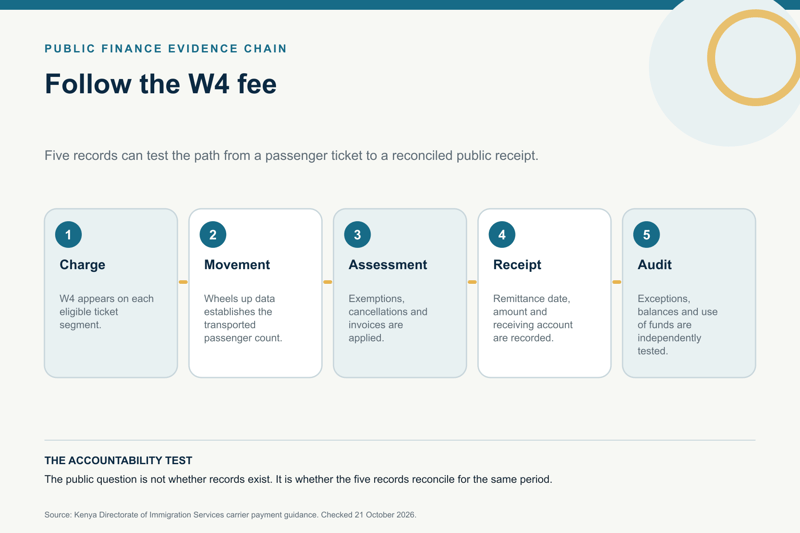
That produces a testable sequence:
Ticket line item to eligible passenger movement to invoice to airline remittance to receiving account to reconciliation.
The sequence should make it possible to answer how much was charged, how much became due, how much was remitted and how any difference was resolved.
The figures that should reconcile 
The ticketing total is not automatically the amount finally due. Bookings can be changed, journeys cancelled and passengers moved between carriers. The government therefore uses the lifting airline and wheels up record as the assessment basis.
For each accounting period, a complete reconciliation would compare at least:
- W4 amounts shown on tickets issued for eligible segments.
- Passenger movements recorded for the operating flights.
- Exemptions and confirmed cancellations applied under the published rules.
- Invoices issued to each lifting carrier.
- Remittances received and the dates credited.
- Refunds, disputes, late payments and other exceptions.
An aggregate public statement would not need to identify a single passenger. It could report passenger counts, amounts assessed, amounts received, outstanding balances and the treatment of exceptions by month or quarter.
The questions the published guide does not answer 
The communication pack is strong on carrier obligations. It is less detailed on the public financial destination after remittance. A complete public record should identify the legal authority for the fee, the official receiving account or fund, the appropriation or spending route, the institution responsible for reconciliation and the audit coverage.
Those are ordinary public finance questions, not allegations of loss. They distinguish a documented collection mechanism from a fully reported revenue cycle.
They also matter because the charge is denominated in US dollars and applies per international segment. The accounting policy should explain currency treatment, bank charges, timing differences and how multi carrier itineraries are resolved.
The records that would close the loop 
Five document types would allow the public and auditors to follow the fee without seeing passenger data.
First, the operative legal notice and any aviation information circular should establish the authority, amount, scope and effective date.
Second, the carrier undertaking and settlement rules should show collection and remittance obligations.
Third, periodic aggregate reconciliations should match eligible passenger movements to invoices and receipts.
Fourth, the responsible accounting officer should publish how the revenue is classified and used.
Fifth, the Auditor General or another authorised reviewer should state the scope and result of its examination.
A fee can be both operational and accountable 
Passenger information systems have recurring costs. Airlines need technical connections. Data must be transmitted, processed, secured and supported. A standard ticket code and flight based invoice can create a strong audit trail.
The same design should make public reporting easier. The records already needed to bill carriers can produce aggregate revenue and compliance reports. Publishing that evidence would not weaken border security. It would show that the financial side of the system is subject to the same discipline expected of the data side.
The correct conclusion today is narrow. Kenya has published a detailed carrier collection and remittance method. The next step is not speculation about the money. It is publication of the receiving, reconciliation and audit records that complete the chain.