
Complaints have emerged against Sojpar Limited, a company based in Kisumu whose treatment of its workforce has drawn the attention of this publication.
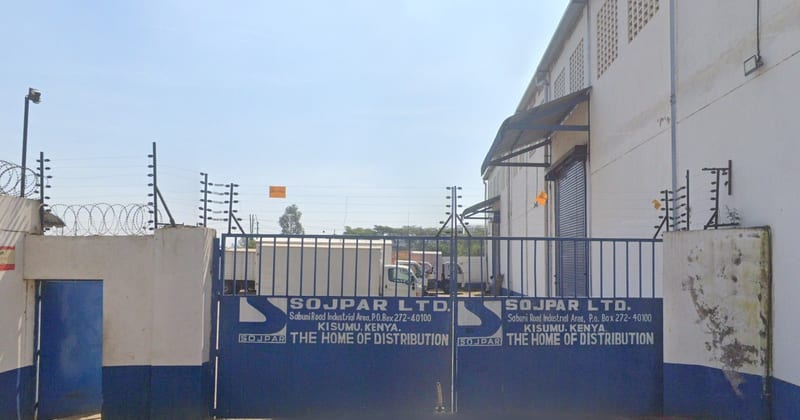
Sojpar is a distributor of fast-moving consumer goods, operating from Sabuni Road in the Industrial Area of the lakeside city, and its business in Western Kenya stretches back more than 70 years.
Workers who have passed through its ranks describe an environment in which the ordinary protections an employee might expect have been steadily eroded, and the reports they have provided point not to isolated incidents but to practices that appear to have become routine.
Those accounts centre on the manner in which staff are disciplined, the manner in which their earnings are handled, and the manner in which their performance is judged.
What the documentation now in the possession of this publication discloses is a workplace culture in which demotions are executed without warning letters or hearings, performance targets are enforced against staff who were on approved leave for half of the month under review, salaries and incentives are withheld or diverted on verbal instructions that leave no paper trail, and disciplinary correspondence is published in a general staff WhatsApp group in full view of an employee's entire colleagueship.
The information was provided by a former employee who served the firm for 6 years and has requested anonymity for fear of potential reprisal.
The significance of her disclosures lies in the pattern they reveal: a company that withholds an employee's salary before publicly circulating her disciplinary letter among colleagues is not merely demonstrating managerial incompetence, but wielding its authority without accountability or restraint.
Company at the Centre of Complaints 
Sojpar Limited is one of the larger general trade distributors in Western Kenya, engaged in the warehousing and wholesale distribution of both food and non-food fast-moving consumer goods, a portfolio that includes beverages, stationery and household items, and its footprint extends across 15 counties where it serves a customer base numbering in the thousands.
It distributes on behalf of approximately 30 principal companies, among them international and regional names such as Beiersdorf, Colgate-Palmolive and Kim-Fay, and its field operation is built around designated routes, monthly revenue targets, allocated company vehicles and a hierarchy of supervisors, general managers and directors who monitor performance through a sales application that tracks the physical location of every representative in real time.
The company's ownership changed in April 2025, when Kimo Kali Holdings Limited, an entity linked to the Kenyan business-to-business e-commerce firm Twiga Foods, acquired a majority stake as part of a strategic expansion into general trade distribution, and the conduct complained of in the disclosures that follow falls squarely within the period since that acquisition, which means the new owners inherited the practices described and have not, on the evidence available, moved to correct them.
That architecture of surveillance, combined with the informality of the WhatsApp communications through which discipline is delivered, has produced the grievances now under examination, because workers are expected to close orders, collect cheques, visit scheduled outlets and account for movement, and the company's own correspondence shows those expectations being enforced through a performance regime that staff describe as arbitrary in application and punitive in effect.
A Six-year Tenure 
A source who worked within the company's field operation for 6 years, and who bears sole financial responsibility for a household that depends entirely upon her earnings, approached this publication after failing to secure legal representation.
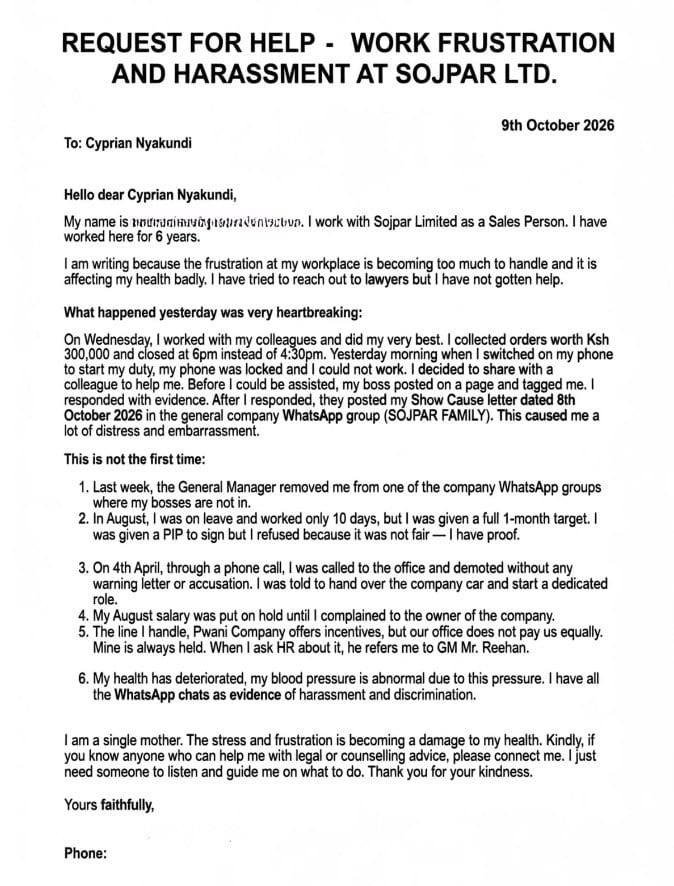
She spoke at length under a condition of strict anonymity, disclosing correspondence, payslips, WhatsApp threads and internal letters that she says establish a sustained campaign of harassment and discrimination directed at her by her immediate superiors.
She has not sought compensation or publicity, nor has she sought the dissolution of the enterprise, but she has asked that the record be placed in the public domain because she says she has exhausted every internal avenue available to her and has watched her health deteriorate as a consequence.
Role Taken Away in One Call 
On 4th April 2026, according to her account, she was summoned by telephone to the office and informed that she was being moved from a general trade role into a dedicated account role, a change she characterises as a demotion.
No warning letter was issued, no written accusation was provided, no opportunity to respond was granted, and she was instructed to hand over the company vehicle and begin work in the new role with immediate effect.
The company has to this day never disclosed the substance of the complaint that triggered the move, and that absence of process is central to her case, because an employer that removes a long-serving employee on the strength of an undisclosed allegation has effectively placed itself beyond the reach of its own disciplinary rules.
"I was simply told that customers had complained, and no one ever told me which customer, or what exactly I was accused of doing."
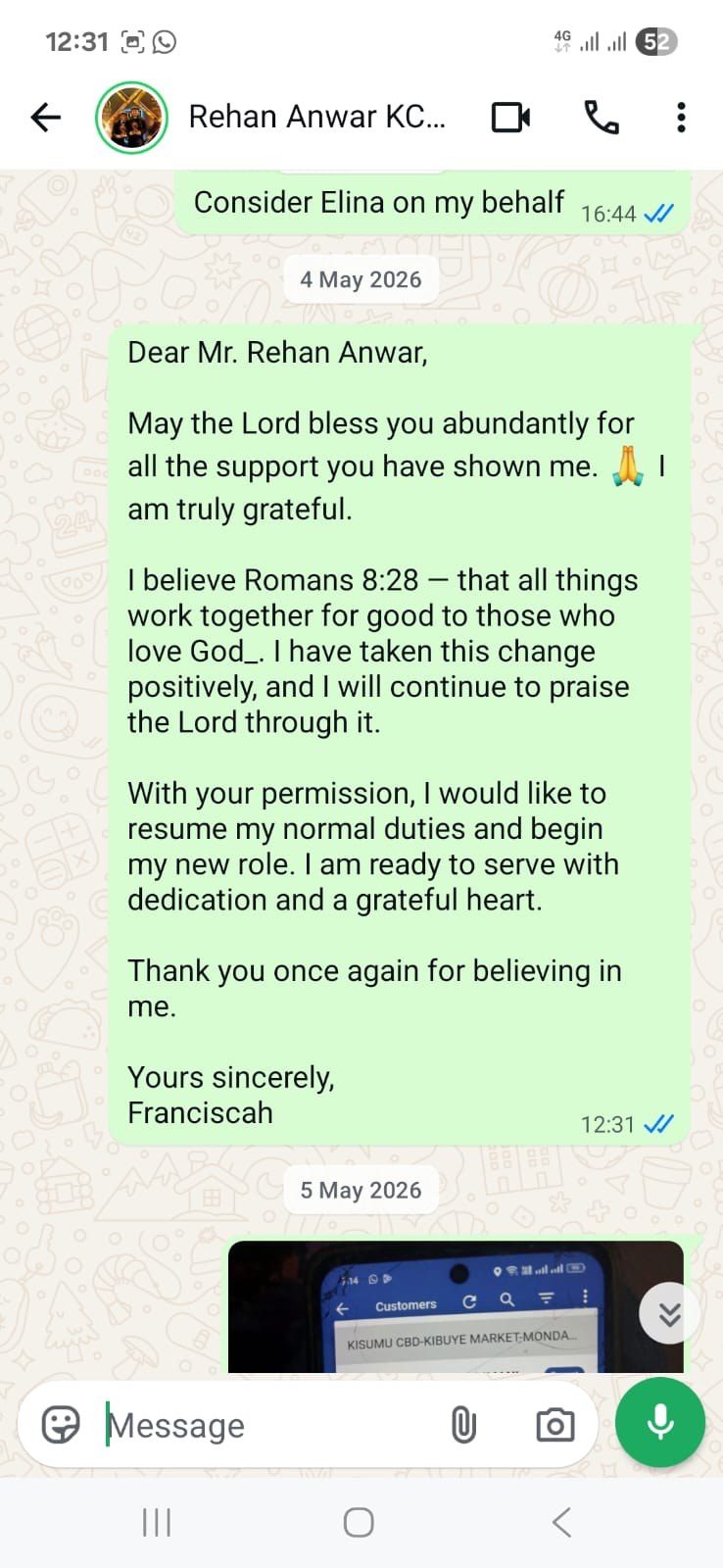
She did not resist at that stage, and the correspondence shows that on 4th May 2026, she wrote to the General Manager expressing gratitude for the support she had been shown, invoking scripture, and stating that she had taken the change positively and wished to resume her normal duties within the new role.
Performance Improvement Plan and Month On Leave 
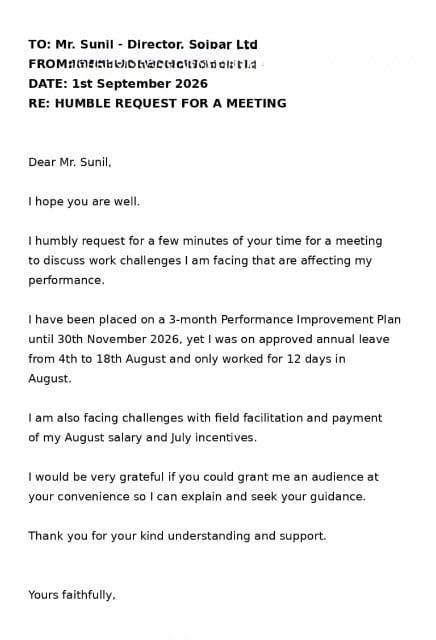
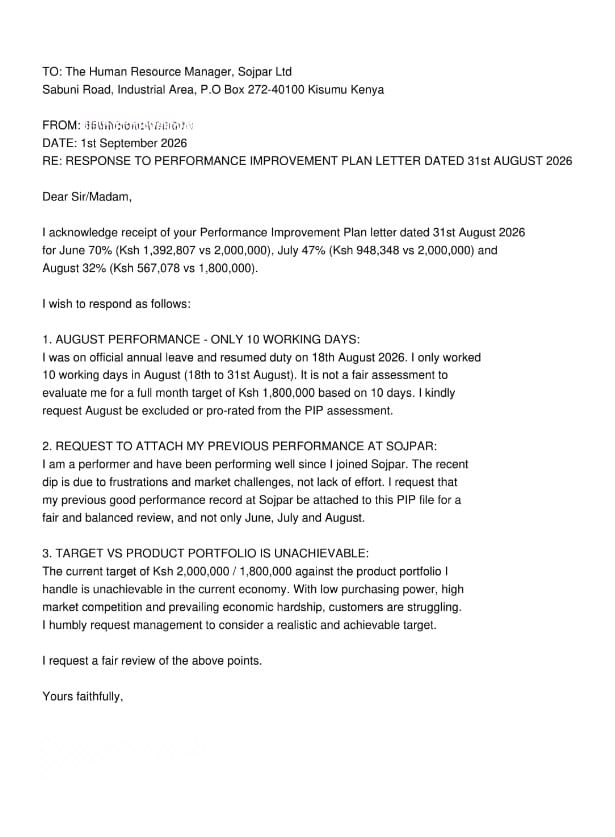
Four months after the demotion, on 31st August 2026, the company issued her with a 3-month Performance Improvement Plan running until 30th November 2026, and it did so on the strength of a 3-month assessment covering June, July and August, in which she was scored at 70%, 47% and 32% respectively.
What the company's own letter does not dispute is that she was on approved annual leave from 4th to 18th August 2026, that she resumed duty only on 18th August, and that she therefore worked barely 10 working days within a month for which she was nevertheless assessed against a full monthly target.
Her written response of 1st September 2026 formally requested that the August assessment be excluded or pro-rated, that her previous performance record be attached to the file, and that the target be reconsidered on the grounds that diminished purchasing power, heightened market competition and prevailing economic hardship had rendered it unattainable.
"I raised every one of those points in writing, and the reply came back dismissing all of them, so it became clear the plan was not meant to help me improve but to build a file against me."
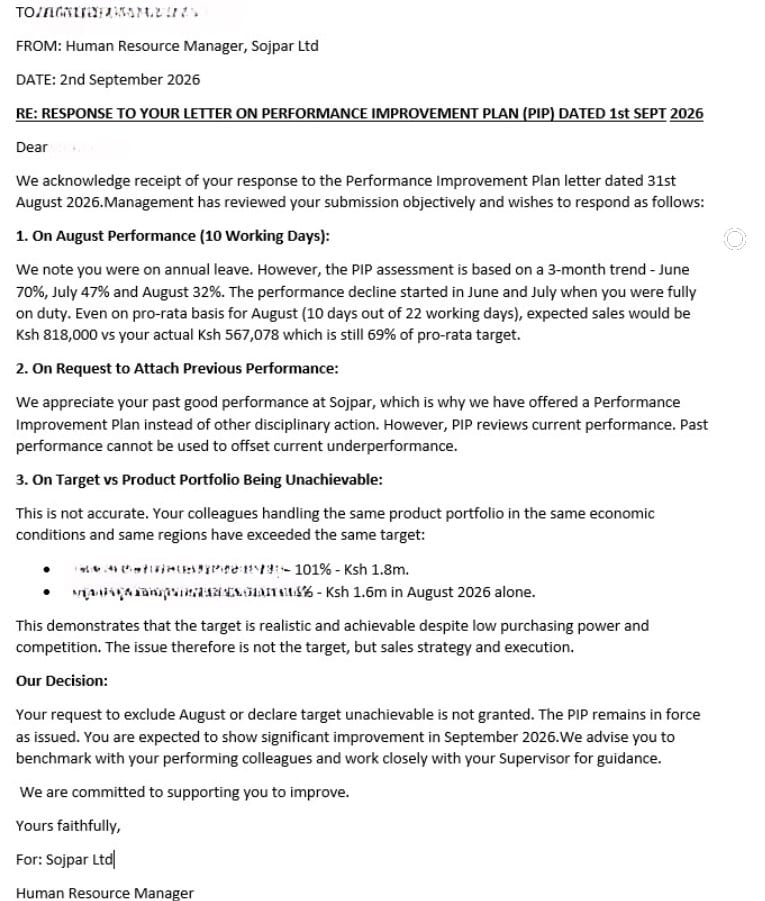
The company's reply of 2nd September 2026, signed on behalf of the Human Resource Manager, acknowledged that she had been on leave but argued that the decline had begun in June and July when she was fully on duty, and that even on a pro-rata basis for August she would still have fallen short of what was expected of her.
It went on to state that the target was demonstrably realistic because 2 colleagues handling the same portfolio in the same regions had exceeded it by comfortable margins during August alone, before concluding that the issue lay not with the target but with sales strategy and execution.
Salary Withheld 
Running alongside the performance dispute is a remuneration dispute, and it is the remuneration dispute that has produced the most troubling correspondence, because she says her August 2026 salary was placed on hold until she escalated the matter to the proprietor of the company, and that her July incentive under the Pwani line was withheld while every one of her colleagues was paid.
The company's own payslip for August 2026 paints a grim picture, showing that after PAYE, NSSF, SHIF, NHDF, SACCO deductions and a staff loan instalment had been deducted, the residual sum that constituted her net remuneration was a paltry KSh 7,252 upon which no household could reasonably be sustained.
"I had to go over the heads of everyone in that office and write to the owner before a salary that had already been earned was released."
The WhatsApp record sharpens the picture further, because in one exchange she is informed that her salary was given to another employee on the instruction of the General Manager, and in another she is told to direct her questions about the incentive to the same manager against whom she was already lodging complaints.
She says the incentive was held while colleagues on the same product line were paid, that the human resource officer referred her back to the manager, and that the circle continued until she abandoned any expectation of receiving what was owed to her.
"We watched colleagues on the same line receive their incentives while ours was held back, and nobody could explain why."
A Full Tank of Excuses 
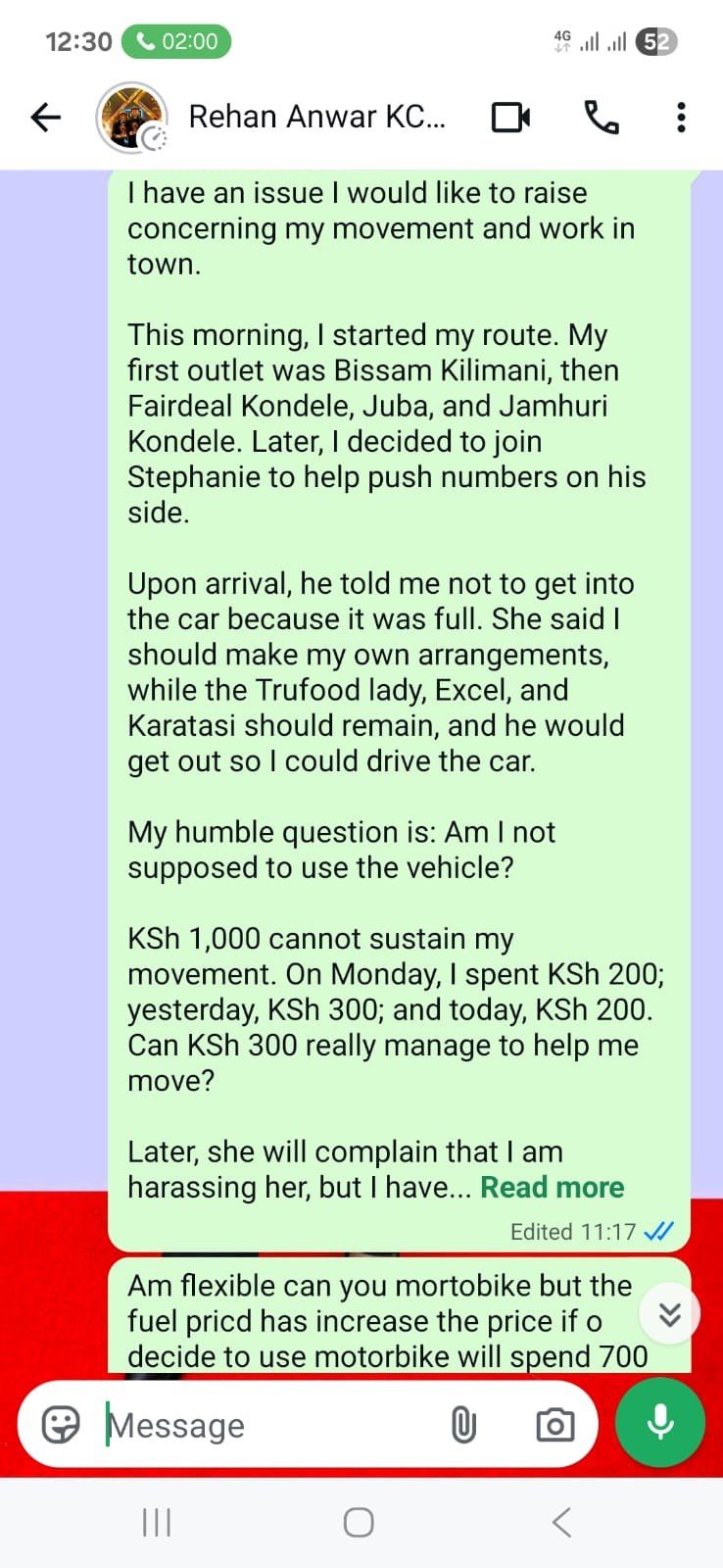
Her submission also extends to the practical conditions under which she was expected to operate, and she has documented a dispute over movement facilitation in which she was allocated KSh 1,000 per day, a sum that she says could not possibly have covered her route, obliging her to defray costs from her own resources on certain days and leaving her short on others.
She was told in a WhatsApp exchange that she was flexible enough to utilise a motorbike notwithstanding the escalation in fuel prices, and that a motorbike would consume KSh 700 of the allocation, the better part of what had been given to her for the entire day.
In a further exchange she described arriving to join a colleague in order to assist in pushing numbers on his side of the business, only to be instructed not to enter the company vehicle because it was occupied to capacity and that she should make her own arrangements, while other members of staff were permitted to remain within it.
"I was told the vehicle was full and that we should make our own arrangements, while other people remained inside it."
She was also accused of remaining in one location when the tracking application showed her off route, an allegation she rebutted with evidence that she had been in motion, and she offered to account for her route step by step because she knew precisely where she had been and what she had accomplished.
"I offered to account for the route outlet by outlet, because I knew I had not been hiding from anyone."
Locked Phone, Open Humiliation 
The gravest allegation concerns 8th and 9th October 2026, when, according to her account, she had worked with colleagues the previous day, closed orders worth KSh 300,000 and concluded her duties at 6pm instead of the scheduled 4:30pm, only to switch on her telephone the following morning and find it locked so that she could not work at all.
She says her supervisor then posted a message tagging her, she responded with evidence, and her Show Cause letter dated 8th October 2026 was published by management in the general company WhatsApp group, SOJPAR FAMILY, in full view of her colleagues.
"A Show Cause letter is supposed to be between an employee and her employer, and mine was placed in front of the entire staff."
She further states that in the preceding week the General Manager removed her from one of the company WhatsApp groups in which her superiors were not present, that she was on leave during August 2026 and worked only a fraction of the month but was nevertheless assigned a full one-month target, and that she declined to append her signature to the plan because she considered it inequitable and retains proof of that refusal.
Health Toll and Search For Help 
Her correspondence states plainly that her health has deteriorated, that her blood pressure has become abnormal, and that the stress of the past months has begun to inflict physical damage, and she has described approaching legal practitioners without success before resolving to place the record before the public.
"I tried to find a lawyer and could not find one who would take it up, and I reached a point where I did not know which direction to turn."
She says she is raising her children unaided, that every decision must be weighed against the consequences for them should she lose her employment, and that this is why she remained as long as she did and did not walk out of the door on the day her letter was posted for everybody to read.
What Sojpar Limited Must Now Answer 
The questions Sojpar Limited must now answer go to the heart of its treatment of an employee who served the firm for 6 years.
The company must explain the basis for removing her from her position following an undisclosed complaint, and why it assessed her against a full monthly target for a month in which it had approved her leave.
It must also account for withholding her salary until she escalated the matter to the proprietor, withholding her incentive without explanation while her colleagues were paid, and circulating her Show Cause letter in a group chat visible to her colleagues.
Most critically, the correspondence places the General Manager under direct scrutiny over whether he instructed that her salary be handed to another employee, and Sojpar Limited must now account for that instruction, the handling of her remuneration, and the decision to expose a disciplinary matter to the entire staff group.
The company's new majority owners at Kimo Kali Holdings, and by extension the principals at Twiga Foods who now hold the controlling interest, must also explain what due diligence was conducted before the acquisition, what has been done since to address the complaints that have been raised internally, and whether the practices described in these disclosures are consistent with the standards they publicly profess.
Until those questions are answered on the record, the account provided to this publication stands uncontradicted, and this publication will continue to follow the matter and to report every development.