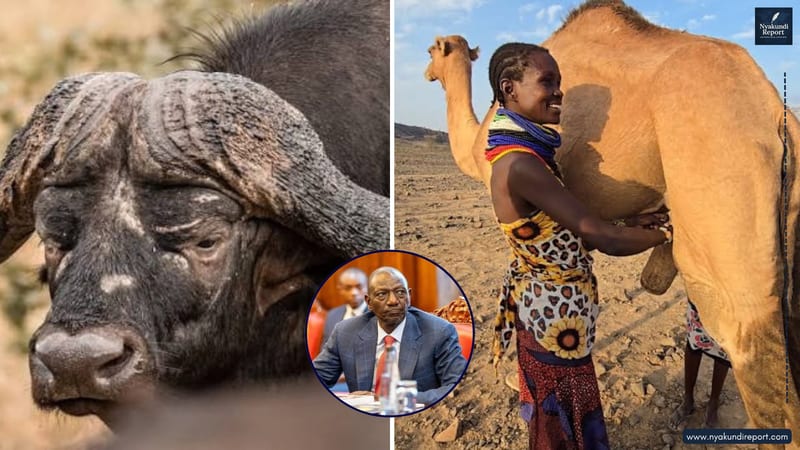
President William Ruto has announced plans to import improved camel breeds and buffaloes to address Kenya’s milk shortage, raising questions about the government’s strategy as consumers face rising prices and dairy farmers struggle with drought-related supply disruptions.
Speaking at the Agriculture and Food Security Summit at Jamhuri Park in Nairobi on Friday, October 9, Ruto directed Agriculture Principal Secretary Jonathan Mueke to facilitate the importation of the animals, arguing that Kenya must diversify its milk production beyond conventional dairy cattle.
The proposal comes as milk deliveries to processors decline and prices rise in major towns, placing additional pressure on households already struggling with the cost of living.
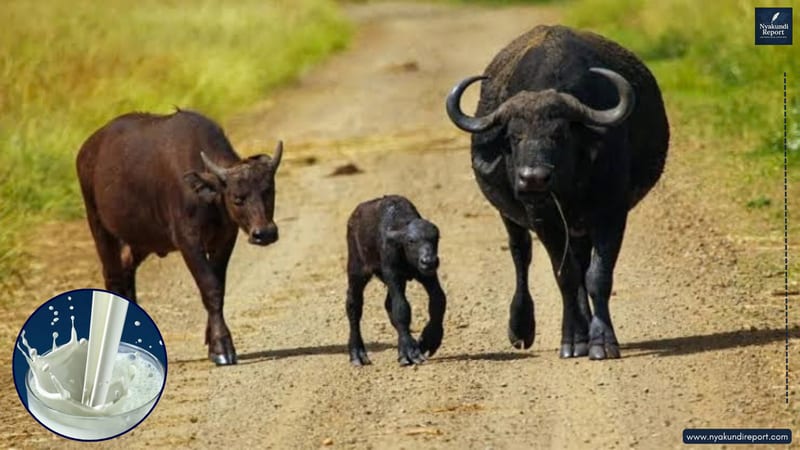
Ruto Orders Importation of Camels and Buffaloes to Boost Milk Supply 
Ruto said the government would explore alternative livestock breeds as part of efforts to increase domestic milk production and reduce the effects of supply shortages.
The President directed Mueke to facilitate the importation of improved camel breeds and buffaloes, arguing that the animals could provide additional milk and help diversify Kenya’s dairy industry.
“I had directed the Agriculture PS to help us bring in a better breed of camel and bring another buffalo breed. Buffaloes also produce a lot of milk. In India there are buffaloes,” Ruto said.
He added that the government should move ahead with the plan, insisting that Kenya needed to expand its sources of milk rather than depend almost entirely on conventional dairy cattle.
“There is no problem in that. So PS Mueke, do as we had agreed. Bring in buffalo and also bring in a better breed of camel because we need to diversify our milk sources,” he stated.
The proposal signals a possible shift in the government's approach to milk production, particularly as drought exposes the vulnerability of livestock farming to changing weather conditions.
However, importing new breeds is only one part of the challenge. The government will also need to consider the cost of acquiring the animals, their adaptation to local conditions, veterinary requirements, breeding programmes, and the infrastructure needed to support commercial production.
The announcement did not specify the number of animals to be imported, the projected cost of the programme or when the first consignments would arrive.
Ruto Cites Expensive Camel Milk as Consumers Face Higher Prices 
Ruto defended the proposal by pointing to the high retail price of camel milk in Nairobi, arguing that the commodity could provide farmers with another source of income while expanding consumer choice.
“Here in Nairobi, the camel's milk is about Ksh190 and is selling at almost Ksh200, beating cow's milk three times. We need to start thinking,” the President said.
His remarks came as households grapple with rising milk prices, with a 500ml packet of fresh milk reportedly selling for between KSh75 and KSh80 in major urban centres, including Nairobi, Mombasa and Kisumu.
The prices represent an increase from the reported range of KSh60 to KSh70, adding to the financial pressure facing households that depend on milk as a regular part of their diets.
However, camel milk and conventional packaged cow's milk are not necessarily direct substitutes in every market. Their prices, processing requirements, distribution networks and consumer demand differ, meaning that expanding camel production alone may not automatically make ordinary milk more affordable.
Ruto maintained that the government needed to think beyond traditional dairy farming to protect supply during periods of drought.
“Currently, we have a slight shortage of milk due to drought. Camels have more milk than cows. We will ensure we bring in a better breed,” he said.
The proposal nevertheless leaves an important question unanswered: how quickly can imported livestock increase the volume of milk reaching consumers, and will the additional supply translate into lower retail prices?
Declining Milk Deliveries Expose Pressure on Kenya’s Dairy Industry 
The announcement comes amid declining milk deliveries to processors, highlighting the pressure facing Kenya's formal dairy supply chain.
Formal deliveries fell from 84.4 million litres in June to 81.3 million litres in July 2026, followed by further reported declines into August and September.
The reduction has coincided with higher retail prices and concerns about the availability of milk in some markets.
Some farmers have also reportedly been selling raw milk directly to neighbourhood consumers and brokers rather than supplying formal cooperatives, reflecting changes in how milk moves through the market.
While direct sales can offer farmers alternative routes to consumers, they can also complicate the collection and processing systems used by formal dairy businesses.
The government now faces the task of addressing immediate supply constraints while developing a more resilient livestock sector capable of withstanding drought.
Camels are already important to pastoral communities in Kenya's arid and semi-arid regions, where they are valued for their ability to survive conditions that challenge conventional dairy cattle. Buffaloes, meanwhile, are commercially milked in countries such as India, although their successful introduction would require appropriate breeding, husbandry and market arrangements.
The success of Ruto's proposal will ultimately depend on implementation, production costs and the ability to deliver additional milk at prices consumers can afford.
Importing improved breeds may widen Kenya's production options, but it will not provide an immediate solution to a shortage affecting households today. The government must also address drought resilience, animal feed, water availability, farmer productivity and weaknesses in the dairy supply chain.
For consumers paying more for milk, the decisive question is whether the announced plan will produce a measurable increase in supply and meaningful relief at the checkout.