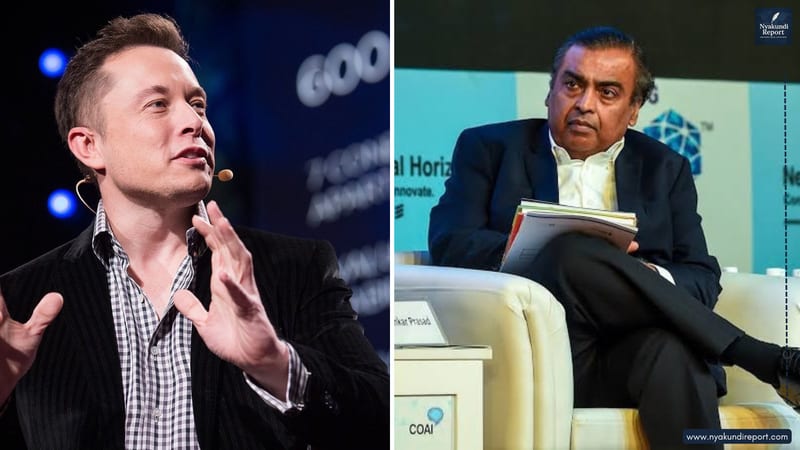
Elon Musk has questioned whether Indian billionaire Mukesh Ambani wields enough influence to determine the fate of Starlink’s entry into India, escalating a dispute over regulatory approvals and competition in one of the world’s largest internet markets.
The SpaceX founder’s remarks followed allegations that powerful business interests were attempting to block his satellite internet company from entering India. Musk subsequently singled out Ambani, whose Reliance Industries controls Jio, the country’s largest mobile network operator.
Indian authorities have rejected claims of unfair treatment, insisting that all satellite internet operators must satisfy the same regulatory requirements before launching commercial services.
Musk Raises Questions Over Ambani’s Influence in India 
Musk intensified his criticism on Thursday, October 8, questioning why Starlink had yet to receive final approval despite being licensed to operate in more than 165 countries.
“Is Ambani the real boss of India?” Musk asked in a post on X, arguing that his company had spent five years complying with Indian government requirements.
His remarks followed an earlier accusation that unnamed powerful business interests were maintaining a “monopolistic chokehold” on Indian consumers.
Musk argued that blocking Starlink’s entry would deny millions of people access to affordable, high-speed internet, particularly in remote areas where conventional broadband infrastructure remains expensive to establish.
The allegations place Reliance Jio and its chairman, Mukesh Ambani, under renewed scrutiny as competition intensifies in India's emerging satellite communications market.
However, neither Ambani nor Reliance Industries had publicly responded to Musk’s latest remarks at the time of reporting.
India’s Ministry of Communications rejected suggestions that its regulatory framework favoured particular companies, maintaining that satellite operators were subject to comparable approval requirements.
The ministry said Starlink, Eutelsat OneWeb, and Jio Satellite Communications were at broadly similar stages of the approval process, with security clearances and spectrum allocation still outstanding.
It described claims that the framework was unfair or discriminatory as baseless and misconceived.
Reliance Jio and Airtel Complicate Starlink’s Entry 
The dispute comes as Reliance Jio and Bharti Airtel prepare to expand into satellite internet services, potentially placing them in direct competition with Starlink.
In March 2025, Jio and Airtel signed agreements with SpaceX to distribute Starlink equipment and services in India, subject to government approval. The companies also indicated that they could explore opportunities to share network infrastructure.
These partnerships complicate Musk’s accusations because two major Indian telecommunications operators seeking to compete in the satellite market are also potential distribution partners for his company.
Reliance Jio has been developing its own satellite communications capabilities, while Airtel is pursuing services through its satellite business.
Speaking at the India Mobile Congress in New Delhi, Reliance Jio chairman Akash Ambani said the company was developing satellite communications technology and working towards regulatory approvals.
Asked about Musk’s allegations, Akash declined to comment directly, saying the company wanted to concentrate on delivering value to Indian consumers.
Airtel chairman Sunil Bharti Mittal similarly indicated that his company’s satellite venture was awaiting government approval.
SpaceX executive Lauren Dreyer, who oversees Starlink’s business operations, said the company had worked with Indian regulators for years and incorporated security controls into its network to satisfy national requirements.
Security Concerns and Affordability Remain Major Hurdles 
Starlink has been attempting to enter India since 2021 and has secured key licences. However, final security clearances and spectrum allocation remain necessary before it can launch commercial services.
Security has been a particularly sensitive issue. In 2024, Indian authorities reported recovering Starlink equipment during a drug-smuggling investigation in the Andaman and Nicobar Islands and an army operation in Manipur.
Musk responded at the time that Starlink had never been operational in India, arguing that the equipment recovered by authorities could not have been accessing its satellite network.
Beyond regulatory hurdles, the affordability of satellite internet remains a significant question for a country where millions of consumers have limited household budgets.
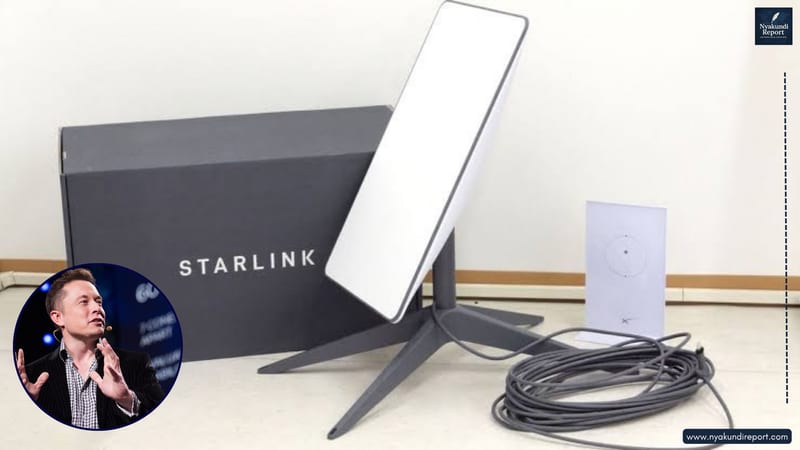
Starlink uses satellites in low Earth orbit to deliver internet connectivity, making it potentially useful in remote communities where mobile networks and fibre-optic infrastructure are difficult or expensive to establish.
Musk has argued that the service could connect people who lack reliable internet access or cannot afford existing options.
However, Starlink has yet to announce Indian subscription prices. Its US residential plans start at $55 per month, although prices and equipment costs vary by location and package.
The eventual cost of the service in India could determine how widely it is adopted, particularly among rural households.
The dispute ultimately centres on more than Musk’s public confrontation with Ambani. It raises questions about how India will regulate a growing satellite internet industry, balance national security requirements with commercial competition, and expand connectivity without placing advanced services beyond the reach of ordinary consumers.