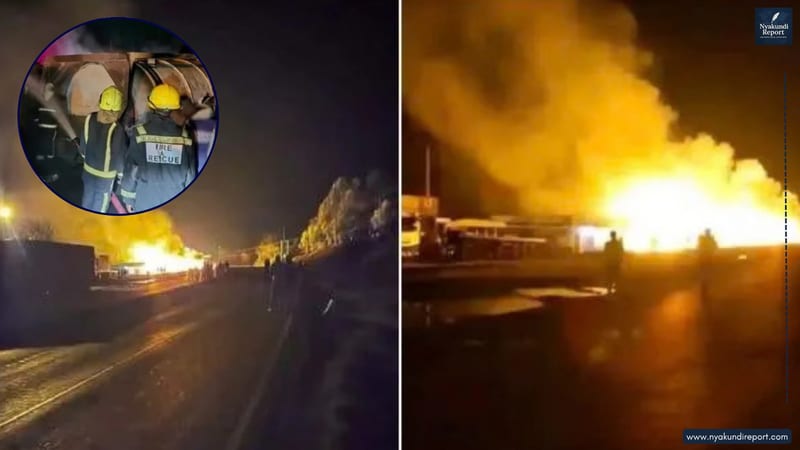
A fuel tanker exploded shortly after midnight along the Nakuru-Eldoret Highway, leaving at least two people injured and forcing authorities to close a section of the busy road as emergency teams battled the resulting fire.
The incident occurred around the Salgaa-Sachangwan area near Kibunja and Soilo interchange, raising fresh concerns over safety along one of Kenya’s most notorious accident corridors. The Kenya Red Cross said its response team attended to two casualties as a multi-agency operation was launched to contain the fire.
The cause of the explosion had not been established by the time of publication.
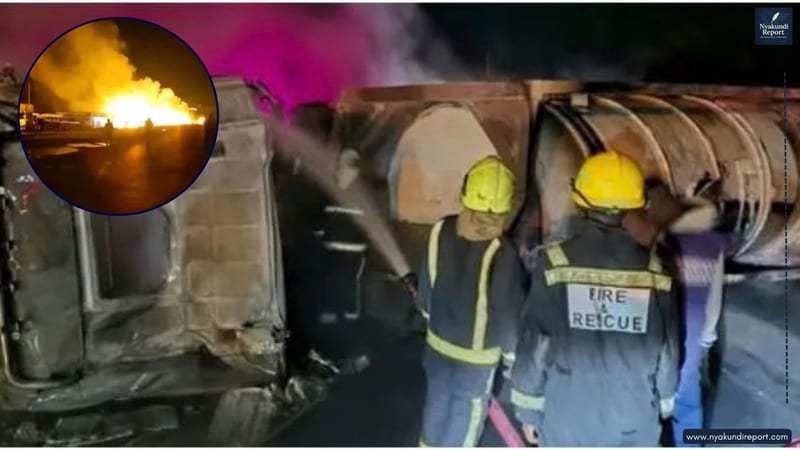
Salgaa Tanker Explosion Triggers Highway Closure 
The Kenya Red Cross said a fuel tanker exploded shortly after midnight, prompting an emergency response involving multiple agencies.
“ A multi-agency team had contained the fire following the explosion,” the organisation said in a statement.
The Red Cross said its team responded to the scene and attended to two casualties. It also urged motorists using the Nakuru-Eldoret Highway to seek alternative routes as emergency operations continued.
The highway was closed at Kibunja and Soilo interchange because of the incident, disrupting traffic along the critical transport corridor linking Nakuru with western Kenya and Uganda.
Footage from the scene showed massive flames engulfing the tanker while thick, dark smoke rose into the night sky. Residents and motorists gathered near the scene as emergency teams worked to control the fire.
The number of casualties could not immediately be independently established beyond the two people attended to by the Red Cross.
Authorities had also not released details explaining what caused the tanker to explode.
Salgaa Corridor Has Deadly History 
The latest incident has renewed attention on the approximately 20-kilometre Sachangwan-Salgaa stretch, which has a long history of devastating road crashes and fuel tanker disasters.
The corridor has previously recorded deadly accidents linked to speeding, dangerous overtaking, steep sections of the road, and mechanical failures.
One of the most notorious incidents occurred in 2009 when a fuel tanker overturned at Sachangwan and burst into flames as residents gathered around the wreckage to siphon fuel. More than 110 people were killed in the inferno, making it one of Kenya’s deadliest road disasters.
The latest explosion has once again exposed the risks posed by fuel tankers operating along a heavily trafficked highway where pedestrians, motorists, and roadside communities remain vulnerable whenever accidents occur.
The incident also comes less than a month after another fuel tanker crash on the Eldoret-Turbo road.
On September 17, a tanker carrying petrol overturned near Paul Boit High School and burst into flames. Residents who reportedly rushed to the scene to collect leaking fuel were feared to have been caught in the resulting fire.
The Kenya Red Cross described that incident as a mass casualty event and responded alongside police officers and firefighters.
The latest Salgaa explosion adds to a series of serious road accidents recorded across Kenya since the beginning of October.
Seventeen people were killed and seven others injured in a collision involving a matatu and lorry at Mlima Kiu in the Salama area along the Nairobi-Mombasa Highway.
Two days later, two people were feared dead in separate crashes along the Salama-Sultan Hamud section, with the incidents occurring only metres apart.
The succession of crashes is raising renewed questions about road safety enforcement, vehicle inspection, driver behaviour and emergency preparedness on major highways.
At Salgaa, however, authorities still face the immediate task of determining what caused the tanker to explode and whether any safety violations contributed to the incident.
Until investigators establish the circumstances, the explosion remains a serious warning about the dangers surrounding fuel transportation along one of Kenya’s busiest and deadliest highway corridors.