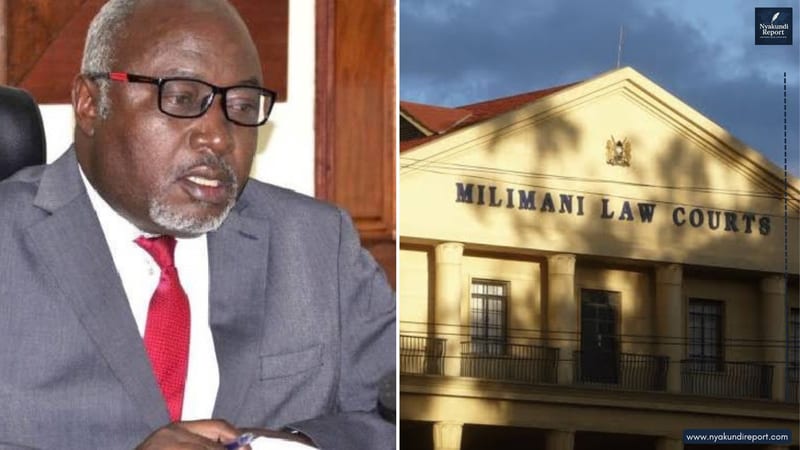
The High Court has stopped the Judicial Service Commission from asking President William Ruto to appoint a tribunal to investigate Justice Anthony Ombwayo, temporarily blocking further disciplinary action against the sitting judge.
A three-judge bench comprising Justices Onesmus Makau, Jemimah Keli, and Dr. Jacob Gakeri issued orders restraining the JSC from taking further action against Ombwayo pending the determination of his challenge. The judges said they were satisfied with the application filed by Ombwayo through lawyer Neville Amolo.
The decision raises questions about how disciplinary complaints against serving judges are processed and whether constitutional safeguards were followed before the JSC sought a tribunal.
Court Questions JSC Decision to Seek Tribunal 
The dispute arose from proceedings handled by Justice Ombwayo when he was serving at the Nakuru High Court. The matter involved two land files, in which the judge heard the parties before dismissing an application brought by the petitioners.
The parties who lost the application challenged the decision at the appellate court. They sought to overturn the judge’s ruling and asked the appellate court to stay its implementation while their challenge was considered.
The stay application was disallowed, leaving the original decision in place as the dispute moved through court.
Before pursuing the appellate challenge, the petitioners had also sought to have Justice Ombwayo recuse himself from hearing their petition.
The judge declined to recuse himself after finding that the applicants had not presented sufficient evidence to justify his removal from the matter. The finding became part of the dispute that later reached the Judicial Service Commission.
Land Dispute Escalates Into Judicial Complaint 
Following their dissatisfaction with the decisions made by Justice Ombwayo, the petitioners approached the JSC and sought action against the judge.
The complaint subsequently developed into a move by the commission to pursue the formation of a tribunal to investigate Ombwayo.
That decision prompted the judge to move to the High Court, arguing that the JSC had not properly considered the matter and that its intended action was inconsistent with constitutional requirements.
The three judge bench has now temporarily restrained the commission from forwarding its request to the President.
The order does not determine the underlying allegations against Justice Ombwayo. Instead, it pauses the JSC’s intended action while the court considers the legal challenge brought by the judge.
That distinction is significant because the court has not, at this stage, made a final finding on whether the complaints against Ombwayo have merit. The immediate issue is whether the process adopted by the JSC in seeking a tribunal complied with the law.
JSC Action Faces Constitutional Scrutiny 
The judges questioned whether the JSC decision to pursue a tribunal had been properly considered and whether it was consistent with constitutional provisions governing the removal and investigation of serving judges.
The court’s intervention effectively prevents the commission from taking the next step of forwarding the tribunal request to the President until the legal dispute is addressed.
The case therefore places the JSC’s disciplinary powers under renewed judicial scrutiny. The commission plays a central role in receiving and handling complaints involving judicial officers, but its actions remain subject to constitutional and legal requirements.
For Justice Ombwayo, the orders provide temporary protection against the immediate progression of the tribunal process. For the JSC, the challenge creates a legal test over how it reached its decision and whether the constitutional threshold for seeking a tribunal was met.
The matter also highlights a recurring tension within judicial accountability. Serving judges must be subject to mechanisms that can address legitimate complaints and misconduct, but those mechanisms must operate within the safeguards established by the Constitution.
The Nakuru land dispute that triggered the complaint is therefore no longer only about the original ruling. It has evolved into a broader legal contest over the boundaries of judicial disciplinary action and the procedures that must be followed before a sitting judge can face a tribunal.
The High Court orders remain temporary as the substantive challenge proceeds. Until the court makes further determinations, the JSC is barred from advancing its request to the President.
The outcome could clarify how complaints arising from disputed judicial decisions should be handled and where the line lies between challenging a judge’s ruling through the appeals process and pursuing disciplinary action against the judge personally.
For now, the court has placed the tribunal process on hold, leaving the constitutional and procedural questions surrounding the JSC decision to be determined through the ongoing case.