

Fresh documents from the Office of the Registrar of Political Parties (ORPP) have opened another chapter in the battle over the Ukombozi name, showing that Ukombozi People’s Party was approved for reservation in March 2025, long before the current fight involving several opposition camps erupted.
A letter dated March 13, 2025, addressed to Allan Jayuga Akivaga, shows that an application to reserve the name Ukombozi People’s Party (UPP) had been considered and approved by the Registrar, who reserved the name for ninety days and directed the applicant to proceed with the next steps required to register a political party.

The paper trail becomes more interesting in 2026, when the people behind the proposed UPP later moved to discontinue the registration process, creating questions over what happened to the name and whether the attempted withdrawal had actually been completed.
Founders Asked to Discontinue UPP Registration 
A second letter from the Registrar, dated August 6, 2026, refers to correspondence submitted on July 9 by UPP concerning a resolution by its founding members to discontinue the party’s registration process and dissolve the proposed outfit.
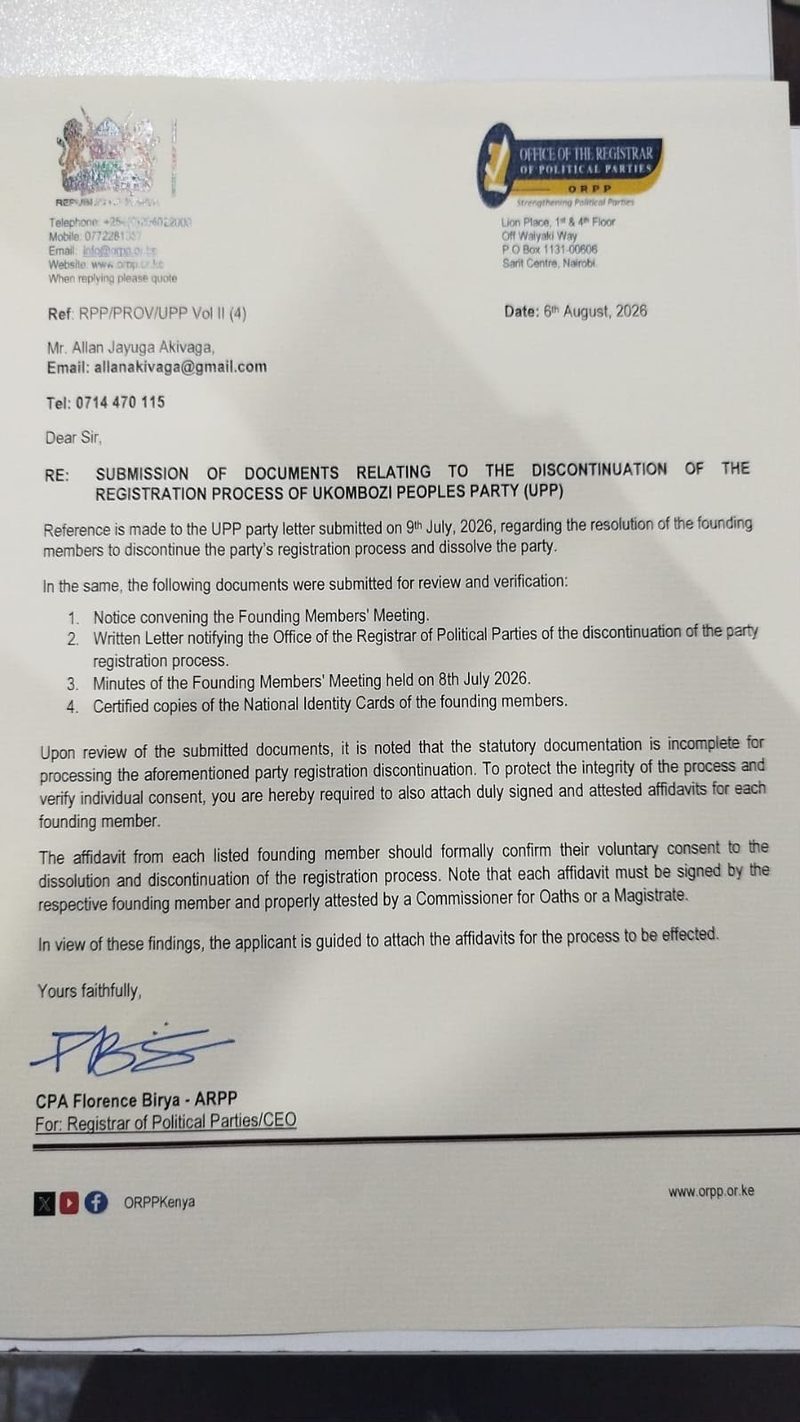
The applicants submitted several documents, such as notice of the founding members’ meeting, a written notification informing the Registrar about the decision, minutes of the meeting held on July 8 and certified copies of the national identity cards belonging to the founding members.
The Registrar found that the paperwork was incomplete and directed the applicants to provide signed and attested affidavits from each founding member, with every person required to confirm voluntarily that they consented to the dissolution and discontinuation of the registration process.
The August letter says those affidavits were required “for the process to be effected”, meaning the documents presented here do not show that the proposed party’s discontinuation had already been completed by that date.
That detail is central to the timeline because The Ukombozi Alliance was reserved on July 20, 2026, just eleven days after the original UPP group wrote to the Registrar seeking to discontinue its registration process, yet the Registrar’s August 6 letter shows that the earlier discontinuation had not been completed because the required affidavits were still outstanding.
Another Ukombozi Name Was Reserved in July 
According to a third letter dated September 8, 2026, another applicant had successfully reserved the name The Ukombozi Alliance (TUA) on July 20, 2026, eleven days after the original UPP group wrote to the Registrar seeking to discontinue its registration process.
The identity of that applicant is not stated in the September letter shown here, but the dates create a key question in the dispute: how was the TUA name reserved on July 20 while the earlier Ukombozi People’s Party process had not yet been formally discontinued by the Registrar?
The August 6 letter shows that the UPP founders’ request still required signed and attested affidavits before the discontinuation could be effected. The documents therefore place the July 20 reservation of TUA in the middle of an unfinished UPP discontinuation process.
Events announced on Monday have now brought the reservation into the wider political fight surrounding the opposition.
Azimio la Umoja One Kenya Coalition announced on Monday, September 21 that its members had unanimously agreed to change the coalition’s name to The Ukombozi Alliance, with Kalonzo Musyoka announcing the decision and saying the required processes arising from it would follow.
Former President Uhuru Kenyatta remains associated with the coalition leadership, and the announcement places Azimio directly inside a naming dispute that was already developing elsewhere within opposition politics.
UDP Blocked From Becoming Ukombozi People’s Party 
The September 8 letter reveals another part of the story involving the United Democratic Party, the political party associated with the late Cyrus Jirongo, which had sought to adopt the Ukombozi People’s Party name.
The Registrar states that UDP had not been approved or authorised to use the name Ukombozi People’s Party, referring to Section 8(c) of the Political Parties Act covering proposed party names, abbreviations, slogans and symbols that closely resemble those belonging to another registered political party or legal entity.
The Registrar then pointed directly to The Ukombozi Alliance, saying the proposed Ukombozi People’s Party name resembled TUA, which had already been reserved by another applicant on July 20.
Media reports have linked the attempted UDP rebranding to Trans Nzoia Governor George Natembeya and Nairobi Senator Edwin Sifuna, whose Linda Mwananchi movement has faced questions about which political party could provide its vehicle ahead of the 2027 elections.
Recent media reports had identified Ukombozi People’s Party as one of the possible vehicles around the movement, alongside other political parties being considered by figures associated with Linda Mwananchi.
The Dates Tell a Bigger Story 
The sequence begins on March 13, 2025, when Ukombozi People’s Party was approved for reservation, before its founding members later resolved in July 2026 to discontinue the registration process.
On July 9, the UPP group wrote to the Registrar seeking to discontinue the process, following a resolution reached by its founding members on July 8.
On July 20, just eleven days later, another applicant successfully reserved The Ukombozi Alliance, even though the original UPP discontinuation had not yet been completed.
On August 6, the Registrar told the UPP founders that their discontinuation documents were incomplete and that individual signed affidavits were still required before their request could be effected.
The sequence therefore leaves a clear gap between the decision by the UPP founders to give up their registration process and the formal completion of that process by the Registrar, with TUA being reserved during that period.
Then came UDP’s attempt to adopt the Ukombozi People’s Party identity, which was rejected in the Registrar’s September 8 letter because the proposed name was considered similar to TUA, the name already reserved on July 20.
Then came Monday’s announcement that Azimio had agreed to rebrand itself as The Ukombozi Alliance, putting the name publicly at the centre of another opposition grouping.
The three letters do not establish from the material presented here who currently holds every legal right connected to the different Ukombozi names, since reserving a name, registering a political party, discontinuing an application and changing the name of an existing party are separate processes.
What the documents clearly establish is that the fight over Ukombozi did not begin with Monday’s announcement, since the name had already passed through several applications, reservations and registration processes stretching back to March 2025.