
The 2027 Nairobi gubernatorial race is exposing an uncomfortable weakness in Kenya's politics. As men position themselves to fight for control of the capital, women who have spent years building political profiles are largely staying away from the battle.
Johnson Sakaja is preparing to defend his seat. Embakasi East MP Babu Owino has built a formidable political base and is openly associated with the race. Kasarani MP Ronald Karauri has also emerged as one of the strongest names in the conversation. Other men are circling the contest.
The female field remains remarkably thin.
Margaret Wanjiru has announced her interest, but her political history and current alignment make it difficult to present her as the fresh, disruptive female challenger Nairobi has been waiting for.
Agnes Kagure has generated attention and has appeared prominently in published opinion polls, but there is still no broad movement of established Nairobi women politicians towards City Hall.
That should worry women who have spent years demanding greater representation in Kenyan politics.
Nairobi is not short of politically experienced women. It is short of women willing to take the biggest political risk.
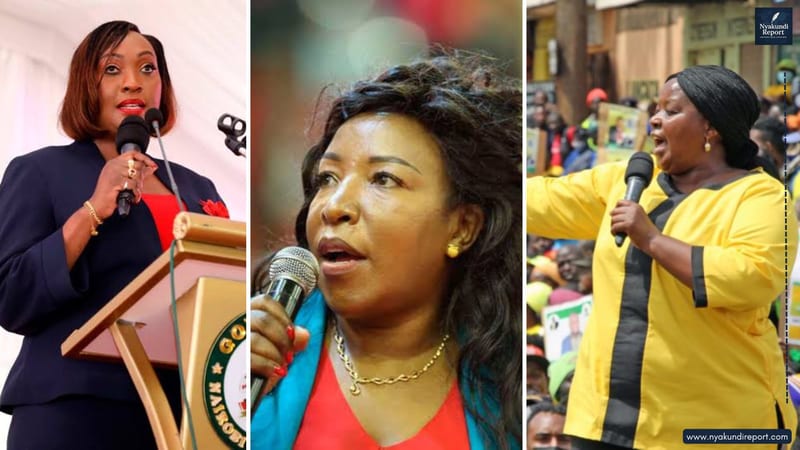
Nairobi Has Never Elected a Woman Governor 
The facts are brutally simple. Since devolution began in 2013, Nairobi has had Evans Kidero, Mike Sonko, Ann Kananu, and Johnson Sakaja as governors.
Not one woman has won the Nairobi governor's seat through the ballot.
Kananu became the first woman to occupy the office after Sonko's removal, but her route to City Hall was fundamentally different from that of an elected governor. She inherited the position following Sonko's impeachment in 2021 and served until Sakaja took office after winning the 2022 election.
Kananu's tenure was also overshadowed by the extraordinary political arrangement under which Nairobi Metropolitan Services, headed by Lieutenant General Mohamed Badi, continued to exercise significant control over transferred county functions.
Kananu therefore became the first woman to sit in the governor's office, but she did not establish a female electoral breakthrough in Nairobi.
The capital remains one of the most important political prizes in Kenya without a woman ever winning it directly.
That is not a minor historical footnote. It is a glaring political gap.
Women Have Learned To Win The Easier Political Battles 
The uncomfortable conversation must now move beyond claims that women are victims of a male political system.
Kenya's political system certainly presents serious obstacles to women. Campaign financing, political violence, harassment, party structures, and gender stereotypes have all been identified as barriers to women's political participation.
But those obstacles do not explain everything.
Women have demonstrated that they can overcome them when the prize is sufficiently attractive.
The Woman Representative position has become one of the most reliable entry points for women into elective politics. Party nominations have also created political careers without requiring candidates to undertake the enormous task of building an independent citywide political machine.
There is nothing wrong with becoming a Woman Representative.
The problem begins when women with the experience, resources, and political visibility to seek executive office repeatedly settle for positions that carry considerably less responsibility than running an entire county.
The governor's office demands something different.
It requires money, organization, aggressive grassroots mobilization, political alliances, and the willingness to withstand a campaign that can become intensely personal.
The easier political calculation is obvious. A parliamentary seat or party nomination can preserve political relevance. A gubernatorial campaign can destroy it.
Nairobi's women appear increasingly reluctant to take that risk.
Margaret Wanjiru Does Not Solve The Female Problem 
Margaret Wanjiru's declaration does not suddenly transform the Nairobi race into a serious female contest.
Wanjiru has a long history in Nairobi politics and attempted to become governor in 2013. Her bid was derailed by controversy surrounding her academic qualifications, which became a major issue during the nomination process.
Her 2026 declaration should therefore be understood in the context of her long political career rather than treated as evidence of a new female political wave.
More importantly, Wanjiru's political alignment matters.
She is closely associated with Deputy President Rigathi Gachagua's political camp and has spoken about her support for the emerging opposition coalition around him. Her political future is therefore connected to a wider national political calculation that extends beyond City Hall.
That makes her candidacy politically significant, but it does not automatically make her the formidable female challenger Nairobi lacks.
If the presidential political alignment she supports succeeds in 2027, Wanjiru could potentially have opportunities beyond an unsuccessful gubernatorial campaign. Any claim that securing a future state appointment is her actual motivation, however, would require a direct statement or other evidence from Wanjiru.
The larger point remains unchanged. Nairobi still does not have a deep bench of women openly fighting for City Hall.
Agnes Kagure Has Put Women Back Into the Conversation 
Agnes Kagure is the exception that deserves serious attention.
She has attracted measurable support in 2026 polling, making it difficult to dismiss her as merely a social media or blog personality.
A Centre for African Progress poll reported in April placed Kagure at 34 percent, close to Babu Owino's 37 percent. A separate Mizani Africa survey conducted in August placed Kagure at 27.2 percent, compared with Babu's 28.4 percent.
Those numbers do not predict the election, but they demonstrate that Kagure has established a meaningful level of recognition among surveyed Nairobi voters.
Her challenge is now much bigger than publicity.
She must demonstrate that she can build political structures in all 17 constituencies, mobilize ward-level support, and withstand the financial and organizational demands of a citywide campaign.
That is where many aspirants disappear.
Sakaja, Babu, and Karauri Have Accepted the Risk 

The leading male contenders illustrate what women are currently avoiding.
Sakaja already controls City Hall and has a political organization built around an incumbent governor's profile. He understands the machinery of county government and has spent his first term building relationships across Nairobi.
Babu Owino brings a different political asset. He has represented Embakasi East for two terms and has developed a highly recognizable political identity in Nairobi. His politics are confrontational and sometimes controversial, but he has demonstrated repeatedly that he can mobilize voters and win elections.
Karauri represents yet another political model. The former businessman entered elective politics in 2022 as an independent candidate and captured Kasarani, one of Nairobi's largest constituencies. His victory demonstrated that a candidate can build an electoral machine outside the traditional party establishment.
The three men therefore approach City Hall from different directions, but they share one critical characteristic.
They are willing to risk their political capital on Nairobi. That is precisely what is missing from the female field.
Nairobi Women Cannot Keep Complaining About Representation 
Kenyan women have spent years demanding political representation, and rightly so. But representation cannot end with nominations and reserved or designated positions.
At some point, political ambition has to move beyond seats created specifically to increase women's representation and into the positions where executive power is exercised.
Nairobi provides the clearest test.
Women constitute roughly half of the country's population. Women have won parliamentary seats across the country. Seven women won gubernatorial elections in 2022, proving that female candidates can defeat men in direct countywide contests.
Yet Nairobi has never elected one.
The problem is therefore not a lack of women. It is a lack of women willing to enter the most brutal political contest in the country.
The capital does not need another woman whose political ambition ends at a party nomination. It does not need another politician who sees the Woman Representative position as the final destination. It needs women prepared to build organizations, raise money, fight political battles, and persuade voters across all corners of Nairobi.