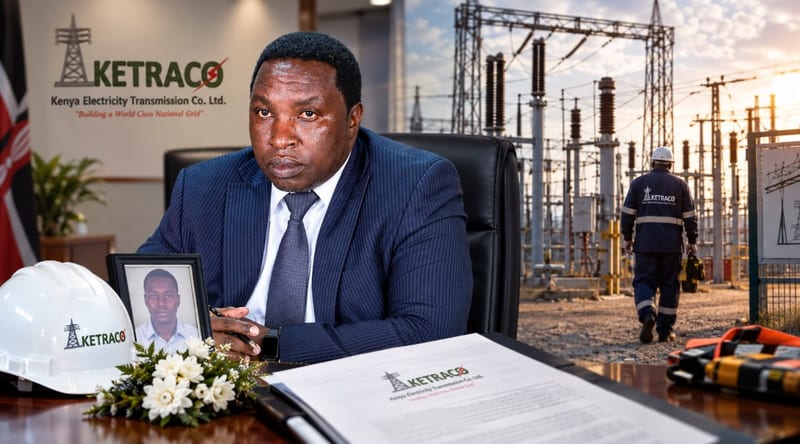
A technician at the Kenya Electricity Transmission Company (KETRACO) died on duty at the Suswa 400kV AC Yard on Saturday, September 12, 2026, in the latest of what sources within the state agency describe as a recurring pattern of electrocution incidents that have been quietly buried rather than properly investigated, documented or disclosed.
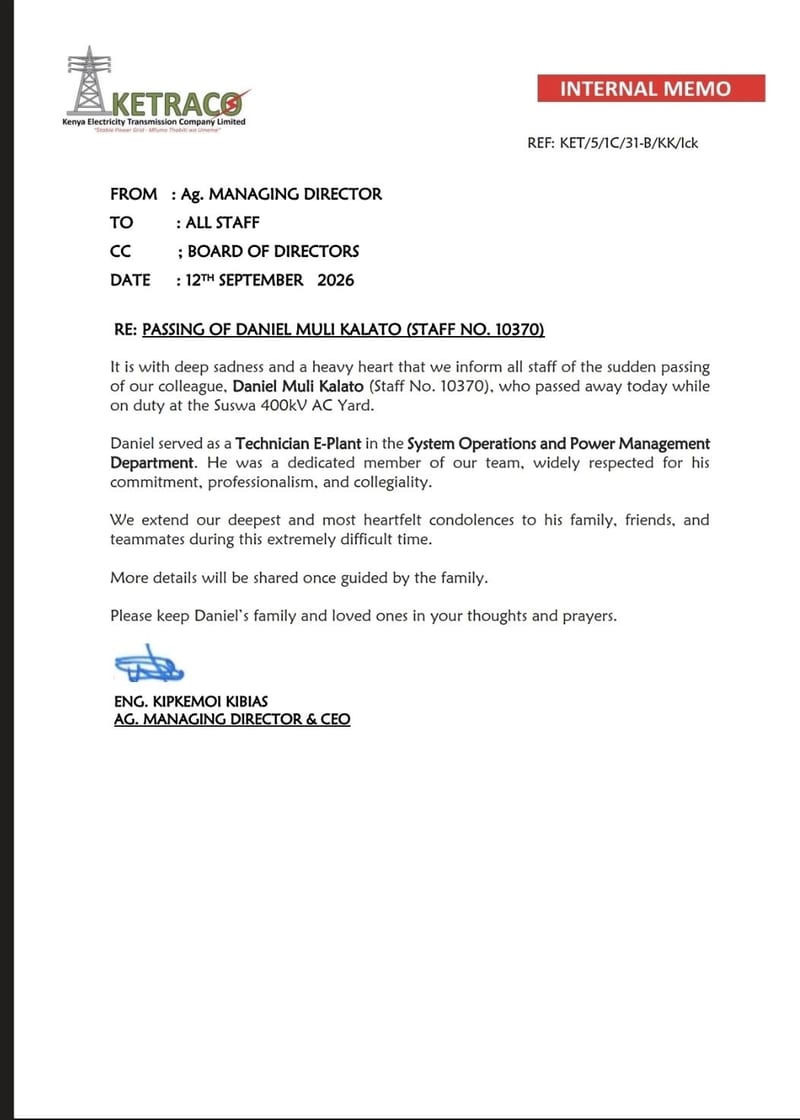
Daniel Muli Kalato, staff number 10370, was a Technician E-Plant in the System Operations and Power Management Department.
In an internal memo dated September 12 and signed by Acting Managing Director Eng. Kipkemoi Kibias, the agency informed staff of his sudden passing, describing him as a dedicated member of the team widely respected for his commitment, professionalism and collegiality.
The memo said more details would be shared once guided by the family, and asked staff to keep his loved ones in their thoughts and prayers.
What the memo did not say was how he died, why he was at the yard, whether the incident was being investigated, or whether any safety failures contributed to his death.
It offered no timeline, no account of what happened, and no indication that the agency had reported the matter to any regulator or opened an inquiry of its own.
It was, in the words of one source familiar with the agency's internal communications, a notice of death dressed up as a notice of condolence, with the substance stripped out.
A Pattern
Sources within KETRACO say Kalato's death is not an isolated tragedy but the latest in a series of electrocution incidents involving staff that have become alarmingly routine at the agency's substations and transmission facilities across the country.
They say the incidents are rarely investigated to conclusion, rarely disclosed to the public, and rarely followed by accountability for those responsible for safety lapses.
Instead,the pattern has been for the agency to issue a brief internal memo, express condolences, promise that more details will follow once the family is consulted, and then move on.
Despite the regularity of these deaths, no root-cause analysis is published, no safety audit is announced, and no official is held to account.
The dead are mourned, the files are closed, and the conditions that produced the deaths remain unchanged.
The sources spoke on condition of anonymity, citing fear of reprisal within an institution where speaking out about safety failures is described as career-ending.
"These deaths are not accidents in the way people think. They are the predictable result of an institution that does not care enough to fix what is broken," one colleague said.
A second colleague described the pattern as institutional rather than incidental.
"If you look at the number of incidents that have happened and the number that have been investigated, the gap tells you everything. Nothing is followed through."
"A lot is wrong at KETRACO. It is not just one department, and it is not just one incident. The rot runs through the whole institution, and until somebody from outside forces the truth out, nothing will change," a third employee offered a broader indictment, promising to spill the beans on what he described as the rot at the core of the agency once the time is right.
Agency With a Troubled Record
The questions surrounding Kalato's death land on an institution that has, over the past several years, accumulated a record of controversies that raise serious doubts about its internal governance and its commitment to accountability, with auditors repeatedly flagging financial irregularities, courts weighing disputes over unpaid debts, and investigators probing how the agency has handled its money and its mandate.
The agency has faced court petitions challenging an alleged targeted purge of senior executives and an ethnic imbalance in its top leadership, with litigants claiming that five out of nine executive positions were filled by members of a single community following the removal of previous management, in violation of constitutional requirements for diversity, equality and non-discrimination in public service.
Anti-corruption investigators have also moved against senior officials over unexplained wealth, while separate audits have raised questions about the agency's financial standing and the way it has handled compensation payments, procurement and staffing matters.
Questions the Memo Did Not Answer 
Against that record, the death of a technician at one of the agency's flagship facilities raises several questions the internal memo did not address and that sources say the agency has no intention of answering publicly.
How does a trained E-Plant technician die on duty at a 400kV yard?
What was he doing at the time of the incident, and was he working alone?
Were the safety protocols observed, and was the equipment he was handling properly maintained and certified?
Was anyone supervising him, and did anyone witness what happened?
Has the agency notified the relevant regulators, and has an independent investigation been commissioned?
Most importantly, what does his death say about the safety culture at KETRACO, and why do sources within the agency say such incidents have become routine and are quietly buried rather than investigated?
The Suswa 400kV AC Yard is a high-voltage facility, and work at such installations demands strict adherence to safety protocols, rigorous supervision, and equipment that is properly maintained and certified.
When a technician dies at such a facility, the standard response in any serious institution would be to immediately suspend operations at the site, notify the relevant regulators, commission an independent investigation, and publish the findings.
Sources say none of that has happened.
Swept Under the Carpet 
The phrase used repeatedly by sources is that these deaths are swept under the carpet.
They describe a culture in which safety incidents are treated as reputational problems to be managed rather than tragedies to be investigated, in which the priority is to contain the story rather than to establish the truth, and in which the families of the dead are left with condolences and little else.
They say the pattern has gone on long enough that staff have come to expect it, and that the fear of speaking out has kept the true scale of the problem hidden from the public, from regulators, and from the very institutions that are supposed to hold state agencies to account.
Kalato's family has been promised that more details will be shared once they are consulted, and whether those details will include an honest account of how he died, and whether his death will be treated as anything more than another line in a memo, remains to be seen.
As they wait, the family is gripped by a quiet pessimism, convinced that the same institutional reflexes that have buried previous deaths will bury this one too, and that whatever justice they might hope for will be withheld by an agency with a track record of closing ranks rather than opening files.
"We have been told to wait, but for what?" a family member said.
"They promised us details once we are consulted, but we know how these things go. We have seen it before. They will give us condolences, they will give us a funeral, and then they will give us silence."
They are now calling on the Directorate of Criminal Investigations (DCI), the Directorate of Occupational Safety and Health Services (DOSHS), the Energy and Petroleum Regulatory Authority (EPRA) and KETRACO's own own board to intervene, to demand an independent inquiry, and to ensure that the agency does not engage in the kind of monkey business that has characterised its handling of past incidents.
This publication will not let the matter rest, and will pursue every lead, every document and every source until the full account of how Daniel Muli Kalato died at Suswa is brought into the light, no matter how uncomfortable that account proves to be for those who would prefer it stayed buried.
KETRACO should consider this a formal notice that the questions asked here will not be forgotten, that the names of those responsible for the safety of its workers will not be shielded by silence, and that whatever is being hidden behind condolence memos and delayed consultations will eventually be laid bare for the public, the regulators and the courts to see.