
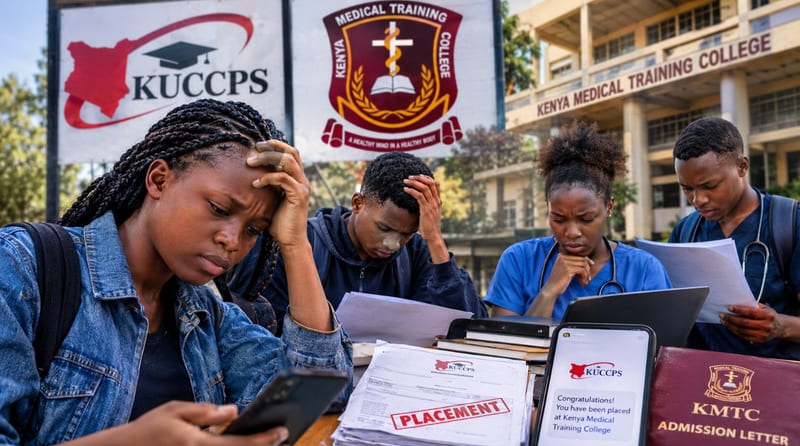
A storm is brewing over the Kenya Universities and Colleges Central Placement Service (KUCCPS) and the Kenya Medical Training College (KMTC) as students and parents raise serious questions about the integrity of the placement system, with growing suspicion that placements are being manipulated for financial gain and that some seats are being sold to the highest bidders.
KMTC, which trains thousands of healthcare professionals annually, has surrendered its independent admissions mandate to KUCCPS, meaning that all regular certificate and diploma programme placements are now processed through the centralised placement service, but parents and students now believe that this arrangement has created a breeding ground for corruption, exploitation and unexplained disparities in access to sought after training opportunities.
The complaints are not confined to students receiving institutions or courses they did not want, but extend to applicants who say their KCSE results were not reflected in the placements they received, others who were left without any placement, and families who have encountered difficulties obtaining admission letters even after receiving SMS confirmations from the placement system.
At the centre of the dispute is KUCCPS, the government agency responsible for coordinating placement into universities, TVET institutions, polytechnics and KMTC, with the agency matching applicants against course requirements, cluster points, institutional capacity and the preferences submitted through its online portal before forwarding successful placements to the respective institutions.
For regular pre service students seeking admission to KMTC, the distinction is important because applicants no longer deal directly with KMTC for the initial placement exercise, with KUCCPS responsible for processing applications and generating the placement list while the college takes over once placement has been completed.
Yet it is this initial stage that is now attracting sustained complaints, with students and parents questioning how applicants with apparently strong academic results can end up with less favourable placements while other applicants with lower marks obtain positions that appear more desirable.
The concerns have increasingly moved beyond individual disappointment to questions about the consistency of the placement system itself, particularly where affected applicants say they cannot establish why their results, course preferences and eventual placements do not appear to correspond.
Good Grades, Unexpected Placements 
One of the most contentious complaints is the apparent mismatch between academic performance and placement outcomes.
Students who attained strong KCSE grades say they expected to compete for institutions and programmes commensurate with those results, only to receive placements they regard as considerably less favourable, while applicants with lower grades have obtained places in institutions perceived by students and parents as more competitive.
The disparity has left families asking how KUCCPS ranks applicants and allocates available places, particularly in cases where students with stronger academic profiles appear to have received less favourable outcomes than applicants with lower grades.
The issue is not simply that some students have missed their preferred institution. In some cases, applicants say the placements they received do not appear to correspond with the competitive requirements attached to the courses they selected, leaving them questioning how the matching exercise was applied to their applications.
"I have applied multiple times now and I still do not have a placement. I just want to go to school and become a nurse. Why is it so difficult? What is the point of getting good grades if they do not help you?" said a disappointed student who has been trying to secure a KMTC placement.
For families that have already begun planning for college, an unexpected placement can also carry financial consequences, particularly where accommodation, transport and other expenses had been calculated around a different institution.
A placement therefore determines far more than the name appearing in an SMS because it sets in motion the costs and logistical arrangements required for a student to report and begin training.
Some Applicants Receive No Placement 
A separate category of students is confronting a more fundamental problem: they have received no placement at all.
Some applicants say they have applied more than once without securing a place, leaving them outside the training system altogether rather than simply being assigned to an institution they did not prefer.
For these students, there is no campus to report to and no admission process to begin, creating uncertainty over when another opportunity will be available and whether another application will produce a different outcome.
The complaints are particularly difficult to reconcile for applicants who say they met the published requirements for the courses they selected but were nonetheless left without an allocation.
The absence of clear explanations has pushed some applicants onto social media, where students have been publicly asking KUCCPS, KMTC and the Ministry of Education to explain how placement decisions are reached and why applicants with similar academic profiles can receive markedly different outcomes.
Placement Message Arrives, Admission Letter Does Not 
The complaints do not end once a student receives a placement.
Some parents and students say they have received SMS notifications informing them that they have secured KMTC placements, including congratulatory messages, only to encounter difficulties when attempting to download their formal admission letters or joining instructions through the KMTC admissions portal.
The situation has created an unusual gap between confirmation of placement and access to the documentation required for admission, leaving families uncertain about the next step even after receiving what appears to be an official placement notification.
For students who have already been assigned a course and campus, an inaccessible admission letter can disrupt preparations for reporting and create further uncertainty at a time when families need to know when and where the student is expected to begin training.
The division of responsibilities between KUCCPS and KMTC makes the problem even more difficult for applicants to navigate because KUCCPS handles the placement while KMTC takes over the admission process after placement has been completed.
The applicants affected by the problem are now asking the two institutions to clarify where responsibility lies when placement has been confirmed but the formal admission documentation cannot be accessed.
The urgency is compounded by the September 8 deadline facing students, leaving affected families with only a limited window to resolve placement, admission and transfer problems before reporting arrangements take effect.
Parents and students are now questioning how they are expected to make informed decisions, secure admission documents, arrange fees, accommodation and transport, or pursue alternative placements when key elements of the process remain unresolved and the available time continues to run down.
Transfers and Reapplication Become Another Obstacle 
Students who receive placements they do not want are also encountering difficulty changing them.
Applicants say they have attempted to seek transfers or reapply for institutions they consider more suitable, only to find that opportunities to make changes are restricted or unavailable.
The same frustration is being reported by students who had previously deferred their studies and expected to return to the placement system when they were ready to resume their training.
Some say they have waited for another placement cycle only to discover that the process is primarily structured around new applicants, leaving them without a clear mechanism through which to return or compete for spaces that may have become available.
The explanation that KMTC has limited campuses and that available spaces fill quickly has become part of the discussion, but affected students say the capacity argument does not resolve the larger question of how applicants who have already entered the system can access another opportunity after an unsuitable placement or a deferment.
For a student whose original placement is not workable, the inability to transfer can effectively turn an unwanted allocation into a forced choice, particularly where there is no alternative pathway for securing another campus.
The resulting frustration is particularly acute for students who believe their academic results would allow them to compete for a different institution but are unable to access a process through which that possibility can be tested.
Questions Over the Placement System 
The placement model is designed to match applicants with institutions and programmes according to published requirements, applicant preferences and available capacity, with KUCCPS conducting the initial selection before successful applicants proceed to the relevant institution.
For thousands of students, that makes the placement exercise one of the most consequential stages after KCSE because the outcome determines where they begin higher education, what course they pursue and the financial arrangements their families must make.
The growing complaints are therefore raising questions over the transparency of the criteria used to determine individual placements, particularly when affected families cannot understand why applicants with apparently stronger grades have obtained less favourable outcomes.
The suspicion has also taken a more serious turn, with some parents and students questioning whether money or personal influence could be affecting access to highly sought after placements.
Claims that placements are being sold to the highest bidders are serious and have not been established by the complaints presented to this publication, but the persistence of the suspicion reflects the level of distrust now surrounding the process among some affected families.
The demand from students and parents is for KUCCPS to explain how its ranking and matching system operates, how available spaces are distributed and what safeguards exist to prevent manipulation or favouritism.
Social Media Outcry Grows 
The complaints have increasingly spilled onto social media, particularly TikTok, where students have been sharing placement outcomes and calling on government agencies to intervene.
Students have been posting about unexpected institutions, failed placements, inaccessible admission documents and difficulties changing their allocations, often directing their appeals to KUCCPS, KMTC and the Ministry of Education.



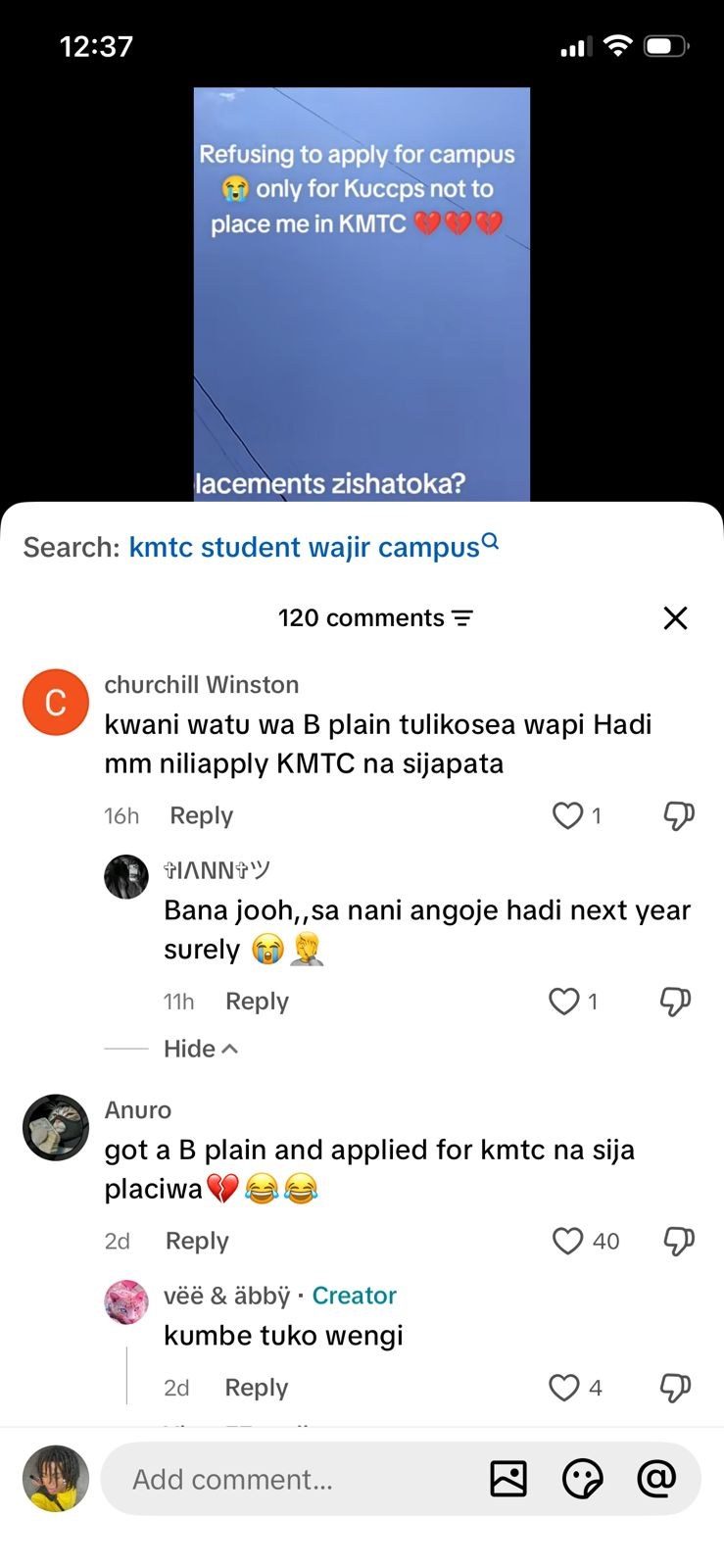

The online complaints have brought together applicants experiencing different problems but seeking the same basic answers over how placement decisions are made and what recourse exists where an applicant believes an outcome is wrong.
For parents who have spent years preparing financially for their children to proceed to professional training, the uncertainty has also created practical challenges around fees, accommodation, transport and other costs that depend on knowing where a student has been placed and when they are expected to report.
Who Is Responsible? 
The division of responsibilities between KUCCPS and KMTC is central to understanding the complaints.
KUCCPS handles the initial placement of regular pre service students into KMTC certificate and diploma programmes, while KMTC assumes responsibility once placement is complete, including admission, training and the subsequent administration of students.
KUCCPS is headed by Chief Executive Officer Dr Agnes Mercy Wahome, while KMTC is led by Chief Executive Officer Dr Kelly Oluoch and overseen by Board Chairperson Joseah Kiplangat Cheruiyot.
The Ministry of Education, under Cabinet Secretary Julius Migos Ogamba, also provides the wider policy and oversight framework within which the two institutions operate.
That structure means complaints about who received which placement are principally directed at KUCCPS, while problems encountered after placement, such as access to admission documents, fall within the operational responsibilities of KMTC.
For students and parents, the distinction offers little comfort when the placement and admission stages form one continuous process from the applicant’s perspective and a problem at one stage can prevent the student from progressing to the next.
The immediate demand now is for clear explanations of the criteria governing placement, reliable access to admission documents, transparent mechanisms for transfers and reapplication, and a functioning channel through which applicants can challenge outcomes they believe do not reflect their academic performance or submitted preferences.
Unless those questions are addressed, the mismatch between grades and placements, students left without offers, inaccessible admission letters and obstacles facing applicants seeking transfers or reapplication will continue to fuel suspicion around a process that is supposed to determine access to publicly coordinated medical training on the basis of clear and consistently applied criteria.